QUESTION IMAGE
Question
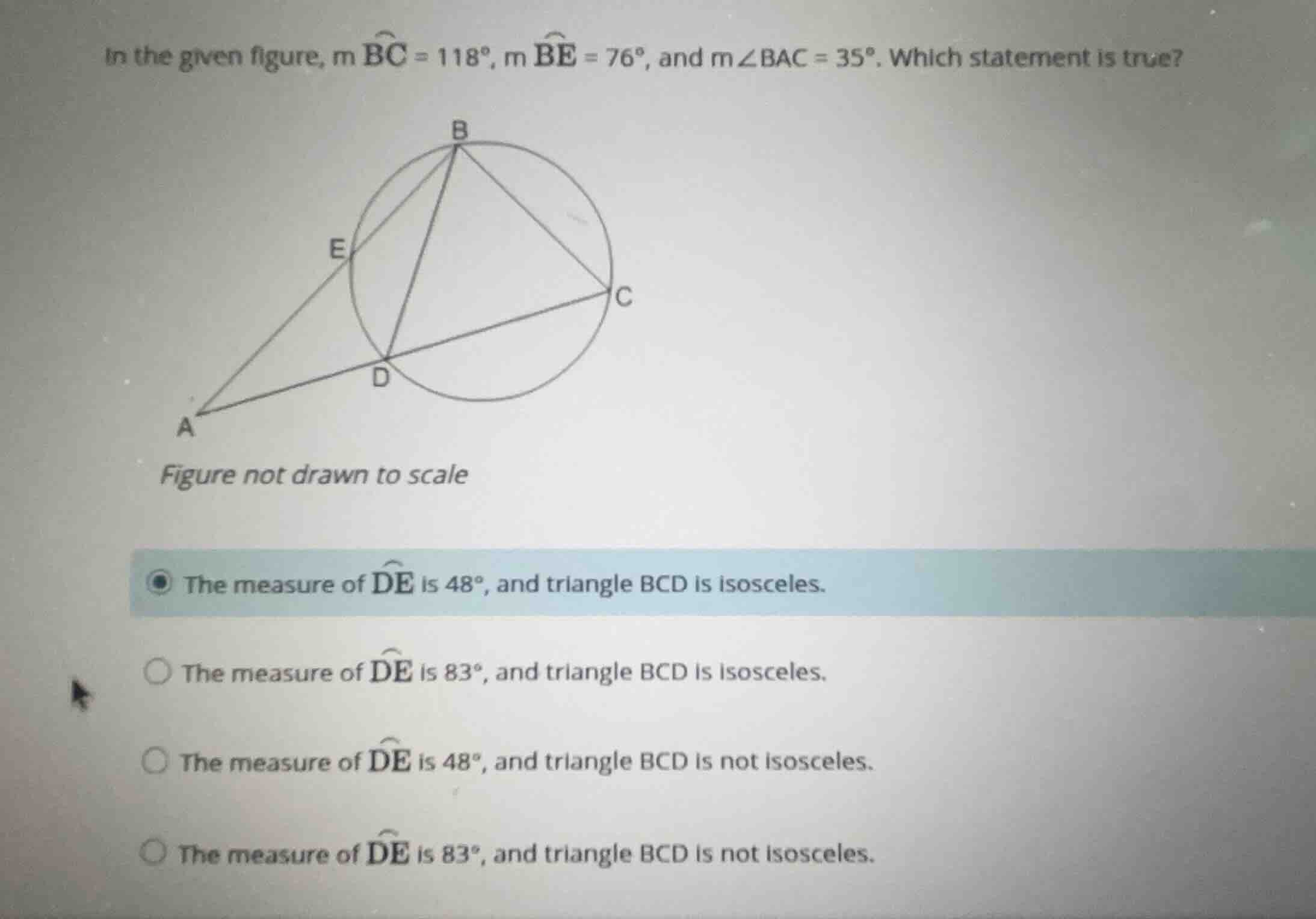
in the given figure, \\(m \widehat{bc} = 118^{\circ}\\), \\(m \widehat{be} = 76^{\circ}\\), and \\(m \angle bac = 35^{\circ}\\). which statement is true?
figure not drawn to scale
- the measure of \\(\widehat{de}\\) is \\(48^{\circ}\\), and triangle bcd is isosceles.
- the measure of \\(\widehat{de}\\) is \\(83^{\circ}\\), and triangle bcd is isosceles.
- the measure of \\(\widehat{de}\\) is \\(48^{\circ}\\), and triangle bcd is not isosceles.
- the measure of \\(\widehat{de}\\) is \\(83^{\circ}\\), and triangle bcd is not isosceles.
🆕 New Concept Discovered: Angles Outside a Circle Theorem
How secant lines form angles outside a circle
Step 1: Find the measure of arc DE
The angle \( \angle BAC \) (or \( \angle DAC \)) is formed by two secants intersecting outside the circle. The measure of this angle is half the difference of the intercepted arcs:
Substitute the given values:
Step 2: Find the remaining arc CD
A full circle measures \( 360^\circ \). The sum of all four arcs making up the circle is:
Substitute the known values:
Step 3: Determine if triangle BCD is isosceles
Find the measures of the angles of \( \triangle BCD \) using the inscribed angle theorem, which states that an inscribed angle is half the measure of its intercepted arc:
- For \( \angle DBC \), the intercepted arc is \( \widehat{CD} \):
- For \( \angle BDC \), the intercepted arc is \( \widehat{BC} \):
- For \( \angle BCD \), the intercepted arc is \( \widehat{BDE} + \widehat{ED} = 76^\circ + 48^\circ = 124^\circ \):
Since \( m\angle DBC = m\angle BDC = 59^\circ \), \( \triangle BCD \) has two equal angles, which means it is an isosceles triangle.

Snap & solve any problem in the app
Get step-by-step solutions on Sovi AI
Photo-based solutions with guided steps
Explore more problems and detailed explanations
The measure of \( \widehat{DE} \) is \( 48^\circ \), and triangle BCD is isosceles.