QUESTION IMAGE
Question
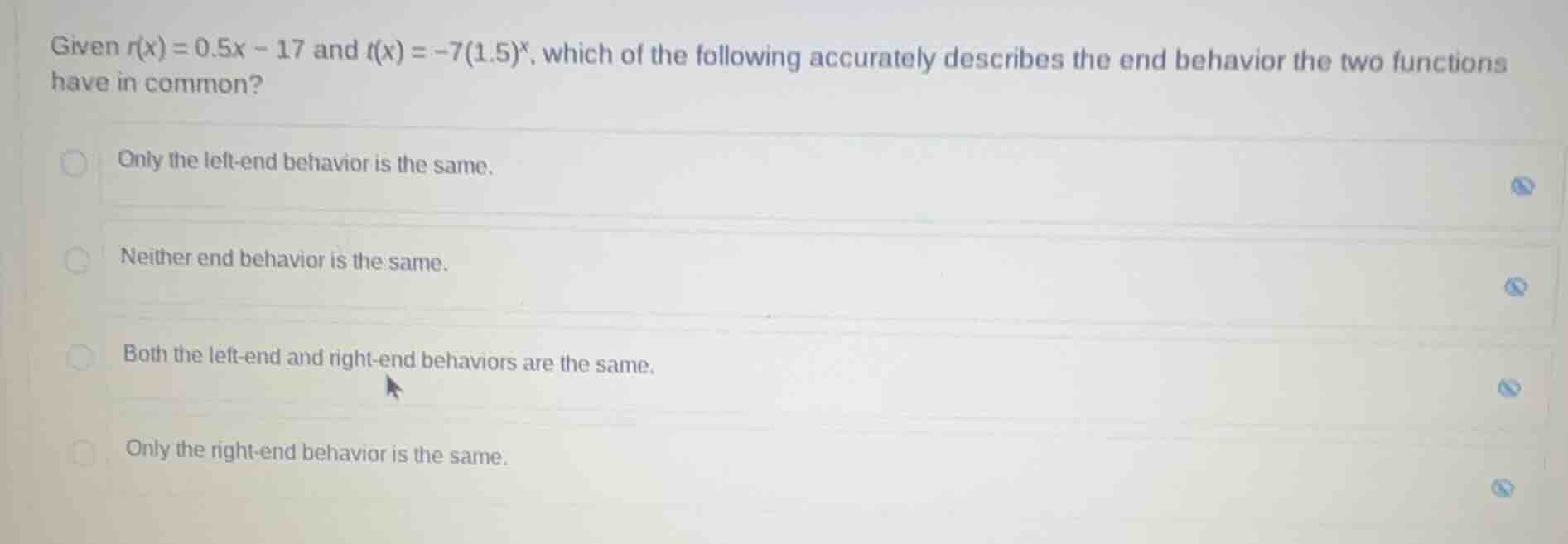
given \\(r(x) = 0.5x - 17\\) and \\(t(x) = -7(1.5)^x\\), which of the following accurately describes the end behavior the two functions have in common?
only the left-end behavior is the same.
neither end behavior is the same.
both the left-end and right-end behaviors are the same.
only the right-end behavior is the same.
Analyze the end behavior of \(r(x)\)
Using the Function Key Features knowledge point
$$
LATEXBLOCK0
$$
Analyze the end behavior of \(t(x)\)
Analyze the limits of the exponential function \(t(x) = -7(1.5)^x\) as \(x\) approaches infinity and negative infinity:
- As \(x \to -\infty\), the term \((1.5)^x \to 0\). Therefore, \(t(x) \to -7(0) = 0\).
- As \(x \to \infty\), the term \((1.5)^x \to \infty\). Since it is multiplied by \(-7\), \(t(x) \to -\infty\).
Compare the end behaviors
Compare the left-end and right-end limits of both functions:
- Left-end behavior (\(x \to -\infty\)): \(r(x) \to -\infty\) while \(t(x) \to 0\). These are different.
- Right-end behavior (\(x \to \infty\)): \(r(x) \to \infty\) while \(t(x) \to -\infty\). These are different.
- Therefore, neither end behavior is the same.

Snap & solve any problem in the app
Get step-by-step solutions on Sovi AI
Photo-based solutions with guided steps
Explore more problems and detailed explanations
- Only the left-end behavior is the same.
- Neither end behavior is the same. (Correct answer)
- Both the left-end and right-end behaviors are the same.
- Only the right-end behavior is the same.