QUESTION IMAGE
Question
ga-advanced algebra: concepts and connections
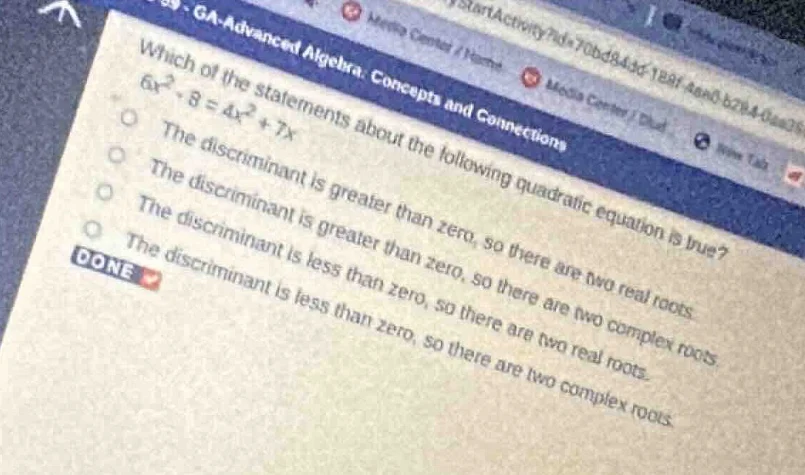
which of the statements about the following quadratic equation is true?
$6x^2 + 8 = 4x^2 + 7x$
- the discriminant is greater than zero, so there are two real roots.
- the discriminant is greater than zero, so there are two complex roots.
- the discriminant is less than zero, so there are two real roots.
- the discriminant is less than zero, so there are two complex roots.
done
Step 1: Rewrite the quadratic equation in standard form
First, we need to rewrite the given equation \(6x^{2}+8 = 4x^{2}+7x\) in the standard form \(ax^{2}+bx + c=0\). Subtract \(4x^{2}\) and \(7x\) from both sides:
\(6x^{2}-4x^{2}-7x + 8=0\)
Simplify to get:
\(2x^{2}-7x + 8 = 0\)
Here, \(a = 2\), \(b=- 7\), and \(c = 8\).
Step 2: Calculate the discriminant
The formula for the discriminant (\(D\)) of a quadratic equation \(ax^{2}+bx + c = 0\) is \(D=b^{2}-4ac\).
Substitute \(a = 2\), \(b=-7\), and \(c = 8\) into the formula:
\(D=(-7)^{2}-4\times2\times8\)
First, calculate \((-7)^{2}=49\) and \(4\times2\times8 = 64\).
Then, \(D=49 - 64=-15\).
Step 3: Analyze the discriminant
If the discriminant \(D>0\), the quadratic equation has two distinct real roots. If \(D = 0\), it has one real root (a repeated root). If \(D<0\), it has two complex conjugate roots (of the form \(p+qi\) and \(p - qi\) where \(q
eq0\)).
Since \(D=-15<0\), the quadratic equation has two complex roots.

Snap & solve any problem in the app
Get step-by-step solutions on Sovi AI
Photo-based solutions with guided steps
Explore more problems and detailed explanations
The discriminant is less than zero, so there are two complex roots (the last option: "The discriminant is less than zero, so there are two complex roots").