QUESTION IMAGE
Question
fundamental counting principle
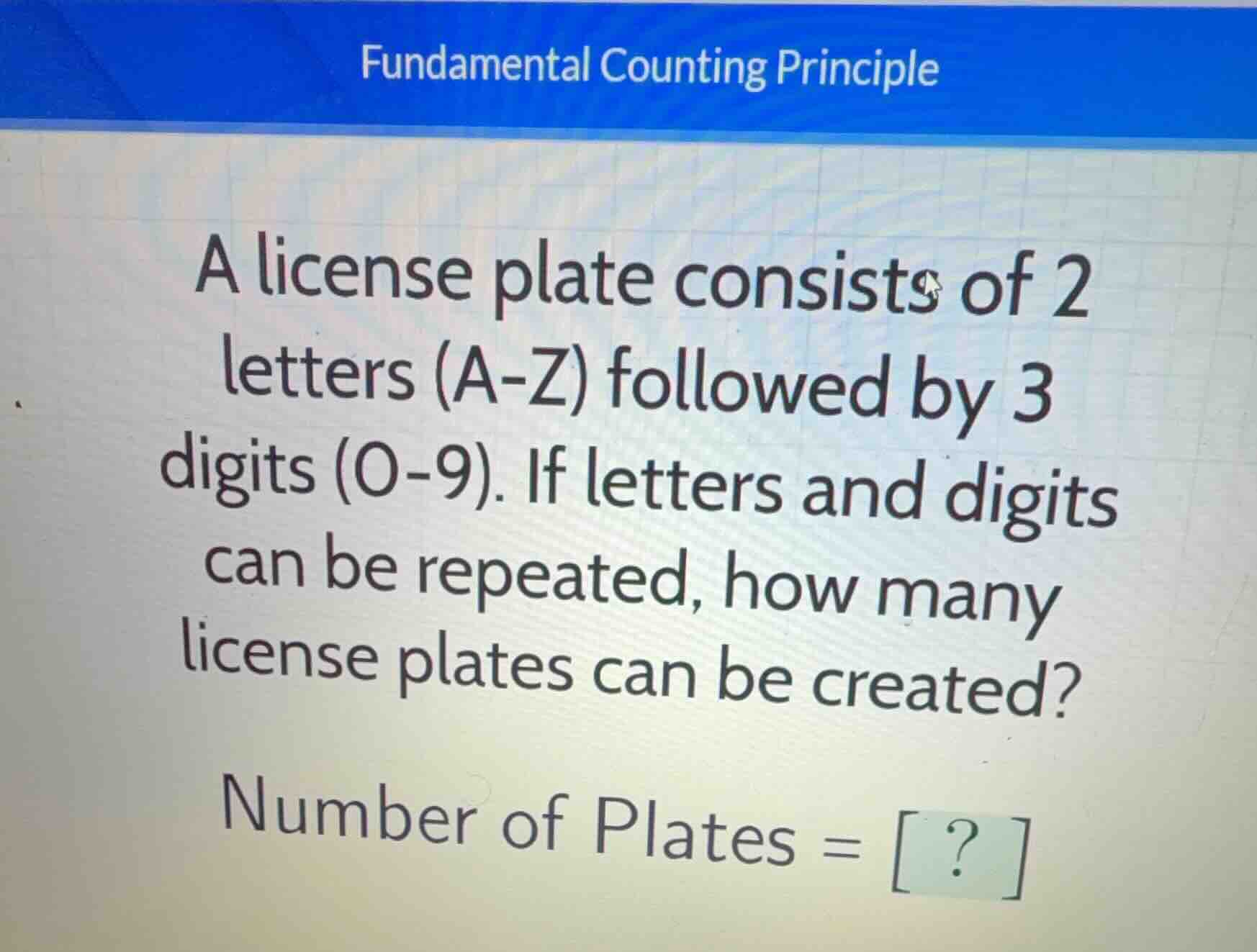
a license plate consists of 2 letters (a-z) followed by 3 digits (0-9). if letters and digits can be repeated, how many license plates can be created?
number of plates = ?
<pre_analysis>
{
"quality": "clear",
"question_count": 1,
"skills_matched": [
"step_cot",
"blank_filling_formatter",
"explain_then_answer",
"tutor"
],
"needs_drawing": false,
"concepts_used": [
"Sample Space"
],
"new_concepts": [
"Fundamental Counting Principle",
"Permutations with Repetition"
],
"current_concepts": [
"Sample Space",
"Fundamental Counting Principle",
"Permutations with Repetition"
]
}
</pre_analysis>
<reasoning>
Identify the choices for each position
The license plate consists of 5 positions: 2 letters followed by 3 digits.
- For each letter position, there are 26 possible choices (A-Z).
- For each digit position, there are 10 possible choices (0-9).
Apply the Fundamental Counting Principle
Since repetition is allowed, the choices for each position are independent.
We multiply the number of possibilities for each of the 5 positions:
\[
\text{Total Plates} = 26 \times 26 \times 10 \times 10 \times 10
\]
Calculate the final product
We compute the multiplication:
\[
26^2 = 676
\]
\[
10^3 = 1000
\]
\[
676 \times 1000 = 676,000
\]
</reasoning>
<answer>
A license plate consists of 2 letters (A-Z) followed by 3 digits (0-9). If letters and digits can be repeated, how many license plates can be created?
Number of Plates = <blank>676,000</blank>
</answer>
<post_analysis>
{
"subject": "Mathematics",
"question_type": "Fill-in-the-blank",
"knowledge_point": [
"Mathematics",
"Statistics",
"Fundamental Counting Principle"
]
}
</post_analysis>
Snap & solve any problem in the app
Get step-by-step solutions on Sovi AI
Photo-based solutions with guided steps
Explore more problems and detailed explanations
<pre_analysis>
{
"quality": "clear",
"question_count": 1,
"skills_matched": [
"step_cot",
"blank_filling_formatter",
"explain_then_answer",
"tutor"
],
"needs_drawing": false,
"concepts_used": [
"Sample Space"
],
"new_concepts": [
"Fundamental Counting Principle",
"Permutations with Repetition"
],
"current_concepts": [
"Sample Space",
"Fundamental Counting Principle",
"Permutations with Repetition"
]
}
</pre_analysis>
<reasoning>
Identify the choices for each position
The license plate consists of 5 positions: 2 letters followed by 3 digits.
- For each letter position, there are 26 possible choices (A-Z).
- For each digit position, there are 10 possible choices (0-9).
Apply the Fundamental Counting Principle
Since repetition is allowed, the choices for each position are independent.
We multiply the number of possibilities for each of the 5 positions:
\[
\text{Total Plates} = 26 \times 26 \times 10 \times 10 \times 10
\]
Calculate the final product
We compute the multiplication:
\[
26^2 = 676
\]
\[
10^3 = 1000
\]
\[
676 \times 1000 = 676,000
\]
</reasoning>
<answer>
A license plate consists of 2 letters (A-Z) followed by 3 digits (0-9). If letters and digits can be repeated, how many license plates can be created?
Number of Plates = <blank>676,000</blank>
</answer>
<post_analysis>
{
"subject": "Mathematics",
"question_type": "Fill-in-the-blank",
"knowledge_point": [
"Mathematics",
"Statistics",
"Fundamental Counting Principle"
]
}
</post_analysis>