QUESTION IMAGE
Question
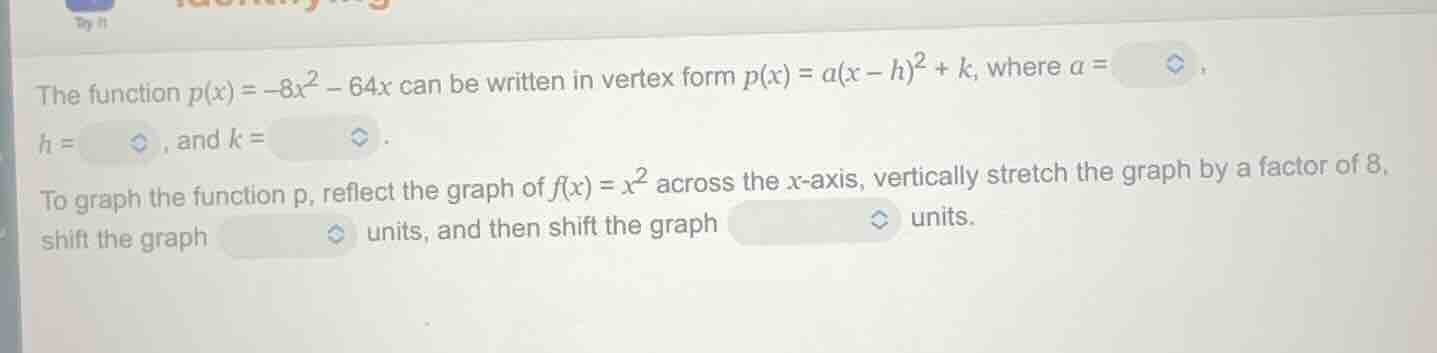
the function $p(x) = -8x^2 - 64x$ can be written in vertex form $p(x) = a(x - h)^2 + k$, where $a = $, $h = $, and $k = $. to graph the function $p$, reflect the graph of $f(x) = x^2$ across the $x$-axis, vertically stretch the graph by a factor of 8, shift the graph units, and then shift the graph units.
Step1: Factor out the coefficient of \(x^2\)
We have \(p(x)= -8x^2 - 64x\). Factor out \(-8\) from the first two terms: \(p(x)=-8(x^2 + 8x)\)
Step2: Complete the square inside the parentheses
To complete the square for \(x^2 + 8x\), we take half of the coefficient of \(x\) (which is \(8\)), square it (\((\frac{8}{2})^2 = 16\)), and add and subtract it inside the parentheses. But since we have a factor of \(-8\) outside, we need to be careful with the constant term.
\(p(x)=-8(x^2 + 8x + 16 - 16)\)
\(p(x)=-8((x + 4)^2 - 16)\)
Step3: Distribute the \(-8\)
\(p(x)=-8(x + 4)^2 + 128\)
Now, comparing with the vertex form \(p(x)=a(x - h)^2 + k\), we have:
- \(a=-8\) (the coefficient of the squared term)
- \(h=-4\) (since it's \(x - h\), and we have \(x + 4 = x - (-4)\))
- \(k = 128\) (the constant term)
For the graph transformations:
- Starting with \(f(x)=x^2\), reflecting across the \(x\)-axis gives \(-x^2\).
- Vertically stretching by a factor of \(8\) gives \(-8x^2\).
- The vertex form is \(p(x)=-8(x + 4)^2 + 128\), which means we shift the graph \(4\) units to the left (because of \(x + 4\)) and then \(128\) units up (because of the \(+ 128\)).

Snap & solve any problem in the app
Get step-by-step solutions on Sovi AI
Photo-based solutions with guided steps
Explore more problems and detailed explanations
- \(a=-8\)
- \(h=-4\)
- \(k = 128\)
- Shift the graph \(4\) units to the left and then \(128\) units up.