QUESTION IMAGE
Question
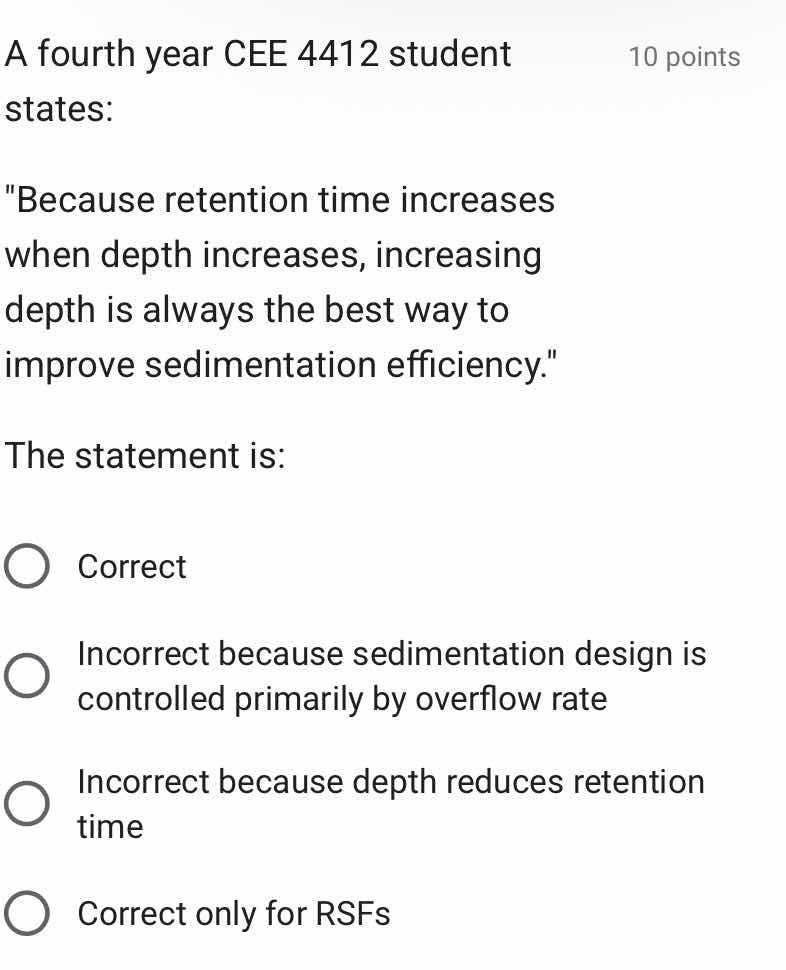
a fourth year cee 4412 student states:
\because retention time increases when depth increases, increasing depth is always the best way to improve sedimentation efficiency.\
the statement is:
- correct
- incorrect because sedimentation design is controlled primarily by overflow rate
- incorrect because depth reduces retention time
- correct only for rsfs
🆕 New Concept Discovered: Sedimentation Overflow Rate
Efficiency depends on surface area, not depth.
Step 1: Analyze the student's claim
The student claims that increasing depth is the best way to improve sedimentation efficiency because it increases retention time.
Let's look at the relationship between volume \( V \), flow rate \( Q \), surface area \( A_s \), depth \( H \), and retention time \( \theta \):
While it is true that increasing depth \( H \) increases the retention time \( \theta \), we must evaluate if this actually improves sedimentation efficiency.
Step 2: Evaluate sedimentation efficiency physics
For an ideal settling basin, a particle is completely removed if its settling velocity \( v_s \) is greater than or equal to the critical settling velocity (overflow rate) \( v_0 \):
The removal efficiency of particles with a settling velocity \( v_s < v_0 \) is given by:
Notice that depth \( H \) does not appear in this efficiency equation. If you increase the depth \( H \), the retention time increases, but particles also have a longer vertical distance to travel before they hit the bottom. These two effects cancel each other out perfectly in an ideal settling basin.
Therefore, sedimentation design and efficiency are controlled primarily by the surface overflow rate \( v_0 = \frac{Q}{A_s} \), not by depth.
Step 3: Match with the given options
- Correct: Incorrect, because the statement is false.
- Incorrect because sedimentation design is controlled primarily by overflow rate: Correct, as shown by the efficiency derivation.
- Incorrect because depth reduces retention time: Incorrect, because increasing depth actually increases retention time.
- Correct only for RSFs: Incorrect.

Snap & solve any problem in the app
Get step-by-step solutions on Sovi AI
Photo-based solutions with guided steps
Explore more problems and detailed explanations
Incorrect because sedimentation design is controlled primarily by overflow rate