Sovi.AI - AI Math Tutor

Scan to solve math questions

QUESTION IMAGE

four students are trying to find the rule that translates point \\(n(-2…

Question

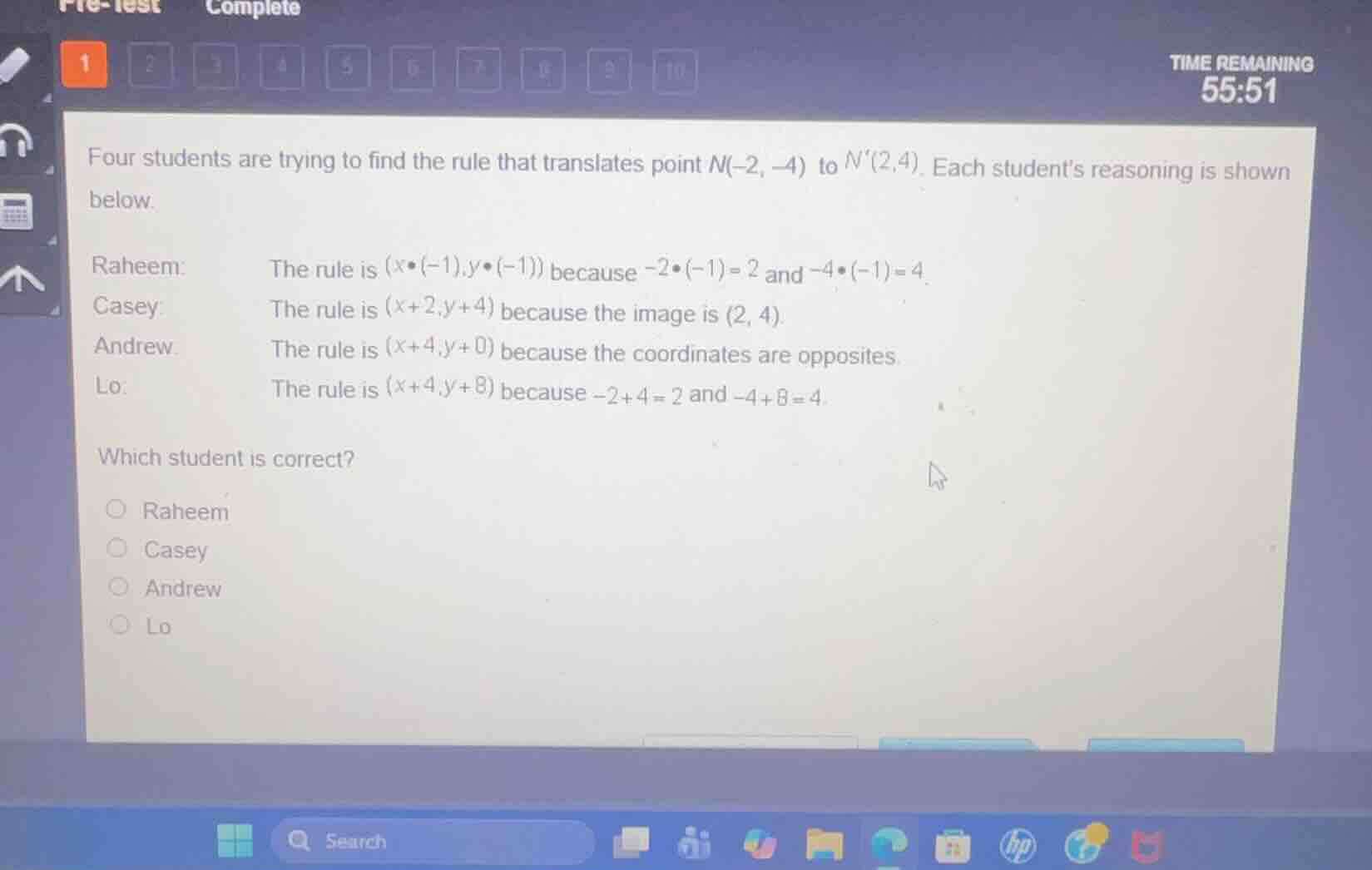
four students are trying to find the rule that translates point \\(n(-2, -4)\\) to \\(n(2, 4)\\). each students reasoning is shown below.

raheem: the rule is \\((x \cdot (-1), y \cdot (-1))\\) because \\(-2 \cdot (-1) = 2\\) and \\(-4 \cdot (-1) = 4\\).
casey: the rule is \\((x + 2, y + 4)\\) because the image is \\((2, 4)\\).
andrew: the rule is \\((x + 4, y + 0)\\) because the coordinates are opposites.
lo: the rule is \\((x + 4, y + 8)\\) because \\(-2 + 4 = 2\\) and \\(-4 + 8 = 4\\).

which student is correct?

raheem
casey
andrew
lo

Explanation:

Response

<pre_analysis>
{
"quality": "clear",
"question_count": 1,
"skills_matched": [
"step_cot",
"multiple_choice_formatter",
"explain_then_answer",
"tutor"
],
"needs_drawing": false,
"concepts_used": [],
"new_concepts": [
"Translation Rule",
"Coordinate Transformations"
],
"current_concepts": [
"Translation Rule",
"Coordinate Transformations"
]
}
</pre_analysis>

<reasoning>

Identify the given points

We are given a pre-image point \(N(-2, -4)\) and its image point \(N'(2, 4)\) after a translation.

Define translation rule

A translation shifts a point horizontally by \(h\) units and vertically by \(k\) units. The general algebraic rule is:
\[(x, y)
ightarrow (x + h, y + k)\]

Calculate horizontal shift

Using the \(x\)-coordinates of \(N\) and \(N'\):
\[-2 + h = 2\]
\[h = 2 - (-2) = 4\]

Calculate vertical shift

Using the \(y\)-coordinates of \(N\) and \(N'\):
\[-4 + k = 4\]
\[k = 4 - (-4) = 8\]

Evaluate student reasoning

The correct translation rule is \((x + 4, y + 8)\). Let's check the students:

  • Raheem proposes a dilation/reflection rule: \((x \cdot (-1), y \cdot (-1))\).
  • Casey proposes \((x + 2, y + 4)\).
  • Andrew proposes \((x + 4, y + 0)\).
  • Lo proposes \((x + 4, y + 8)\) because \(-2 + 4 = 2\) and \(-4 + 8 = 4\).

Therefore, Lo is correct.
</reasoning>

<answer>
<mcq-option>Raheem</mcq-option>
<mcq-option>Casey</mcq-option>
<mcq-option>Andrew</mcq-option>
<mcq-correct>Lo</mcq-correct>
</answer>

<post_analysis>
{
"subject": "Mathematics",
"question_type": "Multiple Choice",
"knowledge_point": [
"Mathematics",
"Geometry",
"Translation Rule"
]
}
</post_analysis>

Answer:

<pre_analysis>
{
"quality": "clear",
"question_count": 1,
"skills_matched": [
"step_cot",
"multiple_choice_formatter",
"explain_then_answer",
"tutor"
],
"needs_drawing": false,
"concepts_used": [],
"new_concepts": [
"Translation Rule",
"Coordinate Transformations"
],
"current_concepts": [
"Translation Rule",
"Coordinate Transformations"
]
}
</pre_analysis>

<reasoning>

Identify the given points

We are given a pre-image point \(N(-2, -4)\) and its image point \(N'(2, 4)\) after a translation.

Define translation rule

A translation shifts a point horizontally by \(h\) units and vertically by \(k\) units. The general algebraic rule is:
\[(x, y)
ightarrow (x + h, y + k)\]

Calculate horizontal shift

Using the \(x\)-coordinates of \(N\) and \(N'\):
\[-2 + h = 2\]
\[h = 2 - (-2) = 4\]

Calculate vertical shift

Using the \(y\)-coordinates of \(N\) and \(N'\):
\[-4 + k = 4\]
\[k = 4 - (-4) = 8\]

Evaluate student reasoning

The correct translation rule is \((x + 4, y + 8)\). Let's check the students:

  • Raheem proposes a dilation/reflection rule: \((x \cdot (-1), y \cdot (-1))\).
  • Casey proposes \((x + 2, y + 4)\).
  • Andrew proposes \((x + 4, y + 0)\).
  • Lo proposes \((x + 4, y + 8)\) because \(-2 + 4 = 2\) and \(-4 + 8 = 4\).

Therefore, Lo is correct.
</reasoning>

<answer>
<mcq-option>Raheem</mcq-option>
<mcq-option>Casey</mcq-option>
<mcq-option>Andrew</mcq-option>
<mcq-correct>Lo</mcq-correct>
</answer>

<post_analysis>
{
"subject": "Mathematics",
"question_type": "Multiple Choice",
"knowledge_point": [
"Mathematics",
"Geometry",
"Translation Rule"
]
}
</post_analysis>