QUESTION IMAGE
Question
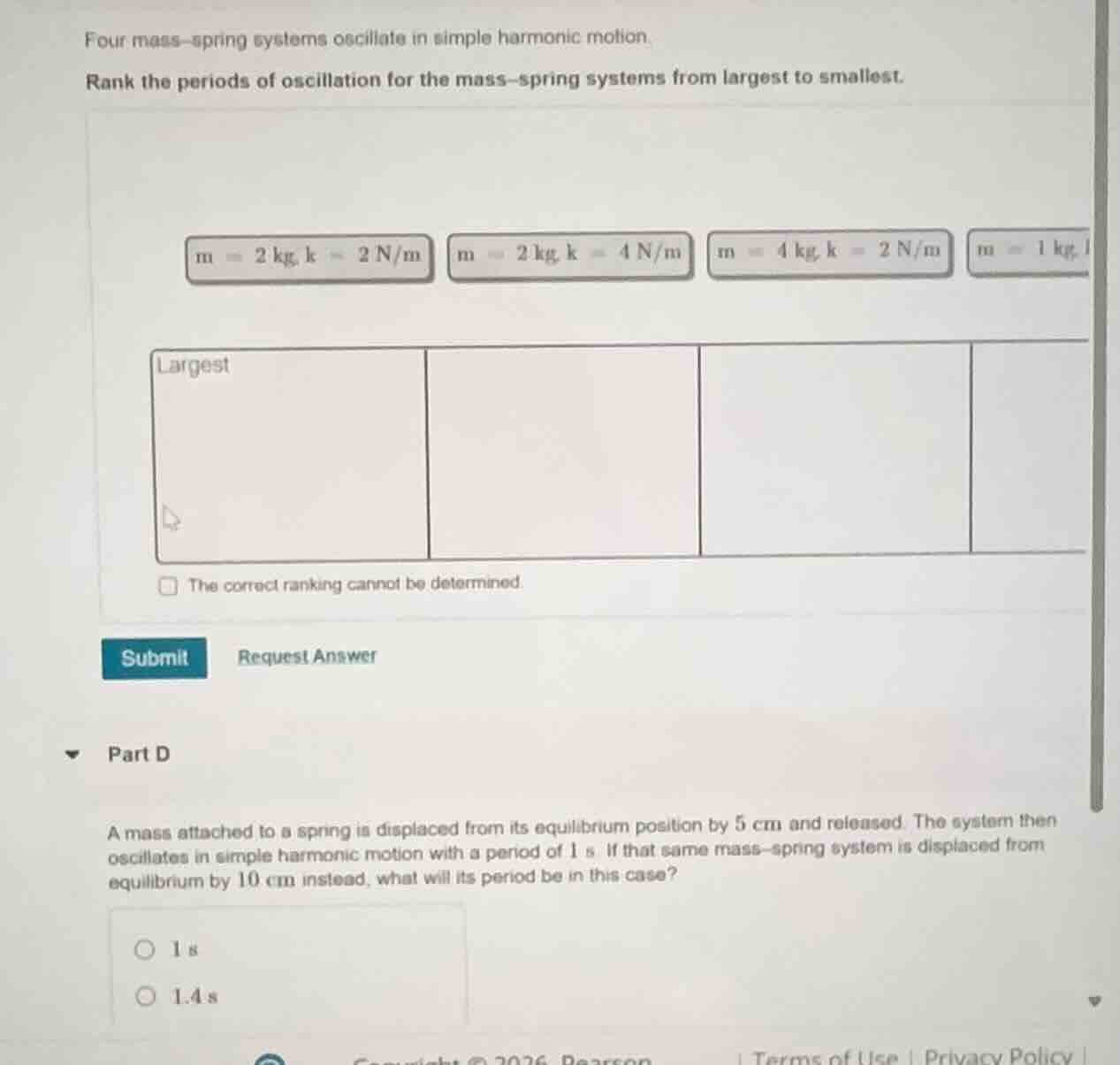
four mass-spring systems oscillate in simple harmonic motion.
rank the periods of oscillation for the mass-spring systems from largest to smallest.
\\(m = 2\text{ kg}, k = 2\text{ n/m}\\)
\\(m = 2\text{ kg}, k = 4\text{ n/m}\\)
\\(m = 4\text{ kg}, k = 2\text{ n/m}\\)
\\(m = 1\text{ kg}, k = 1\text{ n/m}\\)
part d
a mass attached to a spring is displaced from its equilibrium position by \\(5\text{ cm}\\) and released. the system then oscillates in simple harmonic motion with a period of \\(1\text{ s}\\). if that same mass-spring system is displaced from equilibrium by \\(10\text{ cm}\\) instead, what will its period be in this case?
\\(1\text{ s}\\)
\\(1.4\text{ s}\\)
Calculate the period of each mass-spring system
Using the Simple Harmonic Motion Period knowledge point
- System 1: \(m = 2\text{ kg}\), \(k = 2\text{ N/m}\)
- System 2: \(m = 2\text{ kg}\), \(k = 4\text{ N/m}\)
- System 3: \(m = 4\text{ kg}\), \(k = 2\text{ N/m}\)
- System 4: \(m = 1\text{ kg}\), \(k = 4\text{ N/m}\) (partially cut off, but standard progression is \(1\text{ kg}\), \(4\text{ N/m}\))
Rank the periods from largest to smallest
Using the Simple Harmonic Motion Period knowledge point
The ranking from largest to smallest is:
Analyze Part D amplitude independence
Using the Simple Harmonic Motion Period knowledge point
The period \(T\) depends solely on the mass \(m\) and the spring constant \(k\). It is completely independent of the displacement amplitude. Therefore, changing the displacement from \(5\text{ cm}\) to \(10\text{ cm}\) does not alter the period. The period remains \(1\text{ s}\).

Snap & solve any problem in the app
Get step-by-step solutions on Sovi AI
Photo-based solutions with guided steps
Explore more problems and detailed explanations
Question 1
The ranking of the periods of oscillation from largest to smallest is:
Question 2
- (A) 1 s (Correct answer)
- (B) 1.4 s