QUESTION IMAGE
Question
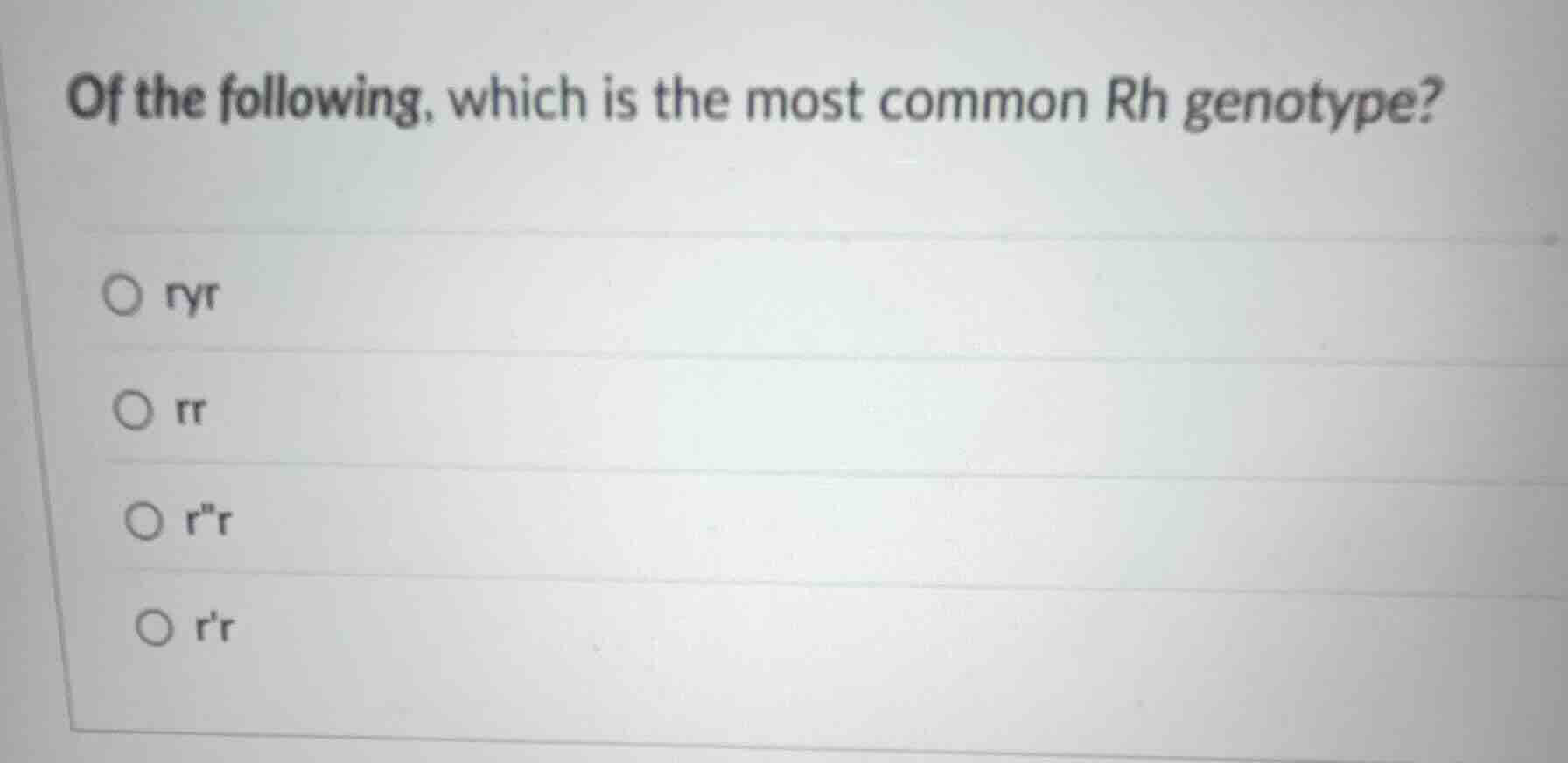
of the following, which is the most common rh genotype?
ryr
rr
r
rr
Identify the given options and nomenclature
The question asks for the most common Rh genotype among the choices: \(r^yr\), \(rr\), \(r''r\), and \(r'r\). These options are written in Wiener nomenclature, which is commonly used in the Rh Blood Group System.
Translate Wiener terms to Fisher-Race haplotypes
To determine the frequencies, we first translate each Wiener haplotype into its Fisher-Race (CDE) equivalent:
- \(r\) corresponds to \(ce\) (absence of D, presence of c and e).
- \(r'\) corresponds to \(Ce\) (absence of D, presence of C and e).
- \(r''\) corresponds to \(cE\) (absence of D, presence of c and E).
- \(r^y\) corresponds to \(CE\) (absence of D, presence of C and E).
Determine the genotypes of the options
Next, we combine the haplotypes to find the corresponding diploid genotypes:
- \(r^yr\) corresponds to \(dCE/dce\) (\(CcEe\), D-negative).
- \(rr\) corresponds to \(dce/dce\) (\(ccee\), D-negative).
- \(r''r\) corresponds to \(dcE/dce\) (\(ccEe\), D-negative).
- \(r'r\) corresponds to \(dCe/dce\) (\(Ccee\), D-negative).
Compare population frequencies
In general populations (especially Caucasians and Blacks), the haplotype frequencies for these D-negative alleles are ranked as follows:
- \(r\) (\(ce\)) is by far the most common D-negative haplotype (approx. 38% frequency in Caucasians, 26% in Blacks).
- \(r'\) (\(Ce\)) is much less common (approx. 1% to 2%).
- \(r''\) (\(cE\)) is rare (approx. 1%).
- \(r^y\) (\(CE\)) is extremely rare (< 0.01%).
Consequently, the homozygous genotype \(rr\) (\(dce/dce\)) has a frequency of approximately \(0.38 \times 0.38 \approx 15\%\) in Caucasians, making it the most common D-negative genotype. The other combinations (\(r'r\) at ~1%, \(r''r\) at ~1%, and \(r^yr\) at <0.01%) are significantly less frequent.

Snap & solve any problem in the app
Get step-by-step solutions on Sovi AI
Photo-based solutions with guided steps
Explore more problems and detailed explanations
- (A) \(r^yr\)
- (B) \(rr\) (Correct answer)
- (C) \(r''r\)
- (D) \(r'r\)