QUESTION IMAGE
Question
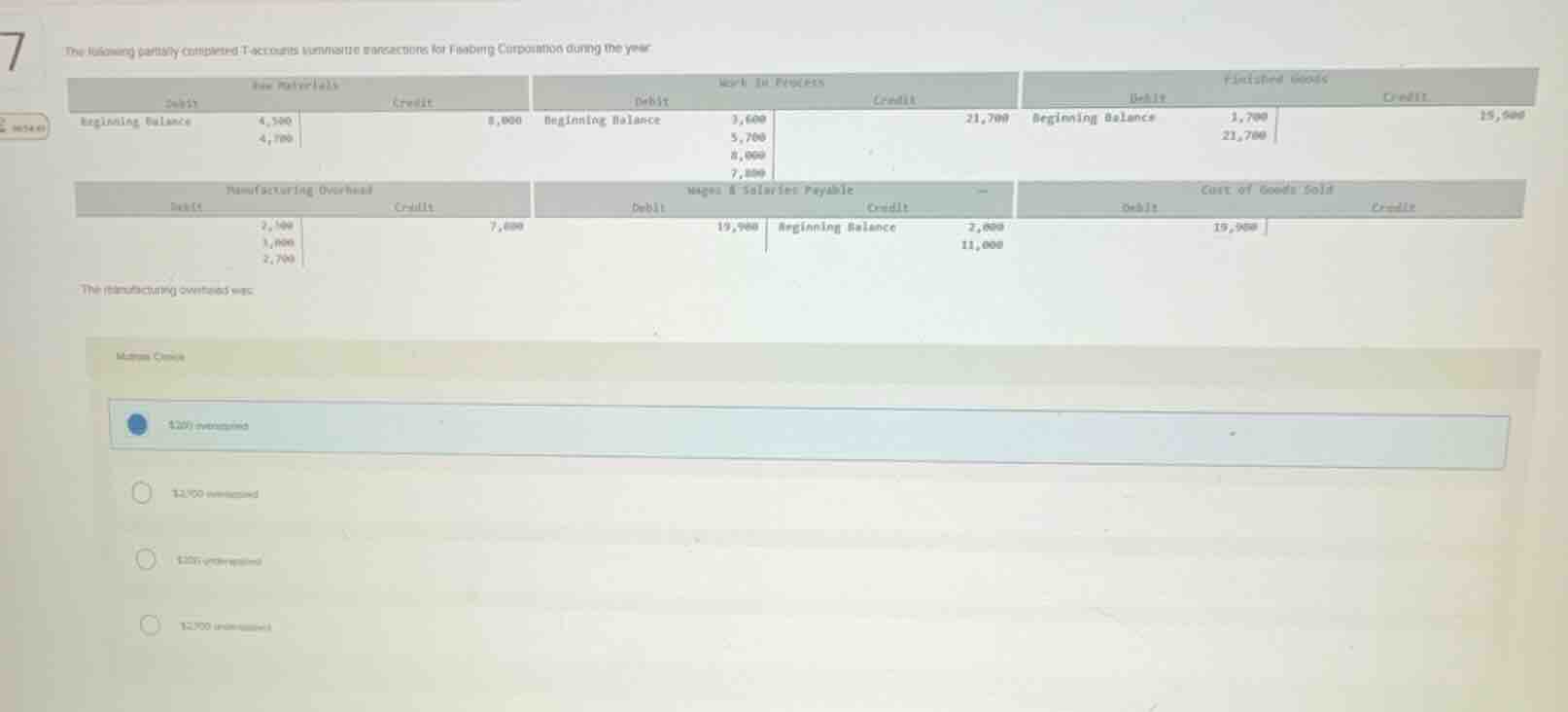
the following partially completed t-accounts summarize transactions for fabbing corporation during the year
raw materials
debit: beginning balance 4,500, 4,700
credit: 8,000
work in process
debit: beginning balance 3,600, 5,700, 8,000, 7,800
credit: 21,700
finished goods
debit: beginning balance 1,700, 21,700
credit: 15,900
manufacturing overhead
debit: 2,100, 3,000, 2,700
credit: 7,600
wages & salaries payable
debit: 19,900
credit: beginning balance 2,800, 11,000
cost of goods sold
debit: 15,900
credit:
the manufacturing overhead was:
multiple choice
$200 overapplied
$2,900 overapplied
$200 underapplied
$2,900 underapplied
Identify actual overhead
Using the Manufacturing Overhead T-Account knowledge point, we sum the debit entries to find the actual manufacturing overhead costs incurred:
Identify applied overhead
Using the Overhead Application knowledge point, we locate the credit entry in the Manufacturing Overhead T-account, which represents the overhead applied to Work in Process:
Calculate overhead variance
We find the difference between actual overhead and applied overhead:
Determine under/overapplied status
Since actual overhead (\(7,800\)) is greater than applied overhead (\(7,600\)), the overhead is underapplied by \(200\).

Snap & solve any problem in the app
Get step-by-step solutions on Sovi AI
Photo-based solutions with guided steps
Explore more problems and detailed explanations
- (A) $200 overapplied
- (B) $2,900 overapplied
- (C) $200 underapplied (Correct answer)
- (D) $2,900 underapplied