QUESTION IMAGE
Question
in the following circuit, if the resistance of the variable resistor is increased, what happens to the current through the 470-ohm resistor?
nothing
increases
cannot predict
decreases
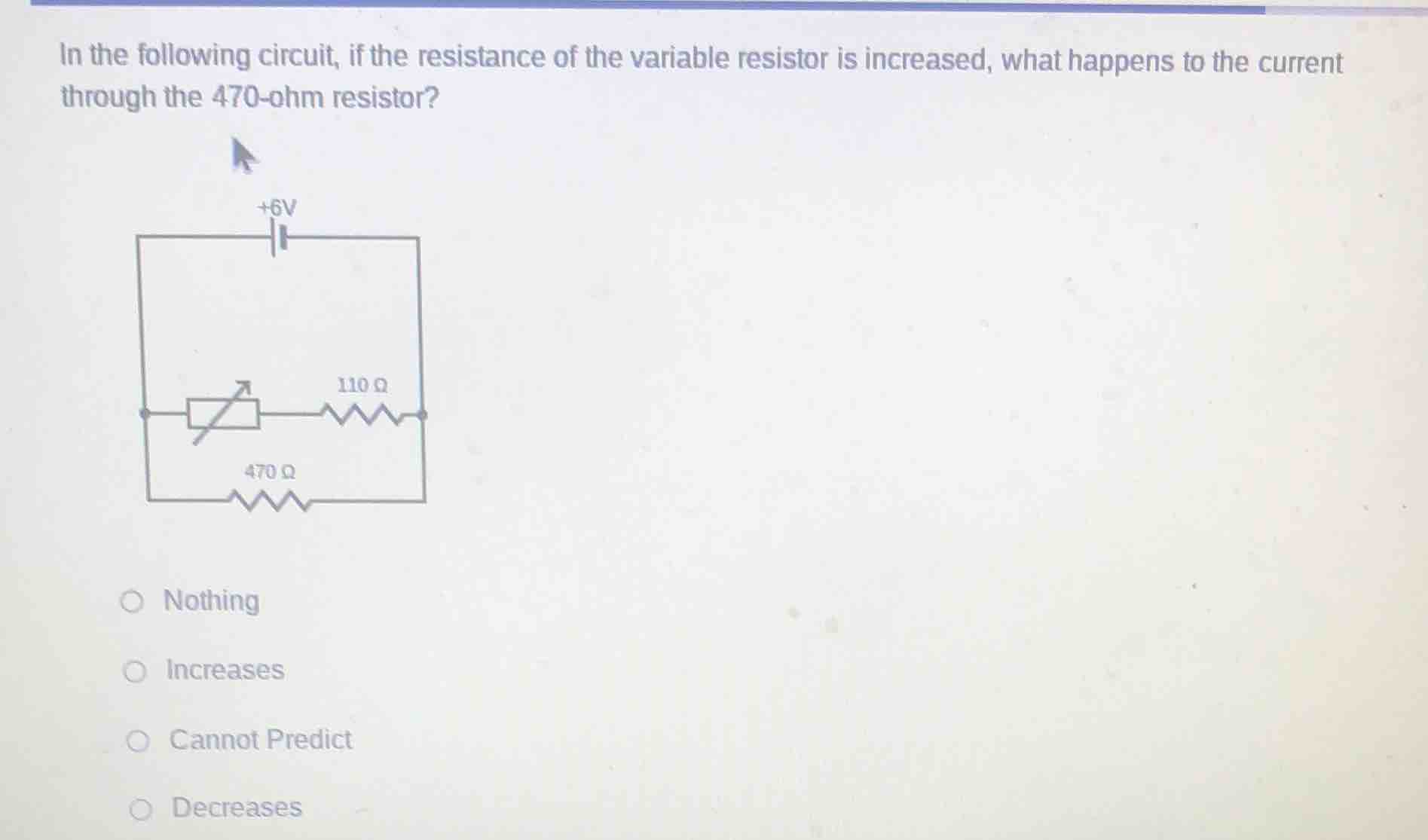
Identify circuit topology
The circuit has a constant voltage source of \(+6\text{ V}\).
It contains two parallel branches connected directly across this source:
- The top branch contains a variable resistor in series with a \(110\ \Omega\) resistor.
- The bottom branch contains a single \(470\ \Omega\) resistor.
Using the Series and Parallel Circuits knowledge point, the voltage across parallel branches connected to an ideal voltage source is independent.
Analyze the target branch
We want to find the current through the \(470\ \Omega\) resistor, denoted as \(I_{470}\).
The voltage across this bottom branch is fixed by the ideal voltage source:
Apply Ohm's Law
Using the Ohm's Law knowledge point:
Determine the effect of the variable resistor
The variable resistor is in the other parallel branch.
Changing its resistance alters the current in the top branch.
However, it does not change the source voltage of \(6\text{ V}\) across the bottom branch.
Thus, \(I_{470}\) remains constant.
Select the correct option
Since the current does not change, the correct choice is "Nothing".

Snap & solve any problem in the app
Get step-by-step solutions on Sovi AI
Photo-based solutions with guided steps
Explore more problems and detailed explanations
- (A) Nothing (Correct answer)
- (B) Increases
- (C) Cannot Predict
- (D) Decreases