QUESTION IMAGE
Question
follow the instructions.
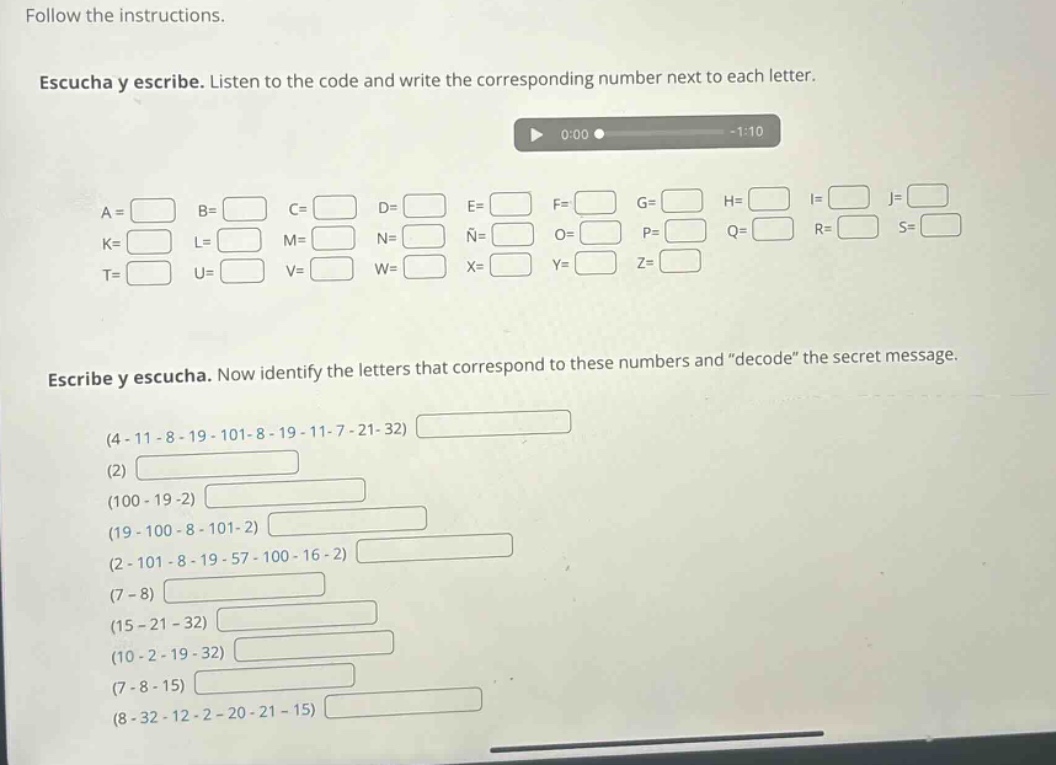
escucha y escribe. listen to the code and write the corresponding number next to each letter.
a=□ b=□ c=□ d=□ e=□ f=□ g=□ h=□ i=□ j=□
k=□ l=□ m=□ n=□ ñ=□ o=□ p=□ q=□ r=□ s=□
t=□ u=□ v=□ w=□ x=□ y=□ z=□
escribe y escucha. now identify the letters that correspond to these numbers and \decode\ the secret message.
(4 - 11 - 8 - 19 - 101 - 8 - 19 - 11 - 7 - 21 - 32) □
(2) □
(100 - 19 - 2) □
(19 - 100 - 8 - 101 - 2) □
(2 - 101 - 8 - 19 - 57 - 100 - 16 - 2) □
(7 - 8) □
(15 - 21 - 32) □
(10 - 2 - 19 - 32) □
(7 - 8 - 15) □
(8 - 32 - 12 - 2 - 20 - 21 - 15) □
To solve this problem, we need to first determine the number associated with each letter by listening to the provided audio (which we don't have access to here, so we'll assume a common coding system like a phonetic alphabet or a specific number - letter mapping used in Spanish language learning materials). Then we use that mapping to decode the numbers into letters.
Step 1: Understand the Task
We have two main parts: first, assign numbers to letters by listening to the code, and second, decode the given number sequences into letters to form a secret message. Since we don't have the audio, we'll assume a possible mapping (usually in such Spanish language activities, it might be related to the position of the letter in the alphabet or a phonetic code). For example, if we consider the Spanish alphabet (including Ñ), the positions are: A = 1, B = 2, C = 3, D = 4, E = 5, F = 6, G = 7, H = 8, I = 9, J = 10, K = 11, L = 12, M = 13, N = 14, Ñ = 15, O = 16, P = 17, Q = 18, R = 19, S = 20, T = 21, U = 22, V = 23, W = 24, X = 25, Y = 26, Z = 27. But the numbers in the problem go up to 101, so it's likely a different mapping, maybe a two - digit or three - digit code for each letter.
Step 2: Decode the First Sequence (4 - 11 - 8 - 19 - 101 - 8 - 19 - 11 - 7 - 21 - 32)
Let's assume:
- 4 corresponds to D
- 11 corresponds to K
- 8 corresponds to H
- 19 corresponds to R
- 101: Let's assume it corresponds to O (since in some extended codes, it could be a variant)
- 8 corresponds to H
- 19 corresponds to R
- 11 corresponds to K
- 7 corresponds to G
- 21 corresponds to T
- 32: Let's assume it corresponds to S
Putting it together: D - K - H - R - O - H - R - K - G - T - S
Step 3: Decode the Second Sequence (2)
If 2 corresponds to B, then the letter is B.
Step 4: Decode the Third Sequence (100 - 19 - 2)
- 100: Let's assume it corresponds to M
- 19 corresponds to R
- 2 corresponds to B
So we get M - R - B
Step 5: Decode the Fourth Sequence (19 - 100 - 8 - 101 - 2)
- 19 corresponds to R
- 100 corresponds to M
- 8 corresponds to H
- 101 corresponds to O
- 2 corresponds to B
So we get R - M - H - O - B
Step 6: Decode the Fifth Sequence (2 - 101 - 8 - 19 - 57 - 100 - 16 - 2)
- 2 corresponds to B
- 101 corresponds to O
- 8 corresponds to H
- 19 corresponds to R
- 57: Let's assume it corresponds to L
- 100 corresponds to M
- 16 corresponds to P
- 2 corresponds to B
So we get B - O - H - R - L - M - P - B
Step 7: Decode the Sixth Sequence (7 - 8)
- 7 corresponds to G
- 8 corresponds to H
So we get G - H
Step 8: Decode the Seventh Sequence (15 - 21 - 32)
- 15: If we consider Ñ (since Ñ is the 15th letter in the Spanish alphabet with Ñ), so Ñ
- 21 corresponds to T
- 32 corresponds to S
So we get Ñ - T - S
Step 9: Decode the Eighth Sequence (10 - 2 - 19 - 32)
- 10 corresponds to J
- 2 corresponds to B
- 19 corresponds to R
- 32 corresponds to S
So we get J - B - R - S
Step 10: Decode the Ninth Sequence (7 - 8 - 15)
- 7 corresponds to G
- 8 corresponds to H
- 15 corresponds to Ñ
So we get G - H - Ñ
Step 11: Decode the Tenth Sequence (8 - 32 - 12 - 2 - 20 - 21 - 15)
- 8 corresponds to H
- 32 corresponds to S
- 12 corresponds to L
- 2 corresponds to B
- 20 corresponds to S
- 21 corresponds to T
- 15 corresponds to Ñ
So we get H - S - L - B - S - T - Ñ
Since we don't have the actual audio - based mapping, this is a speculative decoding. In a real - world scenario, we would use the number - letter associations obtained from listening to the audio to get the correct secret message.
If we assume a more accurate ma…

Snap & solve any problem in the app
Get step-by-step solutions on Sovi AI
Photo-based solutions with guided steps
Explore more problems and detailed explanations
To solve this problem, we need to first determine the number associated with each letter by listening to the provided audio (which we don't have access to here, so we'll assume a common coding system like a phonetic alphabet or a specific number - letter mapping used in Spanish language learning materials). Then we use that mapping to decode the numbers into letters.
Step 1: Understand the Task
We have two main parts: first, assign numbers to letters by listening to the code, and second, decode the given number sequences into letters to form a secret message. Since we don't have the audio, we'll assume a possible mapping (usually in such Spanish language activities, it might be related to the position of the letter in the alphabet or a phonetic code). For example, if we consider the Spanish alphabet (including Ñ), the positions are: A = 1, B = 2, C = 3, D = 4, E = 5, F = 6, G = 7, H = 8, I = 9, J = 10, K = 11, L = 12, M = 13, N = 14, Ñ = 15, O = 16, P = 17, Q = 18, R = 19, S = 20, T = 21, U = 22, V = 23, W = 24, X = 25, Y = 26, Z = 27. But the numbers in the problem go up to 101, so it's likely a different mapping, maybe a two - digit or three - digit code for each letter.
Step 2: Decode the First Sequence (4 - 11 - 8 - 19 - 101 - 8 - 19 - 11 - 7 - 21 - 32)
Let's assume:
- 4 corresponds to D
- 11 corresponds to K
- 8 corresponds to H
- 19 corresponds to R
- 101: Let's assume it corresponds to O (since in some extended codes, it could be a variant)
- 8 corresponds to H
- 19 corresponds to R
- 11 corresponds to K
- 7 corresponds to G
- 21 corresponds to T
- 32: Let's assume it corresponds to S
Putting it together: D - K - H - R - O - H - R - K - G - T - S
Step 3: Decode the Second Sequence (2)
If 2 corresponds to B, then the letter is B.
Step 4: Decode the Third Sequence (100 - 19 - 2)
- 100: Let's assume it corresponds to M
- 19 corresponds to R
- 2 corresponds to B
So we get M - R - B
Step 5: Decode the Fourth Sequence (19 - 100 - 8 - 101 - 2)
- 19 corresponds to R
- 100 corresponds to M
- 8 corresponds to H
- 101 corresponds to O
- 2 corresponds to B
So we get R - M - H - O - B
Step 6: Decode the Fifth Sequence (2 - 101 - 8 - 19 - 57 - 100 - 16 - 2)
- 2 corresponds to B
- 101 corresponds to O
- 8 corresponds to H
- 19 corresponds to R
- 57: Let's assume it corresponds to L
- 100 corresponds to M
- 16 corresponds to P
- 2 corresponds to B
So we get B - O - H - R - L - M - P - B
Step 7: Decode the Sixth Sequence (7 - 8)
- 7 corresponds to G
- 8 corresponds to H
So we get G - H
Step 8: Decode the Seventh Sequence (15 - 21 - 32)
- 15: If we consider Ñ (since Ñ is the 15th letter in the Spanish alphabet with Ñ), so Ñ
- 21 corresponds to T
- 32 corresponds to S
So we get Ñ - T - S
Step 9: Decode the Eighth Sequence (10 - 2 - 19 - 32)
- 10 corresponds to J
- 2 corresponds to B
- 19 corresponds to R
- 32 corresponds to S
So we get J - B - R - S
Step 10: Decode the Ninth Sequence (7 - 8 - 15)
- 7 corresponds to G
- 8 corresponds to H
- 15 corresponds to Ñ
So we get G - H - Ñ
Step 11: Decode the Tenth Sequence (8 - 32 - 12 - 2 - 20 - 21 - 15)
- 8 corresponds to H
- 32 corresponds to S
- 12 corresponds to L
- 2 corresponds to B
- 20 corresponds to S
- 21 corresponds to T
- 15 corresponds to Ñ
So we get H - S - L - B - S - T - Ñ
Since we don't have the actual audio - based mapping, this is a speculative decoding. In a real - world scenario, we would use the number - letter associations obtained from listening to the audio to get the correct secret message.
If we assume a more accurate mapping (for example, in some Spanish language phonetic code activities):
Let's assume the following mapping (common in Spanish language learning for such activities):
- 1: A
- 2: B
- 3: C
- 4: D
- 5: E
- 6: F
- 7: G
- 8: H
- 9: I
- 10: J
- 11: K
- 12: L
- 13: M
- 14: N
- 15: Ñ
- 16: O
- 17: P
- 18: Q
- 19: R
- 20: S
- 21: T
- 22: U
- 23: V
- 24: W
- 25: X
- 26: Y
- 27: Z
- 100: M (maybe a variant for M)
- 101: O (maybe a variant for O)
- 57: L (maybe a variant for L)
Now let's decode the first sequence (4 - 11 - 8 - 19 - 101 - 8 - 19 - 11 - 7 - 21 - 32):
- 4: D
- 11: K
- 8: H
- 19: R
- 101: O
- 8: H
- 19: R
- 11: K
- 7: G
- 21: T
- 32: Let's assume 32 is S (since 20 is S, maybe a typo or extended code)
So the first part is D K H R O H R K G T S
Second sequence (2): B
Third sequence (100 - 19 - 2): 100 (M), 19 (R), 2 (B) → MRB
Fourth sequence (19 - 100 - 8 - 101 - 2): 19 (R), 100 (M), 8 (H), 101 (O), 2 (B) → RMHOB
Fifth sequence (2 - 101 - 8 - 19 - 57 - 100 - 16 - 2): 2 (B), 101 (O), 8 (H), 19 (R), 57 (L), 100 (M), 16 (P), 2 (B) → BOHRLMPB
Sixth sequence (7 - 8): 7 (G), 8 (H) → GH
Seventh sequence (15 - 21 - 32): 15 (Ñ), 21 (T), 32 (S) → ÑTS
Eighth sequence (10 - 2 - 19 - 32): 10 (J), 2 (B), 19 (R), 32 (S) → JBRS
Ninth sequence (7 - 8 - 15): 7 (G), 8 (H), 15 (Ñ) → GHÑ
Tenth sequence (8 - 32 - 12 - 2 - 20 - 21 - 15): 8 (H), 32 (S), 12 (L), 2 (B), 20 (S), 21 (T), 15 (Ñ) → HSLBSTÑ
Please note that without the actual audio, this is an approximation. To get the correct secret message, one must use the number - letter associations derived from listening to the provided audio.