QUESTION IMAGE
Question
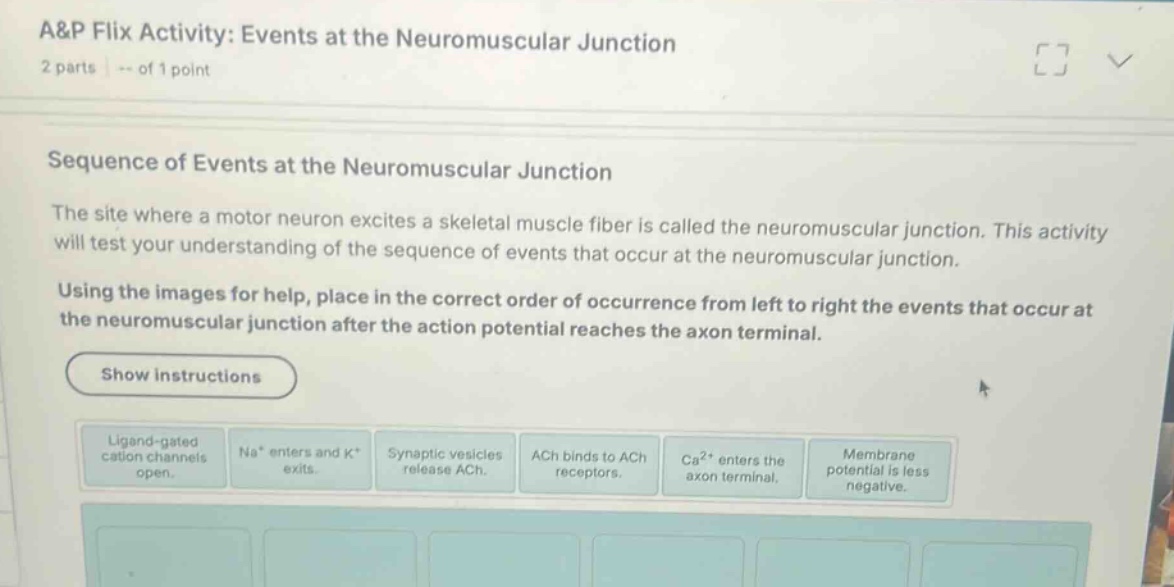
a&p flix activity: events at the neuromuscular junction
2 parts | -- of 1 point
sequence of events at the neuromuscular junction
the site where a motor neuron excites a skeletal muscle fiber is called the neuromuscular junction. this activity will test your understanding of the sequence of events that occur at the neuromuscular junction.
using the images for help, place in the correct order of occurrence from left to right the events that occur at the neuromuscular junction after the action potential reaches the axon terminal.
show instructions
ligand-gated cation channels open.
na+ enters and k+ exits.
synaptic vesicles release ach.
ach binds to ach receptors.
ca2+ enters the axon terminal.
membrane potential is less negative.
🆕 New Concept Discovered: Neuromuscular Junction Signaling
How nerve signals trigger muscle contraction.
Step 1: Calcium Entry into the Axon Terminal
When an action potential (electrical signal) arrives at the axon terminal of the motor neuron, it triggers voltage-gated calcium channels to open. Calcium ions (\(\text{Ca}^{2+}\)) rush into the terminal down their electrochemical gradient.
- Event: \(\text{Ca}^{2+}\) enters the axon terminal.
Step 2: Neurotransmitter Release
The influx of calcium ions causes synaptic vesicles inside the axon terminal to fuse with the neuronal membrane. This fusion releases the neurotransmitter acetylcholine (ACh) into the synaptic cleft (the gap between the neuron and the muscle cell) via exocytosis.
- Event: Synaptic vesicles release ACh.
Step 3: Receptor Binding
The released ACh molecules diffuse across the synaptic cleft and bind to specific ACh receptors located on the motor end plate of the muscle fiber's sarcolemma.
- Event: ACh binds to ACh receptors.
Step 4: Channel Opening
The ACh receptors are chemically gated (ligand-gated) ion channels. When ACh binds to them, these channels change shape and open.
- Event: Ligand-gated cation channels open.
Step 5: Ion Movement
Once the ligand-gated channels open, they allow sodium ions (\(\text{Na}^+\)) to rush into the muscle cell while potassium ions (\(\text{K}^+\)) exit. Because more sodium enters than potassium leaves, there is a net influx of positive charge into the muscle cell.
- Event: \(\text{Na}^+\) enters and \(\text{K}^+\) exits.
Step 6: Depolarization of the Muscle Membrane
The net entry of positive sodium ions makes the inside of the muscle cell membrane less negative (more positive). This local change in membrane potential is called depolarization (or an end-plate potential).
- Event: Membrane potential is less negative.

Snap & solve any problem in the app
Get step-by-step solutions on Sovi AI
Photo-based solutions with guided steps
Explore more problems and detailed explanations
The correct order of events from left to right is:
- \(\text{Ca}^{2+}\) enters the axon terminal.
- Synaptic vesicles release ACh.
- ACh binds to ACh receptors.
- Ligand-gated cation channels open.
- \(\text{Na}^+\) enters and \(\text{K}^+\) exits.
- Membrane potential is less negative.