QUESTION IMAGE
Question
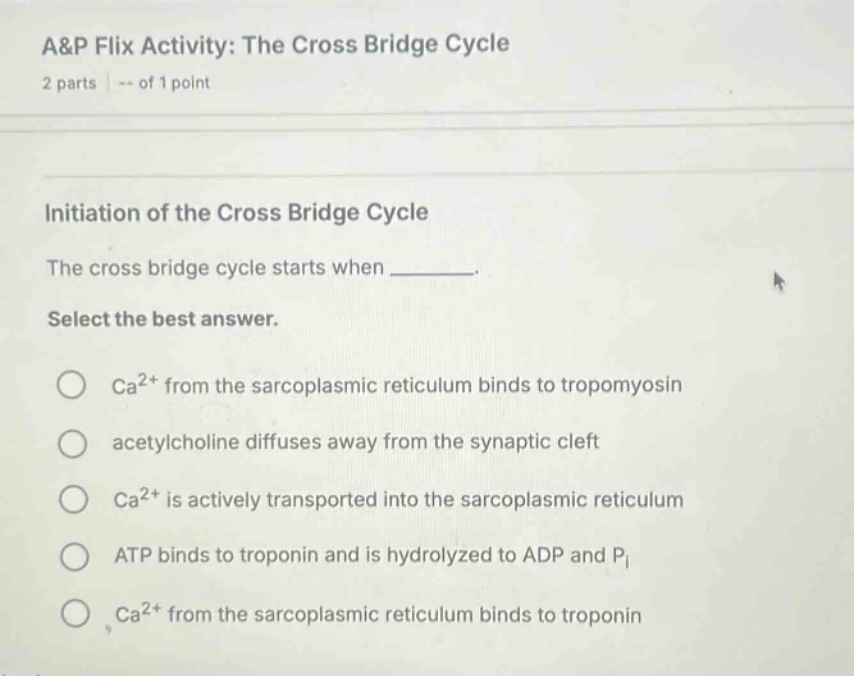
a&p flix activity: the cross bridge cycle
2 parts | -- of 1 point
initiation of the cross bridge cycle
the cross bridge cycle starts when ______.
select the best answer.
- \\(\text{ca}^{2+}\\) from the sarcoplasmic reticulum binds to tropomyosin
- acetylcholine diffuses away from the synaptic cleft
- \\(\text{ca}^{2+}\\) is actively transported into the sarcoplasmic reticulum
- atp binds to troponin and is hydrolyzed to adp and \\(\text{p}_i\\)
- \\(\text{ca}^{2+}\\) from the sarcoplasmic reticulum binds to troponin
🆕 New Concept Discovered: Sliding Filament Theory
How calcium ions trigger muscle contraction.
Step 1: Understand the role of calcium in muscle contraction
In resting muscle fibers, the active binding sites on actin filaments are blocked by a regulatory protein complex called tropomyosin. For muscle contraction (the cross-bridge cycle) to begin, these binding sites must be exposed.
This process is initiated when calcium ions (\(\text{Ca}^{2+}\)) are released from the sarcoplasmic reticulum into the sarcoplasm.
Step 2: Identify the specific binding target of calcium
Once released, \(\text{Ca}^{2+}\) binds directly to troponin, another regulatory protein bound to tropomyosin.
When calcium binds to troponin, it undergoes a conformational (shape) change. This change physically pulls tropomyosin away from the active sites on the actin filament, exposing them so that myosin heads can bind and form cross-bridges.
Step 3: Evaluate the given options
- \(\text{Ca}^{2+}\) from the sarcoplasmic reticulum binds to tropomyosin: Incorrect. Calcium binds to troponin, not tropomyosin.
- acetylcholine diffuses away from the synaptic cleft: Incorrect. This action helps terminate a muscle contraction signal, rather than initiating the cross-bridge cycle.
- \(\text{Ca}^{2+}\) is actively transported into the sarcoplasmic reticulum: Incorrect. This removes calcium from the sarcoplasm, which ends contraction and leads to muscle relaxation.
- ATP binds to troponin and is hydrolyzed to ADP and \(\text{P}_i\): Incorrect. ATP binds to the myosin head, not to troponin.
- \(\text{Ca}^{2+}\) from the sarcoplasmic reticulum binds to troponin: Correct. This is the precise event that triggers the exposure of binding sites to start the cross-bridge cycle.

Snap & solve any problem in the app
Get step-by-step solutions on Sovi AI
Photo-based solutions with guided steps
Explore more problems and detailed explanations
\(\text{Ca}^{2+}\) from the sarcoplasmic reticulum binds to troponin