QUESTION IMAGE
Question
first read: comprehension
identify the choice that best answers the question.
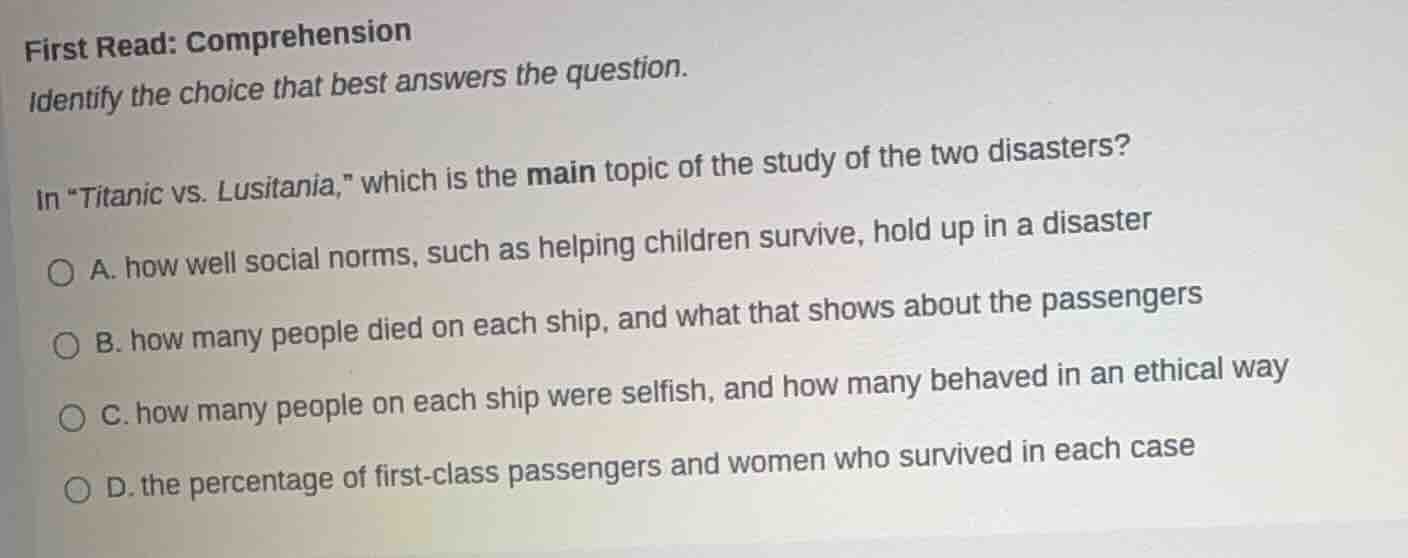
in \titanic vs. lusitania,\ which is the main topic of the study of the two disasters?
a. how well social norms, such as helping children survive, hold up in a disaster
b. how many people died on each ship, and what that shows about the passengers
c. how many people on each ship were selfish, and how many behaved in an ethical way
d. the percentage of first-class passengers and women who survived in each case
Analyze the question prompt
Using the Reading Comprehension and Textual Comprehension knowledge points, we identify that the question asks for the main topic of the comparative study "Titanic vs. Lusitania."
Evaluate the answer choices
- Option A focuses on how social norms (such as protecting children and women) hold up under the extreme stress of a maritime disaster. This is the central sociological thesis of the comparative study between the two shipwrecks.
- Option B focuses purely on death tolls, which is a statistic rather than the main analytical topic of the study.
- Option C frames the study around individual selfishness versus ethical behavior, which is too narrow and moralistic compared to the broader sociological focus on social norms.
- Option D lists specific demographic percentages, which are supporting data points rather than the overarching main topic.
Select the best option
Option A accurately and comprehensively states the main topic of the study, which examines how social norms and behaviors differed during the sinking of the Titanic versus the Lusitania due to the different timeframes of the disasters.

Snap & solve any problem in the app
Get step-by-step solutions on Sovi AI
Photo-based solutions with guided steps
Explore more problems and detailed explanations
- A. how well social norms, such as helping children survive, hold up in a disaster (Correct answer)
- B. how many people died on each ship, and what that shows about the passengers
- C. how many people on each ship were selfish, and how many behaved in an ethical way
- D. the percentage of first-class passengers and women who survived in each case