QUESTION IMAGE
Question
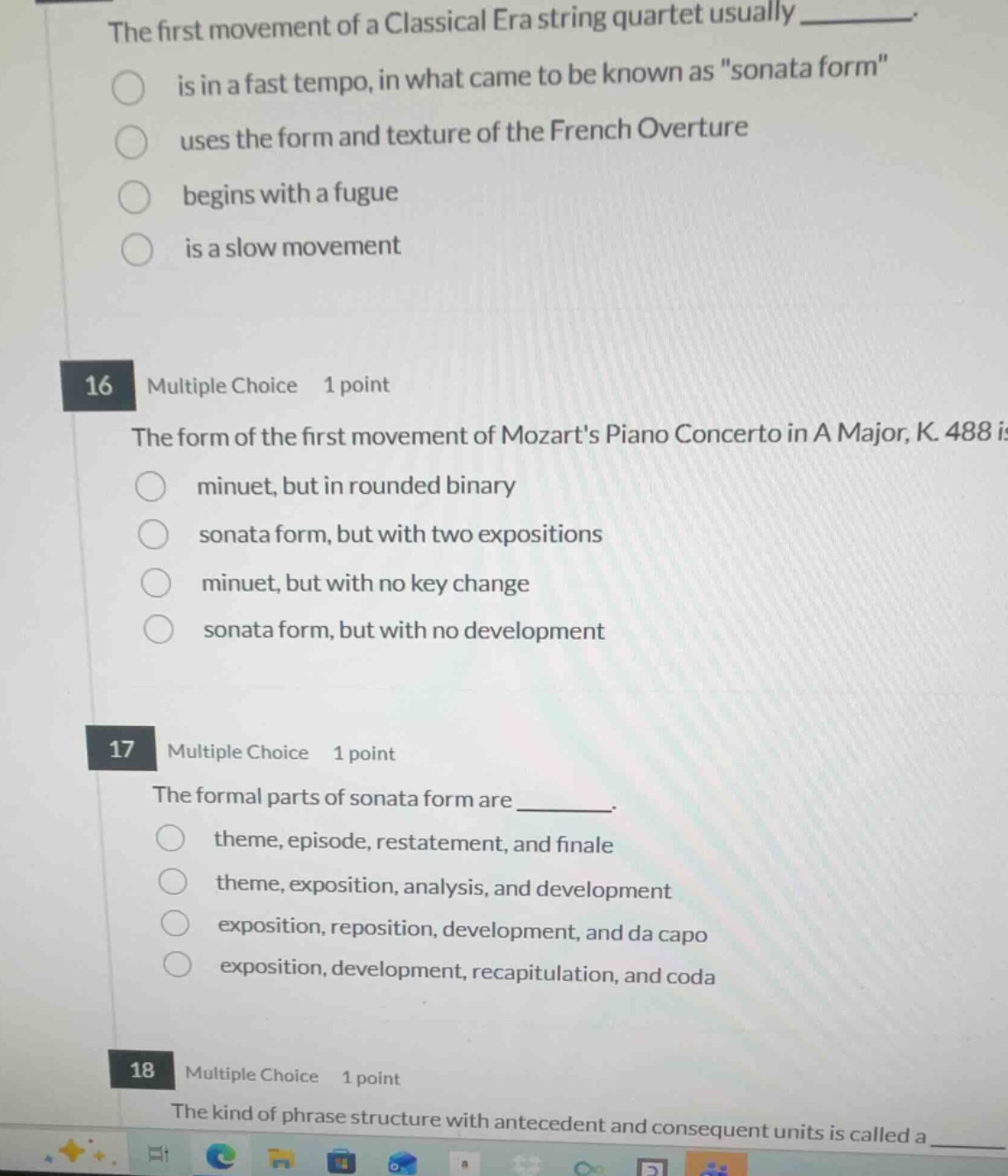
the first movement of a classical era string quartet usually ______.
- is in a fast tempo, in what came to be known as \sonata form\
- uses the form and texture of the french overture
- begins with a fugue
- is a slow movement
16 multiple choice 1 point
the form of the first movement of mozarts piano concerto in a major, k. 488 is ______.
- minuet, but in rounded binary
- sonata form, but with two expositions
- minuet, but with no key change
- sonata form, but with no development
17 multiple choice 1 point
the formal parts of sonata form are ______.
- theme, episode, restatement, and finale
- theme, exposition, analysis, and development
- exposition, reposition, development, and da capo
- exposition, development, recapitulation, and coda
18 multiple choice 1 point
the kind of phrase structure with antecedent and consequent units is called a ______.
Analyze the first movement of a string quartet
The first movement of a Classical Era string quartet is traditionally fast and written in sonata form. This is the standard structural design established by Haydn and Mozart.
Analyze Mozart's Piano Concerto K. 488
Using the Mozart Piano Concerto knowledge point, Classical concertos feature a modified sonata form. This structure is characterized by a double exposition (one for the orchestra and one for the soloist).
Analyze the parts of sonata form
Using the Sonata Form Exposition and Sonata Form Development knowledge points, the standard structural components of a sonata form movement are the exposition, development, and recapitulation, often followed by a concluding coda.
Analyze antecedent and consequent phrase structure
In Classical music, a phrase structure consisting of an opening antecedent phrase and a resolving consequent phrase is known as a period (or periodic phrase structure).

Snap & solve any problem in the app
Get step-by-step solutions on Sovi AI
Photo-based solutions with guided steps
Explore more problems and detailed explanations
Question 15
- (A) is in a fast tempo, in what came to be known as "sonata form" (Correct answer)
- (B) uses the form and texture of the French Overture
- (C) begins with a fugue
- (D) is a slow movement
Question 16
- (A) minuet, but in rounded binary
- (B) sonata form, but with two expositions (Correct answer)
- (C) minuet, but with no key change
- (D) sonata form, but with no development
Question 17
- (A) theme, episode, restatement, and finale
- (B) theme, exposition, analysis, and development
- (C) exposition, reposition, development, and da capo
- (D) exposition, development, recapitulation, and coda (Correct answer)
Question 18
- (A) period (Correct answer)
- (B) sentence
- (C) sequence
- (D) motive