QUESTION IMAGE
Question
finding inverses
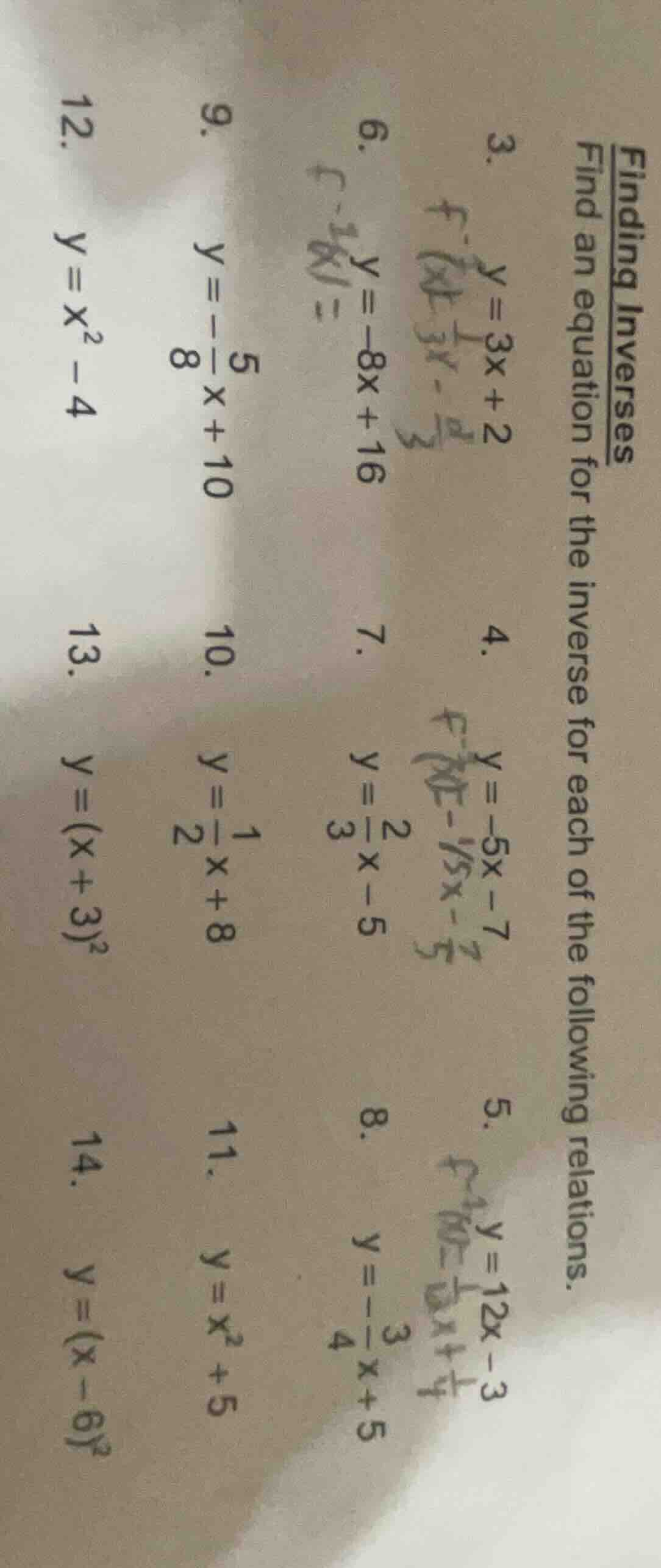
find an equation for the inverse for each of the following relations.
- ( y = 3x + 2 )
- ( y = -5x - 7 )
- ( y = 12x - 3 )
- ( y = -8x + 16 )
- ( y = \frac{2}{3}x - 5 )
- ( y = -\frac{3}{4}x + 5 )
- ( y = -\frac{5}{8}x + 10 )
- ( y = \frac{1}{2}x + 8 )
- ( y = x^2 + 5 )
- ( y = x^2 - 4 )
- ( y = (x + 3)^2 )
- ( y = (x - 6)^2 )
Let's solve for the inverse of the function \( y = 3x + 2 \) (problem 3) as an example.
Step 1: Swap x and y
To find the inverse, we first swap the roles of \( x \) and \( y \) in the equation. So we get \( x = 3y + 2 \).
Step 2: Solve for y
Now we solve this new equation for \( y \). Subtract 2 from both sides: \( x - 2 = 3y \). Then divide both sides by 3: \( y=\frac{x - 2}{3}\), which can be rewritten as \( y=\frac{1}{3}x-\frac{2}{3} \). So the inverse function \( f^{-1}(x)=\frac{1}{3}x - \frac{2}{3} \).
Let's do problem 4: \( y=- 5x - 7 \)
Step 1: Swap x and y
We have \( x=-5y - 7 \)
Step 2: Solve for y
Add 7 to both sides: \( x + 7=-5y \). Then divide both sides by - 5: \( y=-\frac{1}{5}x-\frac{7}{5} \), so the inverse function \( f^{-1}(x)=-\frac{1}{5}x-\frac{7}{5} \)
Problem 5: \( y = 12x-3 \)
Step 1: Swap x and y
\( x = 12y-3 \)
Step 2: Solve for y
Add 3 to both sides: \( x + 3=12y \). Divide both sides by 12: \( y=\frac{x + 3}{12}=\frac{1}{12}x+\frac{1}{4} \), so the inverse function \( f^{-1}(x)=\frac{1}{12}x+\frac{1}{4} \)
Problem 6: \( y=-8x + 16 \)
Step 1: Swap x and y
\( x=-8y + 16 \)
Step 2: Solve for y
Subtract 16 from both sides: \( x-16=-8y \). Divide both sides by - 8: \( y=-\frac{1}{8}x + 2 \), so the inverse function \( f^{-1}(x)=-\frac{1}{8}x + 2 \)
Problem 7: \( y=\frac{2}{3}x-5 \)
Step 1: Swap x and y
\( x=\frac{2}{3}y-5 \)
Step 2: Solve for y
Add 5 to both sides: \( x + 5=\frac{2}{3}y \). Multiply both sides by \( \frac{3}{2} \): \( y=\frac{3}{2}x+\frac{15}{2} \), so the inverse function \( f^{-1}(x)=\frac{3}{2}x+\frac{15}{2} \)
Problem 8: \( y =-\frac{3}{4}x + 5 \)
Step 1: Swap x and y
\( x=-\frac{3}{4}y + 5 \)
Step 2: Solve for y
Subtract 5 from both sides: \( x - 5=-\frac{3}{4}y \). Multiply both sides by \( -\frac{4}{3} \): \( y=-\frac{4}{3}x+\frac{20}{3} \), so the inverse function \( f^{-1}(x)=-\frac{4}{3}x+\frac{20}{3} \)
Problem 9: \( y =-\frac{5}{8}x + 10 \)
Step 1: Swap x and y
\( x=-\frac{5}{8}y + 10 \)
Step 2: Solve for y
Subtract 10 from both sides: \( x - 10=-\frac{5}{8}y \). Multiply both sides by \( -\frac{8}{5} \): \( y=-\frac{8}{5}x + 16 \), so the inverse function \( f^{-1}(x)=-\frac{8}{5}x + 16 \)
Problem 10: \( y=\frac{1}{2}x + 8 \)
Step 1: Swap x and y
\( x=\frac{1}{2}y + 8 \)
Step 2: Solve for y
Subtract 8 from both sides: \( x - 8=\frac{1}{2}y \). Multiply both sides by 2: \( y = 2x-16 \), so the inverse function \( f^{-1}(x)=2x - 16 \)
Problem 11: \( y=x^{2}+5 \)
First, we need to note that the function \( y = x^{2}+5 \) is not one - to - one over the entire real number line. But if we consider the domain \( x\geq0 \) (or \( x\leq0 \)):
Step 1: Swap x and y
\( x=y^{2}+5 \)
Step 2: Solve for y
Subtract 5 from both sides: \( x - 5=y^{2} \). Then \( y=\pm\sqrt{x - 5} \). If we consider the domain \( x\geq0 \) for the original function, the range of the original function is \( y\geq5 \), and the inverse function (for \( x\geq5 \)) is \( y = \sqrt{x - 5} \) (if we took the domain \( x\leq0 \) for the original function, the inverse function would be \( y=-\sqrt{x - 5} \) for \( x\geq5 \))
Problem 12: \( y=x^{2}-4 \)
The function \( y=x^{2}-4 \) is not one - to - one over \( \mathbb{R} \). For domain \( x\geq0 \) (or \( x\leq0 \)):
Step 1: Swap x and y
\( x=y^{2}-4 \)
Step 2: Solve for y
Add 4 to both sides: \( x + 4=y^{2} \). Then \( y=\pm\sqrt{x + 4} \). If the original function has domain \( x\geq0 \), range \( y\geq - 4 \), and the inverse function (for \( x\geq - 4 \)) is \( y=\sqrt{x + 4} \) (for \( x\geq0 \) original domain) or \( y =-\sqrt{x + 4} \) (for \( x\leq0 \) original domain)
Problem 13: \( y=…

Snap & solve any problem in the app
Get step-by-step solutions on Sovi AI
Photo-based solutions with guided steps
Explore more problems and detailed explanations
s (for the linear functions, the inverses are):
- \( f^{-1}(x)=\frac{1}{3}x-\frac{2}{3} \)
- \( f^{-1}(x)=-\frac{1}{5}x-\frac{7}{5} \)
- \( f^{-1}(x)=\frac{1}{12}x+\frac{1}{4} \)
- \( f^{-1}(x)=-\frac{1}{8}x + 2 \)
- \( f^{-1}(x)=\frac{3}{2}x+\frac{15}{2} \)
- \( f^{-1}(x)=-\frac{4}{3}x+\frac{20}{3} \)
- \( f^{-1}(x)=-\frac{8}{5}x + 16 \)
- \( f^{-1}(x)=2x-16 \)
For the quadratic functions (11 - 14), the inverses are defined piece - wise (depending on the domain of the original function):
- If domain of \( y=x^{2}+5 \) is \( x\geq0 \), \( f^{-1}(x)=\sqrt{x - 5},x\geq5 \); if domain is \( x\leq0 \), \( f^{-1}(x)=-\sqrt{x - 5},x\geq5 \)
- If domain of \( y=x^{2}-4 \) is \( x\geq0 \), \( f^{-1}(x)=\sqrt{x + 4},x\geq - 4 \); if domain is \( x\leq0 \), \( f^{-1}(x)=-\sqrt{x + 4},x\geq - 4 \)
- If domain of \( y=(x + 3)^{2} \) is \( x\geq - 3 \), \( f^{-1}(x)=-3+\sqrt{x},x\geq0 \); if domain is \( x\leq - 3 \), \( f^{-1}(x)=-3-\sqrt{x},x\geq0 \)
- If domain of \( y=(x - 6)^{2} \) is \( x\geq6 \), \( f^{-1}(x)=6+\sqrt{x},x\geq0 \); if domain is \( x\leq6 \), \( f^{-1}(x)=6-\sqrt{x},x\geq0 \)