QUESTION IMAGE
Question
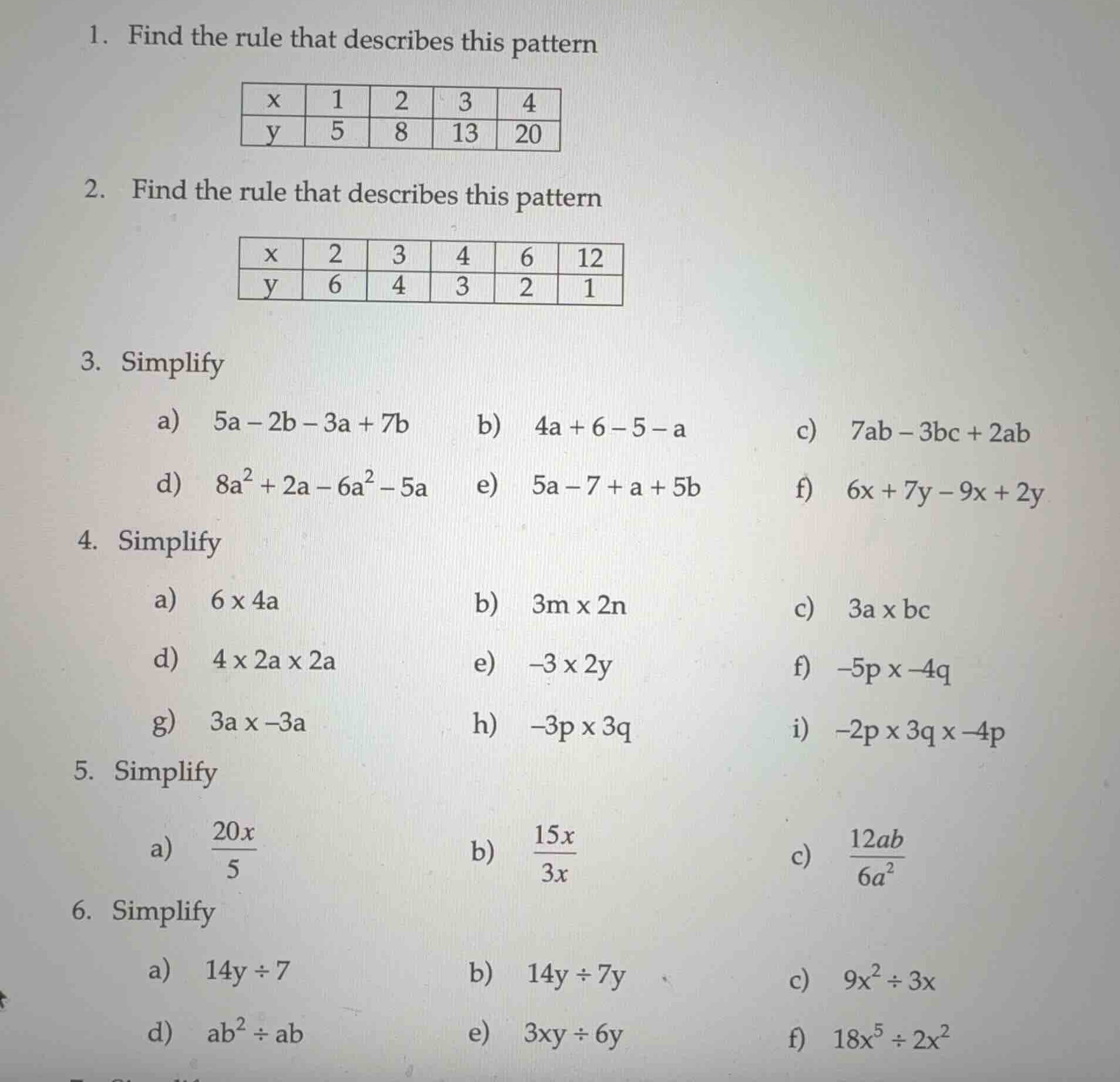
- find the rule that describes this pattern
\
- find the rule that describes this pattern
\
- simplify
a) \\(5a - 2b - 3a + 7b\\)
b) \\(4a + 6 - 5 - a\\)
c) \\(7ab - 3bc + 2ab\\)
d) \\(8a^2 + 2a - 6a^2 - 5a\\)
e) \\(5a - 7 + a + 5b\\)
f) \\(6x + 7y - 9x + 2y\\)
- simplify
a) \\(6 \times 4a\\)
b) \\(3m \times 2n\\)
c) \\(3a \times bc\\)
d) \\(4 \times 2a \times 2a\\)
e) \\(-3 \times 2y\\)
f) \\(-5p \times -4q\\)
g) \\(3a \times -3a\\)
h) \\(-3p \times 3q\\)
i) \\(-2p \times 3q \times -4p\\)
- simplify
a) \\(\frac{20x}{5}\\)
b) \\(\frac{15x}{3x}\\)
c) \\(\frac{12ab}{6a^2}\\)
- simplify
a) \\(14y \div 7\\)
b) \\(14y \div 7y\\)
c) \\(9x^2 \div 3x\\)
d) \\(ab^2 \div ab\\)
e) \\(3xy \div 6y\\)
f) \\(18x^5 \div 2x^2\\)
Analyze patterns in tables
For Question 1, we examine the values:
\(x = 1, 2, 3, 4\)
\(y = 5, 8, 13, 20\)
Let's check the differences:
\(8 - 5 = 3\)
\(13 - 8 = 5\)
\(20 - 13 = 7\)
The second differences are constant (\(2\)), indicating a quadratic relationship of the form \(y = ax^2 + bx + c\).
Using the points:
For \(x = 1\): \(a + b + c = 5\)
For \(x = 2\): \(4a + 2b + c = 8\)
For \(x = 3\): \(9a + 3b + c = 13\)
Subtracting the first from the second: \(3a + b = 3\)
Subtracting the second from the third: \(5a + b = 5\)
Subtracting these results: \(2a = 2 \implies a = 1\)
Then, \(3(1) + b = 3 \implies b = 0\)
Then, \(1 + 0 + c = 5 \implies c = 4\)
Thus, the rule is \(y = x^2 + 4\).
For Question 2, we examine the values:
\(x = 2, 3, 4, 6, 12\)
\(y = 6, 4, 3, 2, 1\)
Notice that the product of \(x\) and \(y\) is constant:
\(2 \times 6 = 12\)
\(3 \times 4 = 12\)
\(4 \times 3 = 12\)
\(6 \times 2 = 12\)
\(12 \times 1 = 12\)
Thus, the rule is \(xy = 12\) or \(y = \frac{12}{x}\).
Simplify expressions by combining like terms
For Question 3, we group and combine like terms:
a) \(5a - 2b - 3a + 7b = (5a - 3a) + (-2b + 7b) = 2a + 5b\)
b) \(4a + 6 - 5 - a = (4a - a) + (6 - 5) = 3a + 1\)
c) \(7ab - 3bc + 2ab = (7ab + 2ab) - 3bc = 9ab - 3bc\)
d) \(8a^2 + 2a - 6a^2 - 5a = (8a^2 - 6a^2) + (2a - 5a) = 2a^2 - 3a\)
e) \(5a - 7 + a + 5b = (5a + a) + 5b - 7 = 6a + 5b - 7\)
f) \(6x + 7y - 9x + 2y = (6x - 9x) + (7y + 2y) = -3x + 9y\)
Simplify expressions by multiplying monomials
For Question 4, we multiply the coefficients and variables:
a) \(6 \times 4a = 24a\)
b) \(3m \times 2n = 6mn\)
c) \(3a \times bc = 3abc\)
d) \(4 \times 2a \times 2a = 16a^2\)
e) \(-3 \times 2y = -6y\)
f) \(-5p \times -4q = 20pq\)
g) \(3a \times -3a = -9a^2\)
h) \(-3p \times 3q = -9pq\)
i) \(-2p \times 3q \times -4p = 24p^2q\)
Simplify algebraic fractions
For Question 5, we divide the numerator by the denominator:
a) \(\frac{20x}{5} = 4x\)
b) \(\frac{15x}{3x} = 5\) (where \(x
eq 0\))
c) \(\frac{12ab}{6a^2} = \frac{2b}{a}\) (where \(a
eq 0\))
Simplify division expressions
For Question 6, we perform the division:
a) \(14y \div 7 = 2y\)
b) \(14y \div 7y = 2\) (where \(y
eq 0\))
c) \(9x^2 \div 3x = 3x\) (where \(x
eq 0\))
d) \(ab^2 \div ab = b\) (where \(a, b
eq 0\))
e) \(3xy \div 6y = \frac{x}{2}\) (where \(y
eq 0\))
f) \(18x^5 \div 2x^2 = 9x^3\) (where \(x
eq 0\))

Snap & solve any problem in the app
Get step-by-step solutions on Sovi AI
Photo-based solutions with guided steps
Explore more problems and detailed explanations
Question 1
\(y = x^2 + 4\)
Question 2
\(y = \frac{12}{x}\)
Question 3
a) \(2a + 5b\)
b) \(3a + 1\)
c) \(9ab - 3bc\)
d) \(2a^2 - 3a\)
e) \(6a + 5b - 7\)
f) \(-3x + 9y\)
Question 4
a) \(24a\)
b) \(6mn\)
c) \(3abc\)
d) \(16a^2\)
e) \(-6y\)
f) \(20pq\)
g) \(-9a^2\)
h) \(-9pq\)
i) \(24p^2q\)
Question 5
a) \(4x\)
b) \(5\)
c) \(\frac{2b}{a}\)
Question 6
a) \(2y\)
b) \(2\)
c) \(3x\)
d) \(b\)
e) \(\frac{x}{2}\)
f) \(9x^3\)