QUESTION IMAGE
Question
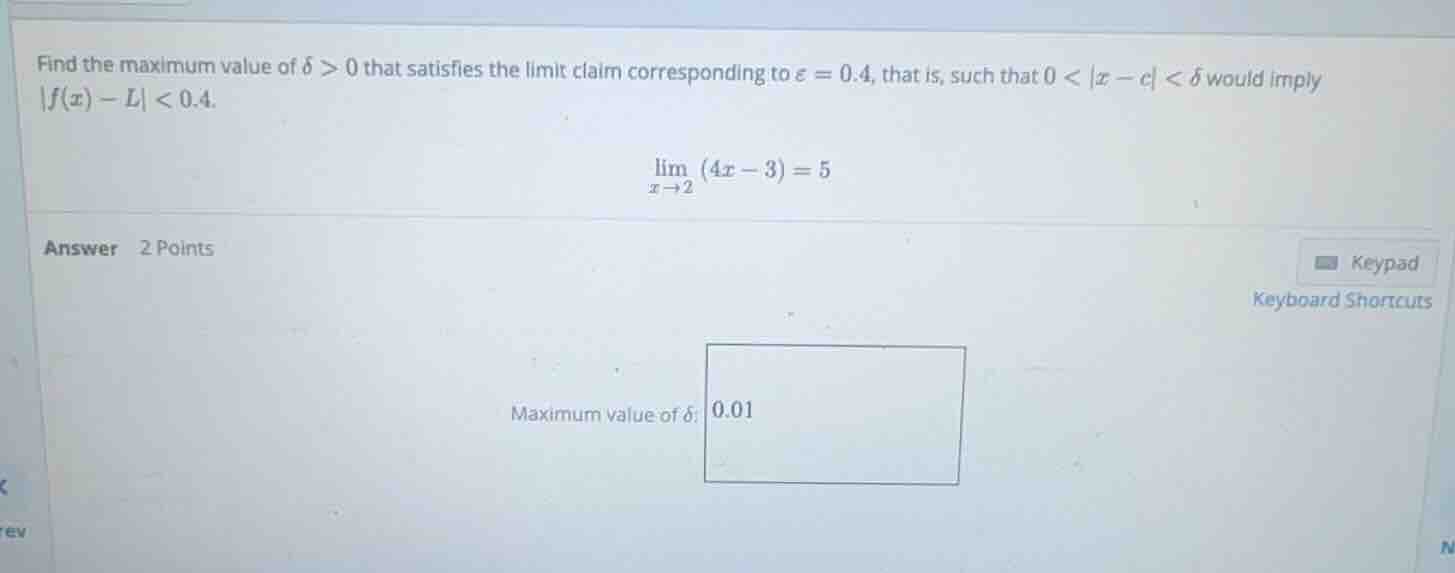
find the maximum value of \\(\delta > 0\\) that satisfies the limit claim corresponding to \\(\varepsilon = 0.4\\), that is, such that \\(0 < |x - c| < \delta\\) would imply \\(|f(x) - l| < 0.4\\).
\\\lim_{x \to 2} (4x - 3) = 5\\
Identify the given limit and parameters
We are given the limit claim:
Here, the function is \(f(x) = 4x - 3\), the limit point is \(c = 2\), and the limit value is \(L = 5\). We are given \(\varepsilon = 0.4\).
Set up the inequality
We want to find the maximum value of \(\delta > 0\) such that \(0 < |x - c| < \delta\) implies \(|f(x) - L| < \varepsilon\).
Using Epsilon-Delta Definition, we substitute our values into the inequality:
Simplify the function inequality
Simplify the expression inside the absolute value:
Factor out the constant \(4\):
Solve for the delta inequality
Divide both sides of the inequality by \(4\):
Determine the maximum delta
Comparing \(|x - 2| < 0.1\) with the definition \(0 < |x - 2| < \delta\), we find that any \(\delta \le 0.1\) satisfies the condition.
Therefore, the maximum value of \(\delta\) is \(0.1\).

Snap & solve any problem in the app
Get step-by-step solutions on Sovi AI
Photo-based solutions with guided steps
Explore more problems and detailed explanations
Find the maximum value of \(\delta > 0\) that satisfies the limit claim corresponding to \(\varepsilon = 0.4\), that is, such that \(0 < |x - c| < \delta\) would imply \(|f(x) - L| < 0.4\).
Maximum value of \(\delta\): <blank>0.1</blank>