Sovi.AI - AI Math Tutor

Scan to solve math questions

QUESTION IMAGE

find the horizontal asymptote, if any, of the graph of the rational fun…

Question

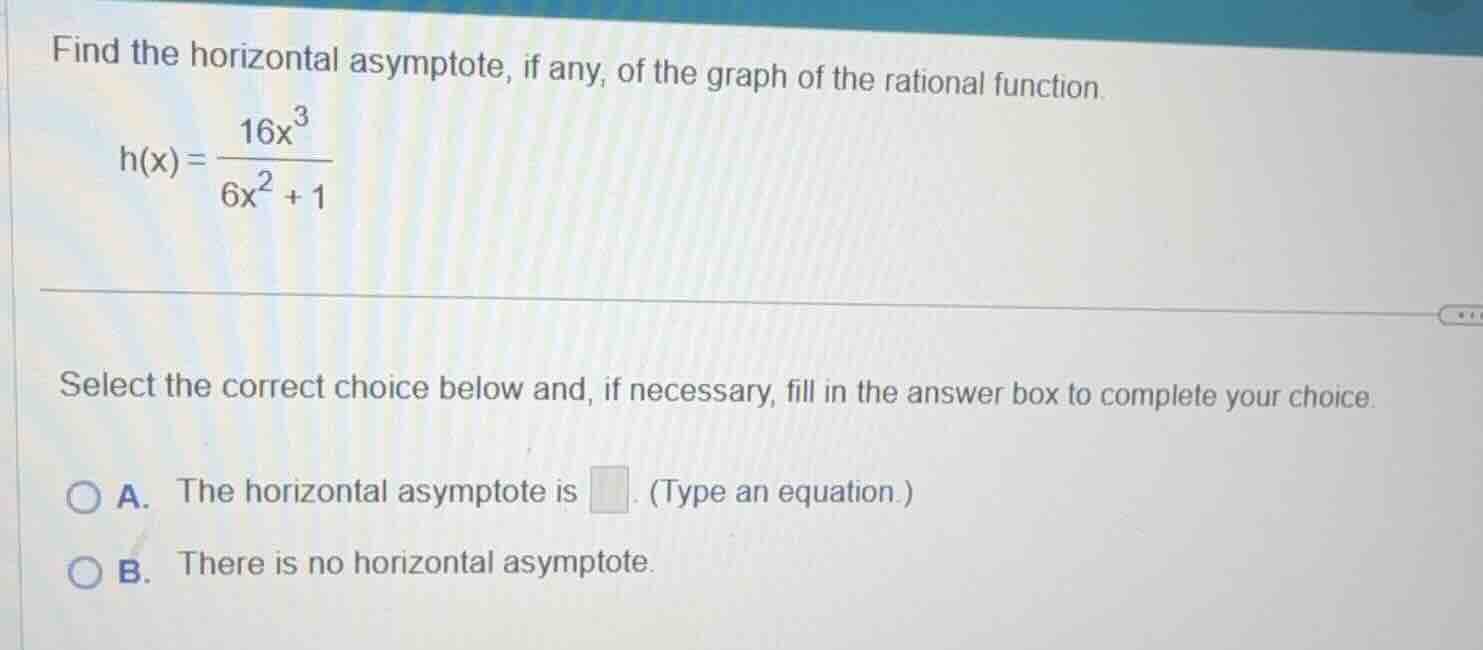
find the horizontal asymptote, if any, of the graph of the rational function.

\\h(x) = \frac{16x^3}{6x^2 + 1}\\

select the correct choice below and, if necessary, fill in the answer box to complete your choice.

a. the horizontal asymptote is (type an equation.)
b. there is no horizontal asymptote.

Explanation:

Response

<pre_analysis>
{
"quality": "clear",
"question_count": 1,
"skills_matched": [
"step_cot",
"multiple_choice_formatter",
"explain_then_answer",
"tutor",
"mastery_adaptive_brevity"
],
"needs_drawing": false,
"concepts_used": [
"Horizontal Asymptotes",
"Rational Function End Behavior"
],
"new_concepts": [],
"current_concepts": [
"Horizontal Asymptotes",
"Rational Function End Behavior"
]
}
</pre_analysis>

<reasoning>

Identify the degrees of the numerator and denominator

Using the Horizontal Asymptotes and Rational Function End Behavior knowledge points
\[

$$\begin{aligned} &\text{Numerator: } p(x) = 16x^3 \implies \text{degree } n = 3\\ &\text{Denominator: } q(x) = 6x^2 + 1 \implies \text{degree } m = 2 \end{aligned}$$

\]

Compare the degrees to determine the asymptote

Using the Horizontal Asymptotes and Rational Function End Behavior knowledge points
\[

$$\begin{aligned} &n = 3,\quad m = 2\\ &n > m \implies \lim_{x \to \pm\infty} h(x) = \pm\infty \end{aligned}$$

\]
Since the degree of the numerator is strictly greater than the degree of the denominator, there is no horizontal asymptote.
</reasoning>

<answer>
<mcq-option>A. The horizontal asymptote is (Type an equation.)</mcq-option>
<mcq-correct>B. There is no horizontal asymptote.</mcq-correct>
</answer>

<post_analysis>
{
"subject": "Mathematics",
"question_type": "Multiple Choice",
"knowledge_point": [
"Mathematics",
"Algebra",
"Horizontal Asymptotes"
]
}
</post_analysis>

Answer:

<pre_analysis>
{
"quality": "clear",
"question_count": 1,
"skills_matched": [
"step_cot",
"multiple_choice_formatter",
"explain_then_answer",
"tutor",
"mastery_adaptive_brevity"
],
"needs_drawing": false,
"concepts_used": [
"Horizontal Asymptotes",
"Rational Function End Behavior"
],
"new_concepts": [],
"current_concepts": [
"Horizontal Asymptotes",
"Rational Function End Behavior"
]
}
</pre_analysis>

<reasoning>

Identify the degrees of the numerator and denominator

Using the Horizontal Asymptotes and Rational Function End Behavior knowledge points
\[

$$\begin{aligned} &\text{Numerator: } p(x) = 16x^3 \implies \text{degree } n = 3\\ &\text{Denominator: } q(x) = 6x^2 + 1 \implies \text{degree } m = 2 \end{aligned}$$

\]

Compare the degrees to determine the asymptote

Using the Horizontal Asymptotes and Rational Function End Behavior knowledge points
\[

$$\begin{aligned} &n = 3,\quad m = 2\\ &n > m \implies \lim_{x \to \pm\infty} h(x) = \pm\infty \end{aligned}$$

\]
Since the degree of the numerator is strictly greater than the degree of the denominator, there is no horizontal asymptote.
</reasoning>

<answer>
<mcq-option>A. The horizontal asymptote is (Type an equation.)</mcq-option>
<mcq-correct>B. There is no horizontal asymptote.</mcq-correct>
</answer>

<post_analysis>
{
"subject": "Mathematics",
"question_type": "Multiple Choice",
"knowledge_point": [
"Mathematics",
"Algebra",
"Horizontal Asymptotes"
]
}
</post_analysis>