QUESTION IMAGE
Question
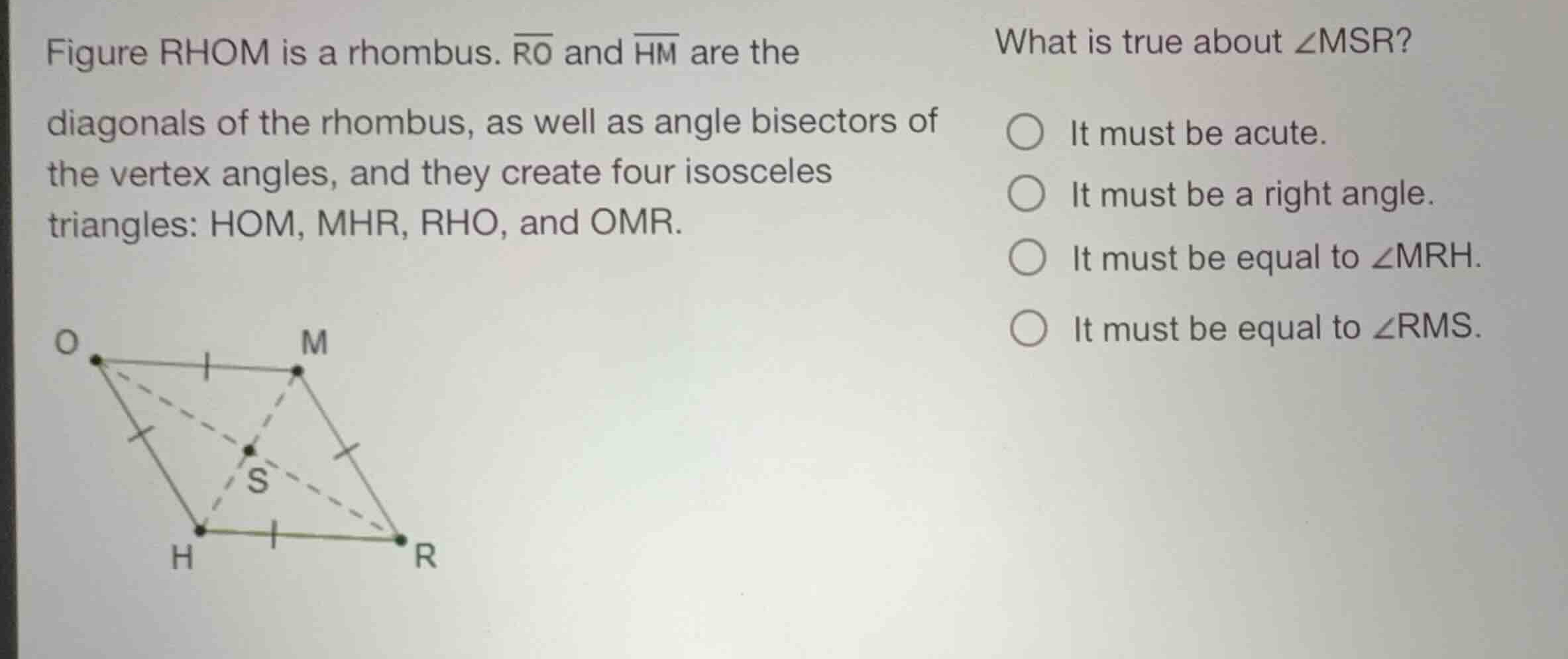
figure rhom is a rhombus. \\(\overline{ro}\\) and \\(\overline{hm}\\) are the diagonals of the rhombus, as well as angle bisectors of the vertex angles, and they create four isosceles triangles: hom, mhr, rho, and omr.
what is true about \\(\angle msr\\)?
it must be acute.
it must be a right angle.
it must be equal to \\(\angle mrh\\).
it must be equal to \\(\angle rms\\).
Identify the geometric properties of the figure
The problem states that figure \(RHOM\) is a rhombus. We are given that \(\overline{RO}\) and \(\overline{HM}\) are the diagonals of this rhombus, intersecting at point \(S\). We need to determine what is true about \(\angle MSR\).
Apply properties of rhombus diagonals
Using the Geometric Figures knowledge point, we recall the key properties of a rhombus. A fundamental theorem of Euclidean geometry states that the diagonals of a rhombus are perpendicular to each other.
Determine the measure of the angle
Since the diagonals \(\overline{RO}\) and \(\overline{HM}\) are perpendicular, they intersect to form four right angles at their intersection point \(S\). Therefore, the angle \(\angle MSR\), which is formed by the intersection of these diagonals, must measure exactly \(90^\circ\).
Evaluate the given options
- "It must be acute": Incorrect, as it is exactly \(90^\circ\).
- "It must be a right angle": Correct, because perpendicular lines form right angles.
- "It must be equal to \(\angle MRH\)": Incorrect, as \(\angle MRH\) is a vertex angle of the rhombus and is not necessarily \(90^\circ\).
- "It must be equal to \(\angle RMS\)": Incorrect, as \(\angle RMS\) is an angle within one of the smaller triangles and is not necessarily \(90^\circ\).

Snap & solve any problem in the app
Get step-by-step solutions on Sovi AI
Photo-based solutions with guided steps
Explore more problems and detailed explanations
- It must be acute.
- It must be a right angle. (Correct answer)
- It must be equal to \(\angle MRH\).
- It must be equal to \(\angle RMS\).