QUESTION IMAGE
Question
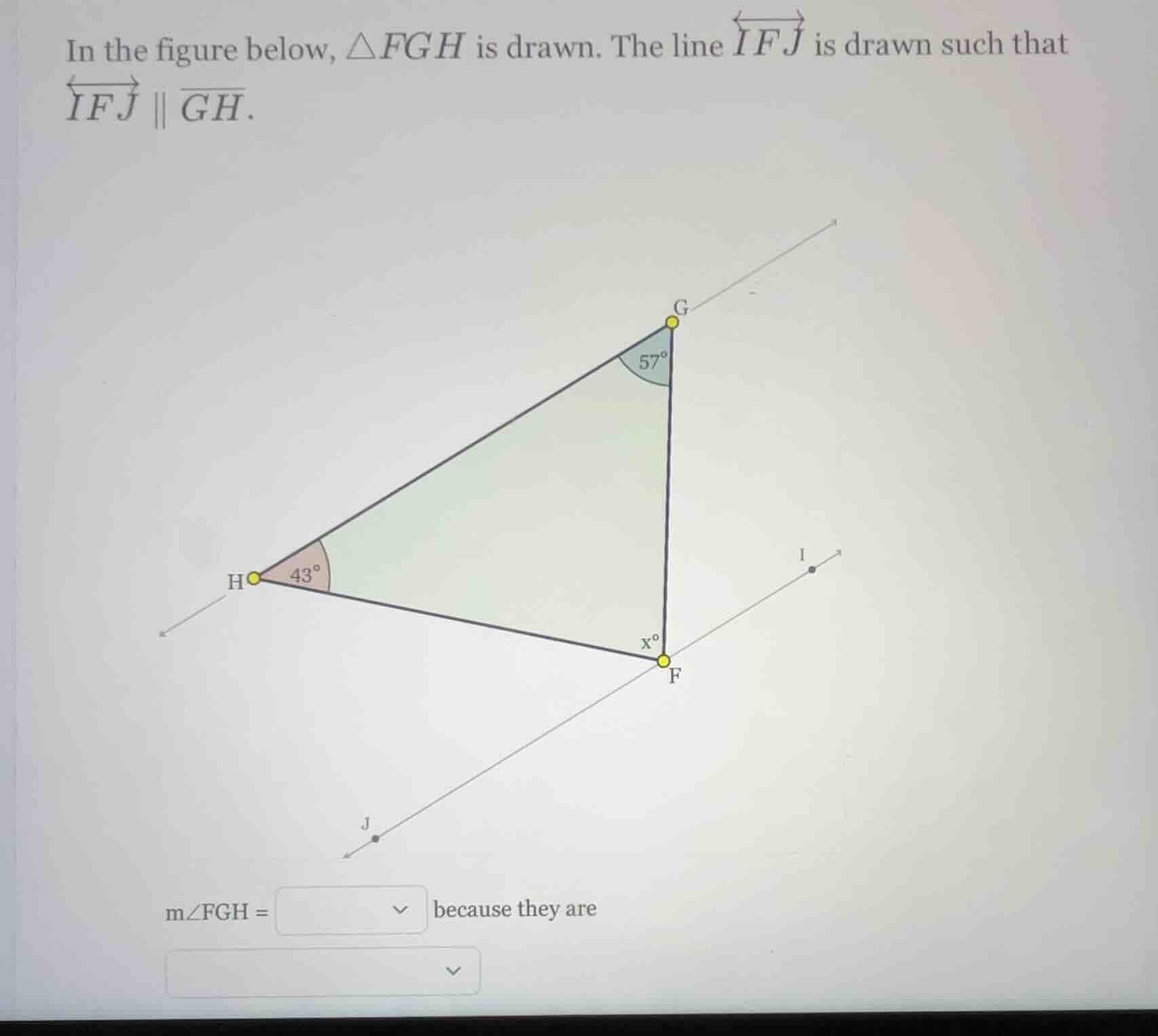
in the figure below, $\triangle fgh$ is drawn. the line $\overleftrightarrow{ifj}$ is drawn such that $\overleftrightarrow{ifj} \parallel \overline{gh}$.
$\text{m}\angle fgh = \quad$ because they are
Step1: Find the third angle in triangle FGH
The sum of angles in a triangle is \( 180^\circ \). In \( \triangle FGH \), we know \( \angle FGH = 57^\circ \) and \( \angle FHG = 43^\circ \). Let \( \angle GFH = y \). Then:
$$
y + 57^\circ + 43^\circ = 180^\circ
$$
$$
y + 100^\circ = 180^\circ
$$
$$
y = 180^\circ - 100^\circ = 80^\circ
$$
Step2: Use the property of parallel lines (supplementary angles)
Since \( \overleftrightarrow{IFJ} \parallel \overline{GH} \), \( \angle GFH \) and \( x^\circ \) are supplementary (they form a linear pair). So:
$$
x + y = 180^\circ
$$
We know \( y = 80^\circ \), so:
$$
x + 80^\circ = 180^\circ
$$
$$
x = 180^\circ - 80^\circ = 100^\circ
$$

Snap & solve any problem in the app
Get step-by-step solutions on Sovi AI
Photo-based solutions with guided steps
Explore more problems and detailed explanations
\( x = 100 \)