QUESTION IMAGE
Question
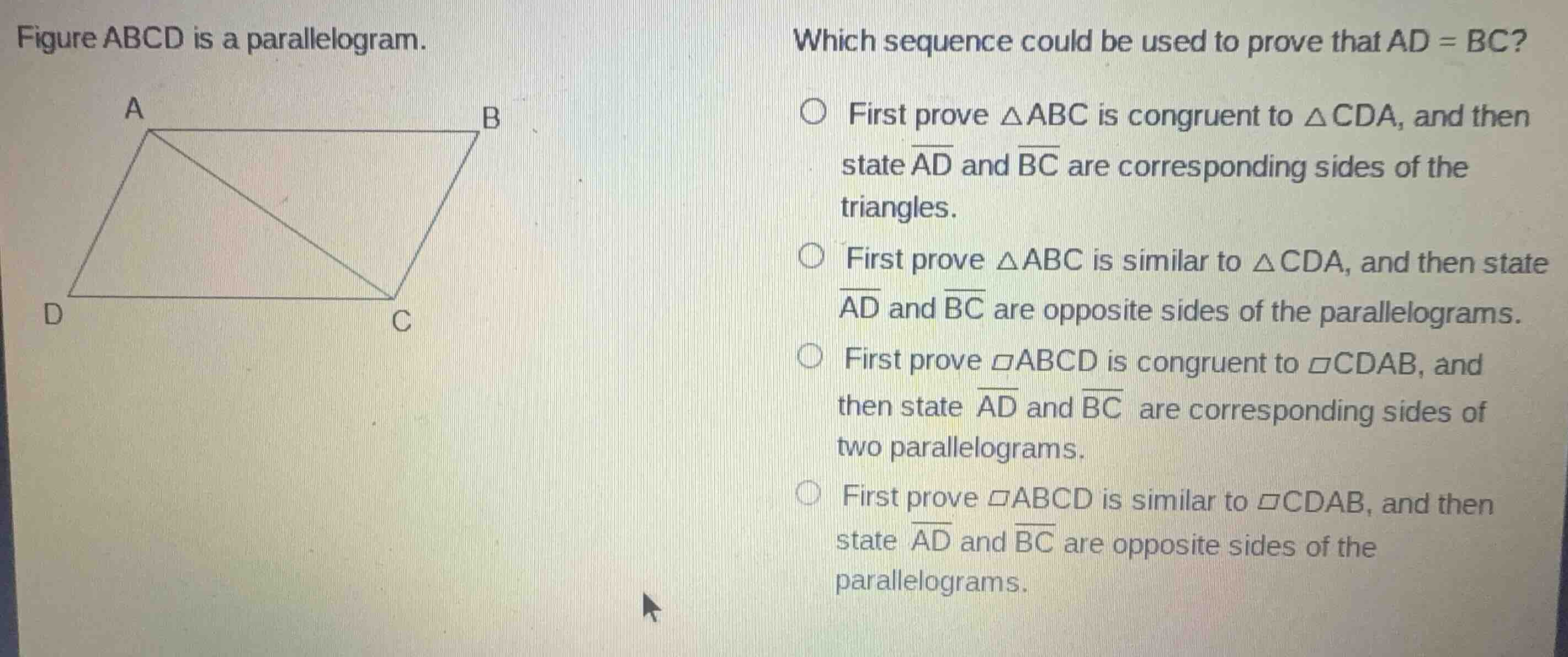
figure abcd is a parallelogram.
which sequence could be used to prove that ad = bc?
first prove \\(\delta abc\\) is congruent to \\(\delta cda\\), and then state \\(\overline{ad}\\) and \\(\overline{bc}\\) are corresponding sides of the triangles.
first prove \\(\delta abc\\) is similar to \\(\delta cda\\), and then state \\(\overline{ad}\\) and \\(\overline{bc}\\) are opposite sides of the parallelograms.
first prove \\(\square abcd\\) is congruent to \\(\square cdab\\), and then state \\(\overline{ad}\\) and \\(\overline{bc}\\) are corresponding sides of two parallelograms.
first prove \\(\square abcd\\) is similar to \\(\square cdab\\), and then state \\(\overline{ad}\\) and \\(\overline{bc}\\) are opposite sides of the parallelograms.
<pre_analysis>
{
"quality": "clear",
"question_count": 1,
"skills_matched": [
"direct_cot",
"multiple_choice_formatter",
"explain_then_answer",
"tutor"
],
"needs_drawing": false,
"concepts_used": [
"Parallelogram Angle Properties"
],
"new_concepts": [
"Triangle Congruence Proofs",
"CPCTC",
"Properties of Parallelograms"
],
"current_concepts": [
"Parallelogram Angle Properties",
"Triangle Congruence Proofs",
"CPCTC",
"Properties of Parallelograms"
]
}
</pre_analysis>
<reasoning>
Identify the goal of the proof
The objective is to prove that the opposite sides of parallelogram \(ABCD\) are equal, specifically that \(AD = BC\). We are given a diagonal \(AC\) that splits the parallelogram into two triangles: \(\triangle ABC\) and \(\triangle CDA\).
Analyze the geometric properties
Using Parallelogram Angle Properties, we know that opposite sides of a parallelogram are parallel (\(AB \parallel CD\) and \(AD \parallel BC\)).
- The diagonal \(AC\) acts as a transversal line intersecting these parallel lines.
- This creates congruent alternate interior angles: \(\angle BAC \cong \angle DCA\) and \(\angle BCA \cong \angle DAC\).
- The diagonal \(AC\) is shared by both triangles (\(AC \cong CA\) by the reflexive property).
Establish triangle congruence
By the Angle-Side-Angle (ASA) congruence postulate, we can prove that:
\[
\triangle ABC \cong \triangle CDA
\]
This shows that the two triangles formed by the diagonal are congruent.
Apply corresponding parts of congruent triangles
Once we establish that \(\triangle ABC \cong \triangle CDA\), we can conclude that their corresponding parts are congruent (CPCTC).
- The side \(\overline{AD}\) in \(\triangle CDA\) corresponds to the side \(\overline{CB}\) (or \(\overline{BC}\)) in \(\triangle ABC\).
- Therefore, \(AD = BC\) because they are corresponding sides of the congruent triangles.
Evaluate the given options
- Option 1: "First prove \(\triangle ABC\) is congruent to \(\triangle CDA\), and then state \(\overline{AD}\) and \(\overline{BC}\) are corresponding sides of the triangles." This matches our logical sequence perfectly.
- Option 2: Mentions similarity, which is not sufficient to prove that side lengths are equal (only proportional).
- Option 3 & 4: Mention proving congruence or similarity of the entire parallelograms to themselves, which does not directly use the triangle decomposition shown in the figure to prove the side equality.
</reasoning>
<answer>
<mcq-correct>(A) First prove \(\triangle ABC\) is congruent to \(\triangle CDA\), and then state \(\overline{AD}\) and \(\overline{BC}\) are corresponding sides of the triangles.</mcq-correct>
<mcq-option>(B) First prove \(\triangle ABC\) is similar to \(\triangle CDA\), and then state \(\overline{AD}\) and \(\overline{BC}\) are opposite sides of the parallelograms.</mcq-option>
<mcq-option>(C) First prove \(\square ABCD\) is congruent to \(\square CDAB\), and then state \(\overline{AD}\) and \(\overline{BC}\) are corresponding sides of two parallelograms.</mcq-option>
<mcq-option>(D) First prove \(\square ABCD\) is similar to \(\square CDAB\), and then state \(\overline{AD}\) and \(\overline{BC}\) are opposite sides of the parallelograms.</mcq-option>
</answer>
<post_analysis>
{
"subject": "Mathematics",
"question_type": "Multiple Choice",
"knowledge_point": [
"Mathematics",
"Geometry",
"Triangle Congruence Proofs"
]
}
</post_analysis>
Snap & solve any problem in the app
Get step-by-step solutions on Sovi AI
Photo-based solutions with guided steps
Explore more problems and detailed explanations
<pre_analysis>
{
"quality": "clear",
"question_count": 1,
"skills_matched": [
"direct_cot",
"multiple_choice_formatter",
"explain_then_answer",
"tutor"
],
"needs_drawing": false,
"concepts_used": [
"Parallelogram Angle Properties"
],
"new_concepts": [
"Triangle Congruence Proofs",
"CPCTC",
"Properties of Parallelograms"
],
"current_concepts": [
"Parallelogram Angle Properties",
"Triangle Congruence Proofs",
"CPCTC",
"Properties of Parallelograms"
]
}
</pre_analysis>
<reasoning>
Identify the goal of the proof
The objective is to prove that the opposite sides of parallelogram \(ABCD\) are equal, specifically that \(AD = BC\). We are given a diagonal \(AC\) that splits the parallelogram into two triangles: \(\triangle ABC\) and \(\triangle CDA\).
Analyze the geometric properties
Using Parallelogram Angle Properties, we know that opposite sides of a parallelogram are parallel (\(AB \parallel CD\) and \(AD \parallel BC\)).
- The diagonal \(AC\) acts as a transversal line intersecting these parallel lines.
- This creates congruent alternate interior angles: \(\angle BAC \cong \angle DCA\) and \(\angle BCA \cong \angle DAC\).
- The diagonal \(AC\) is shared by both triangles (\(AC \cong CA\) by the reflexive property).
Establish triangle congruence
By the Angle-Side-Angle (ASA) congruence postulate, we can prove that:
\[
\triangle ABC \cong \triangle CDA
\]
This shows that the two triangles formed by the diagonal are congruent.
Apply corresponding parts of congruent triangles
Once we establish that \(\triangle ABC \cong \triangle CDA\), we can conclude that their corresponding parts are congruent (CPCTC).
- The side \(\overline{AD}\) in \(\triangle CDA\) corresponds to the side \(\overline{CB}\) (or \(\overline{BC}\)) in \(\triangle ABC\).
- Therefore, \(AD = BC\) because they are corresponding sides of the congruent triangles.
Evaluate the given options
- Option 1: "First prove \(\triangle ABC\) is congruent to \(\triangle CDA\), and then state \(\overline{AD}\) and \(\overline{BC}\) are corresponding sides of the triangles." This matches our logical sequence perfectly.
- Option 2: Mentions similarity, which is not sufficient to prove that side lengths are equal (only proportional).
- Option 3 & 4: Mention proving congruence or similarity of the entire parallelograms to themselves, which does not directly use the triangle decomposition shown in the figure to prove the side equality.
</reasoning>
<answer>
<mcq-correct>(A) First prove \(\triangle ABC\) is congruent to \(\triangle CDA\), and then state \(\overline{AD}\) and \(\overline{BC}\) are corresponding sides of the triangles.</mcq-correct>
<mcq-option>(B) First prove \(\triangle ABC\) is similar to \(\triangle CDA\), and then state \(\overline{AD}\) and \(\overline{BC}\) are opposite sides of the parallelograms.</mcq-option>
<mcq-option>(C) First prove \(\square ABCD\) is congruent to \(\square CDAB\), and then state \(\overline{AD}\) and \(\overline{BC}\) are corresponding sides of two parallelograms.</mcq-option>
<mcq-option>(D) First prove \(\square ABCD\) is similar to \(\square CDAB\), and then state \(\overline{AD}\) and \(\overline{BC}\) are opposite sides of the parallelograms.</mcq-option>
</answer>
<post_analysis>
{
"subject": "Mathematics",
"question_type": "Multiple Choice",
"knowledge_point": [
"Mathematics",
"Geometry",
"Triangle Congruence Proofs"
]
}
</post_analysis>