QUESTION IMAGE
Question
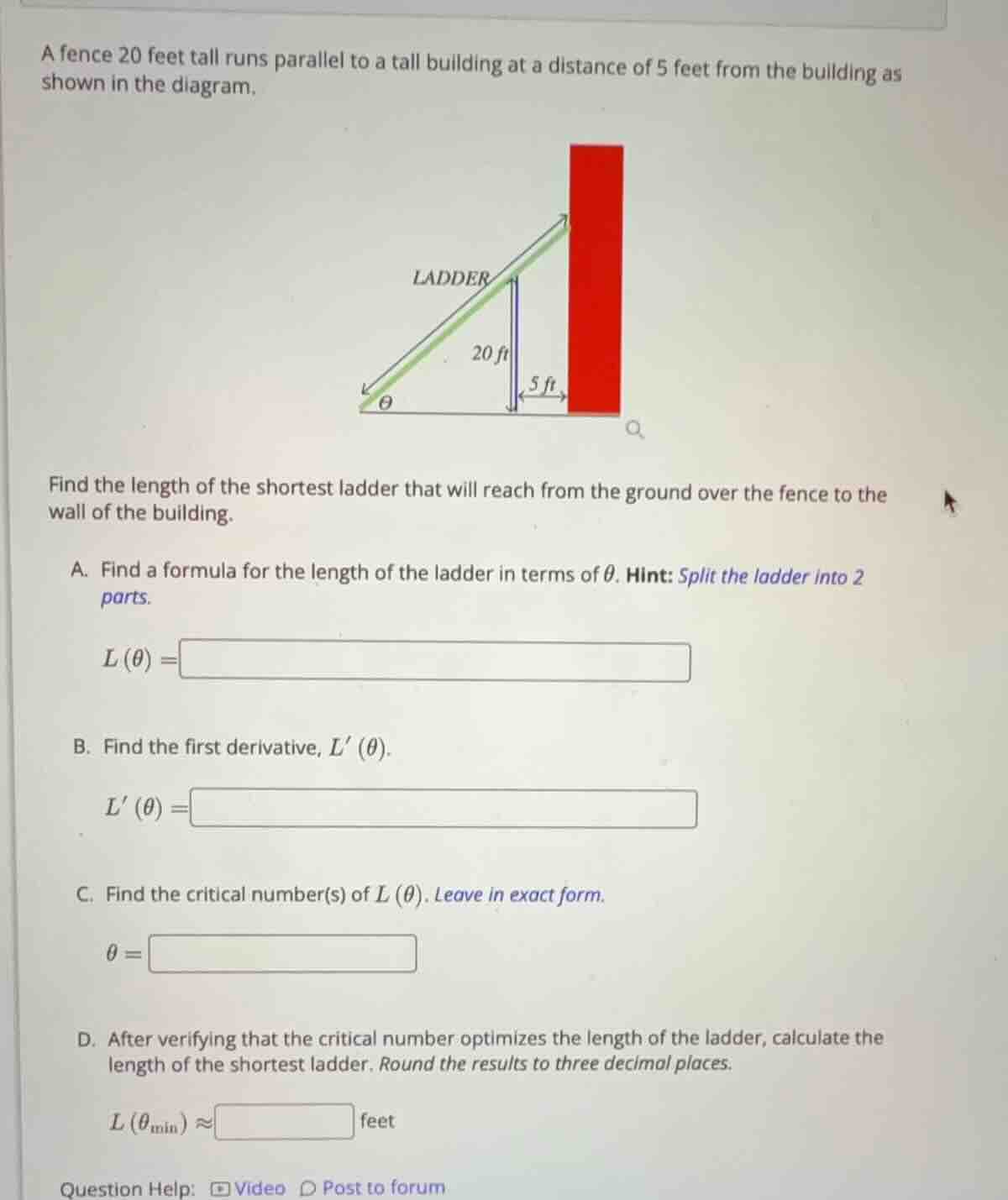
a fence 20 feet tall runs parallel to a tall building at a distance of 5 feet from the building as shown in the diagram.
find the length of the shortest ladder that will reach from the ground over the fence to the wall of the building.
a. find a formula for the length of the ladder in terms of \\(\theta\\). hint: split the ladder into 2 parts.
\\(l(\theta) =\\)
b. find the first derivative, \\(l(\theta)\\).
\\(l(\theta) =\\)
c. find the critical number(s) of \\(l(\theta)\\). leave in exact form.
\\(\theta =\\)
d. after verifying that the critical number optimizes the length of the ladder, calculate the length of the shortest ladder. round the results to three decimal places.
\\(l(\theta_{\min}) \approx\\) feet
Express the ladder length \(L(\theta)\)
Compute the first derivative \(L'(\theta)\)
Find the critical number \(\theta\)
Calculate the minimum length \(L(\theta_{\min})\)

Snap & solve any problem in the app
Get step-by-step solutions on Sovi AI
Photo-based solutions with guided steps
Explore more problems and detailed explanations
Question A
A. Find a formula for the length of the ladder in terms of \(\theta\). Hint: Split the ladder into 2 parts.
\(L(\theta) =\) <blank>\(20\csc\theta + 5\sec\theta\)</blank>
Question B
B. Find the first derivative, \(L'(\theta)\).
\(L'(\theta) =\) <blank>\(-20\csc\theta\cot\theta + 5\sec\theta\tan\theta\)</blank>
Question C
C. Find the critical number(s) of \(L(\theta)\). Leave in exact form.
\(\theta =\) <blank>\(\arctan(\sqrt[3]{4})\)</blank>
Question D
D. After verifying that the critical number optimizes the length of the ladder, calculate the length of the shortest ladder. Round the results to three decimal places.
\(L(\theta_{\min}) \approx\) <blank>\(33.004\)</blank> feet