QUESTION IMAGE
Question
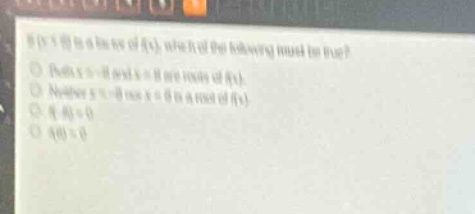
if \\((x + 8)\\) is a factor of \\(f(x)\\), which of the following must be true?
- both \\(x = -8\\) and \\(x = 8\\) are roots of \\(f(x)\\).
- neither \\(x = -8\\) nor \\(x = 8\\) is a root of \\(f(x)\\).
- \\(f(-8) = 0\\)
- \\(f(8) = 0\\)
🆕 New Concept Discovered: Polynomial Factor Theorem
Connecting factors of a polynomial to its zeros.
Step 1: Understand the Factor Theorem
The Factor Theorem states that a polynomial \( f(x) \) has a factor \( (x - c) \) if and only if:
This means that if we plug the value \( c \) into the function, the output is zero, making \( x = c \) a root (or zero) of the polynomial.
Step 2: Apply the theorem to the given factor
The problem states that \( (x + 8) \) is a factor of \( f(x) \).
We can rewrite the factor \( (x + 8) \) in the standard form \( (x - c) \):
Here, \( c = -8 \).
Step 3: Determine the correct statement
Applying the Factor Theorem with \( c = -8 \):
This means that \( x = -8 \) is a root of \( f(x) \). Looking at the given choices:
- "Both \( x = -8 \) and \( x = 8 \) are roots of \( f(x) \)" is not necessarily true.
- "Neither \( x = -8 \) nor \( x = 8 \) is a root of \( f(x) \)" is false because \( x = -8 \) must be a root.
- "\( f(-8) = 0 \)" must be true.
- "\( f(8) = 0 \)" is not necessarily true.

Snap & solve any problem in the app
Get step-by-step solutions on Sovi AI
Photo-based solutions with guided steps
Explore more problems and detailed explanations
\( f(-8) = 0 \)