QUESTION IMAGE
Question
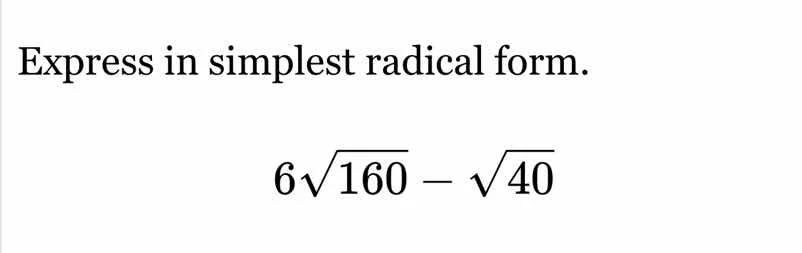
express in simplest radical form.
$6\sqrt{160} - \sqrt{40}$
Step1: Simplify each radical
First, factor the radicands (the numbers inside the square roots) into perfect squares and other factors.
For $\sqrt{160}$, we can factor 160 as $16 \times 10$, where 16 is a perfect square. So, $\sqrt{160} = \sqrt{16 \times 10} = \sqrt{16} \times \sqrt{10} = 4\sqrt{10}$.
For $\sqrt{40}$, we factor 40 as $4 \times 10$, where 4 is a perfect square. So, $\sqrt{40} = \sqrt{4 \times 10} = \sqrt{4} \times \sqrt{10} = 2\sqrt{10}$.
Step2: Substitute the simplified radicals back into the original expression
Now, substitute these simplified forms back into $6\sqrt{160} - \sqrt{40}$.
We have $6 \times 4\sqrt{10} - 2\sqrt{10}$.
Step3: Perform the multiplication and then combine like terms
First, multiply 6 and 4: $6 \times 4\sqrt{10} = 24\sqrt{10}$.
Now, the expression becomes $24\sqrt{10} - 2\sqrt{10}$.
Since both terms have $\sqrt{10}$, we can combine them by subtracting the coefficients: $(24 - 2)\sqrt{10} = 22\sqrt{10}$.

Snap & solve any problem in the app
Get step-by-step solutions on Sovi AI
Photo-based solutions with guided steps
Explore more problems and detailed explanations
$22\sqrt{10}$