QUESTION IMAGE
Question
explaining how to write the explicit rule for an arithmetic sequence
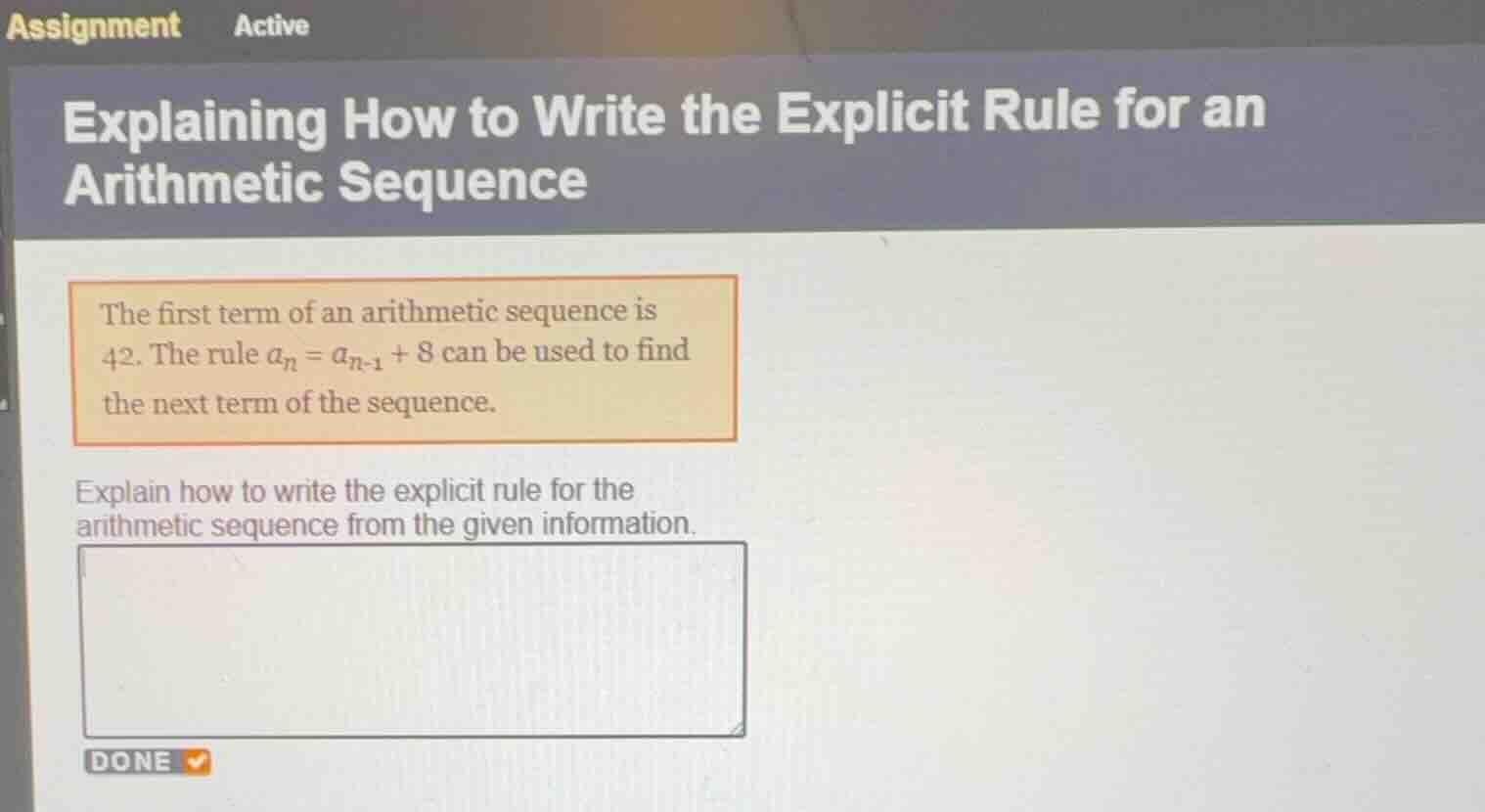
the first term of an arithmetic sequence is 42. the rule \\(a_n = a_{n-1} + 8\\) can be used to find the next term of the sequence.
explain how to write the explicit rule for the arithmetic sequence from the given information.
Identify the first term and common difference
Using the Arithmetic Sequences and Recursive Formulas knowledge points
$$
LATEXBLOCK0
$$
State the general explicit formula
Using the Arithmetic Sequences knowledge point
$$
a_n = a_1 + (n - 1)d
$$
Substitute the known values
Using the Arithmetic Sequences knowledge point
$$
a_n = 42 + (n - 1)8
$$
Simplify the explicit rule
Using the Algebraic Simplification knowledge point
$$
LATEXBLOCK1
$$

Snap & solve any problem in the app
Get step-by-step solutions on Sovi AI
Photo-based solutions with guided steps
Explore more problems and detailed explanations
To write the explicit rule for the arithmetic sequence, follow these steps:
- Identify the first term (\(a_1\)) and the common difference (\(d\)): From the given information, the first term is \(a_1 = 42\). The recursive rule \(a_n = a_{n-1} + 8\) shows that each term is found by adding \(8\) to the previous term, so the common difference is \(d = 8\).
- Use the general explicit formula: The general formula for an arithmetic sequence is \(a_n = a_1 + (n - 1)d\).
- Substitute the values: Replace \(a_1\) with \(42\) and \(d\) with \(8\) to get \(a_n = 42 + (n - 1)8\).
- Simplify the expression: Distribute the \(8\) and combine like terms to get the simplified explicit rule:
$$a_n = 8n + 34$$