QUESTION IMAGE
Question
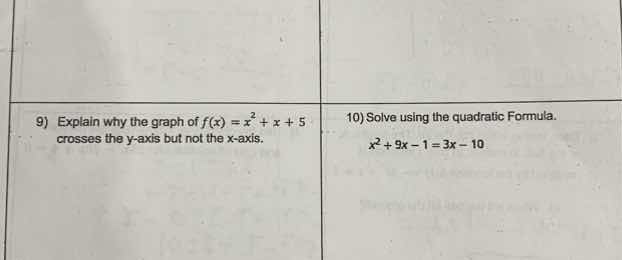
- explain why the graph of $f(x) = x^2 + x + 5$ crosses the y - axis but not the x - axis.
- solve using the quadratic formula.
$x^2 + 9x - 1 = 3x - 10$
Problem 9
Step 1: Find y - intercept
To find the y - intercept, set \(x = 0\) in the function \(f(x)=x^{2}+x + 5\).
\(f(0)=0^{2}+0 + 5=5\). So the graph intersects the y - axis at \((0,5)\) because when \(x = 0\), we get a valid \(y\) - value.
Step 2: Check x - intercepts
To find the x - intercepts, set \(y=f(x)=0\), so we solve the equation \(x^{2}+x + 5=0\). For a quadratic equation \(ax^{2}+bx + c = 0\) (\(a = 1\), \(b = 1\), \(c = 5\)), the discriminant is given by \(\Delta=b^{2}-4ac\).
\(\Delta=(1)^{2}-4\times1\times5=1 - 20=- 19\). Since \(\Delta<0\), the quadratic equation \(x^{2}+x + 5 = 0\) has no real roots. This means the graph of the function does not intersect the x - axis.
Step 1: Rewrite the equation in standard form
Start with \(x^{2}+9x - 1=3x - 10\). Subtract \(3x\) and add \(10\) to both sides to get \(x^{2}+9x-3x - 1 + 10=0\), which simplifies to \(x^{2}+6x + 9 = 0\). Here, \(a = 1\), \(b = 6\), \(c = 9\).
Step 2: Apply the quadratic formula
The quadratic formula is \(x=\frac{-b\pm\sqrt{b^{2}-4ac}}{2a}\). Substitute \(a = 1\), \(b = 6\), \(c = 9\) into the formula.
First, calculate the discriminant \(\Delta=b^{2}-4ac=(6)^{2}-4\times1\times9=36 - 36 = 0\).
Then, \(x=\frac{-6\pm\sqrt{0}}{2\times1}=\frac{-6\pm0}{2}\).
Step 3: Solve for x
\(x=\frac{-6 + 0}{2}=\frac{-6}{2}=-3\) and \(x=\frac{-6-0}{2}=\frac{-6}{2}=-3\). So we have a repeated root.

Snap & solve any problem in the app
Get step-by-step solutions on Sovi AI
Photo-based solutions with guided steps
Explore more problems and detailed explanations
The graph crosses the y - axis because when \(x = 0\), \(f(0)=5\) (so the point \((0,5)\) is on the graph). For the x - axis, solving \(x^{2}+x + 5 = 0\) gives a discriminant \(\Delta=-19<0\), so there are no real x - intercepts, meaning the graph does not cross the x - axis.