QUESTION IMAGE
Question
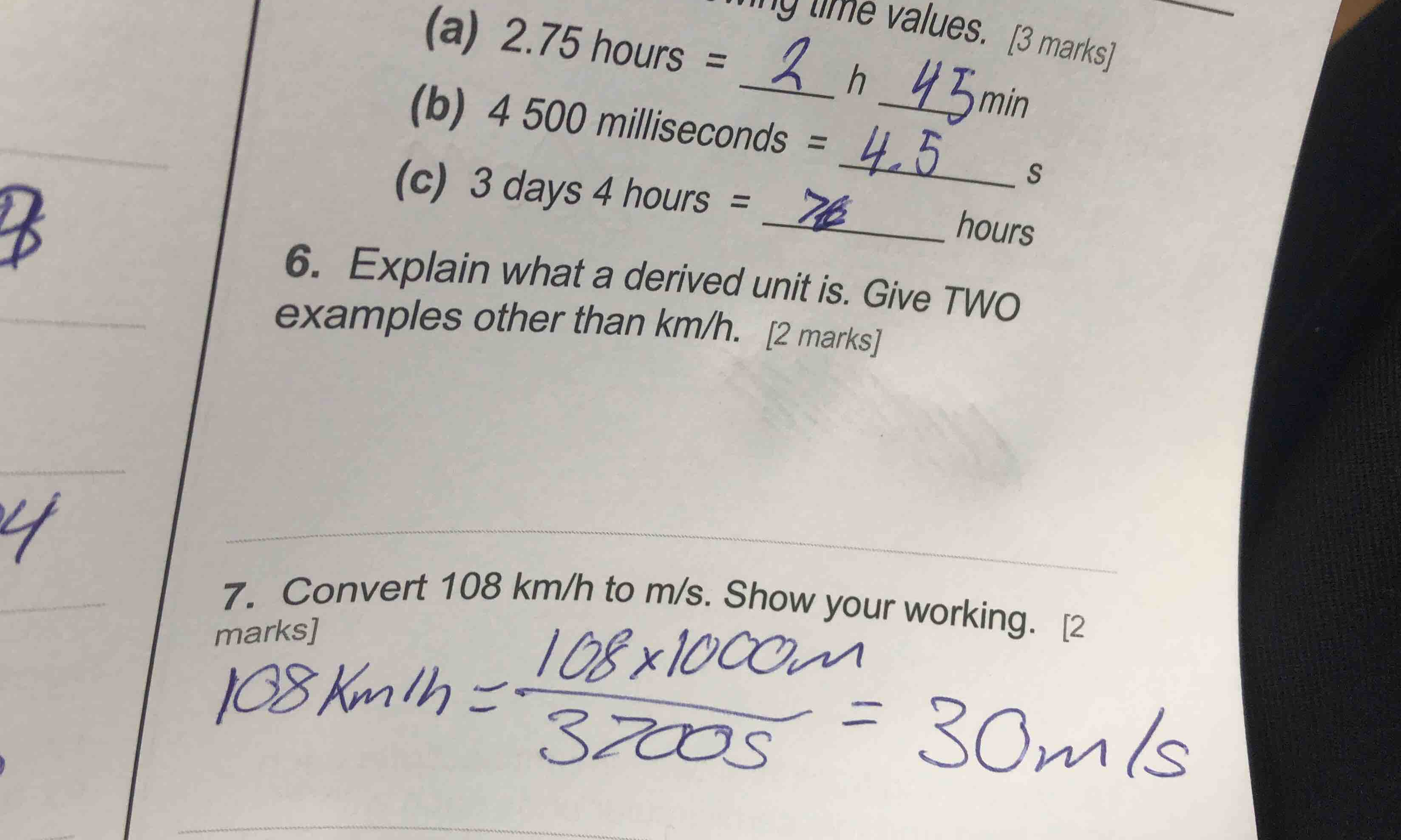
- explain what a derived unit is. give two examples other than km/h. 2 marks
- convert 108 km/h to m/s. show your working. 2 marks
<pre_analysis>
{
"quality": "clear",
"question_count": 3,
"skills_matched": [
"step_cot",
"explain_then_answer",
"tutor"
],
"needs_drawing": false,
"concepts_used": [
"Metric Conversion",
"Derived Units",
"Unit Conversion Rates"
],
"new_concepts": [],
"current_concepts": [
"Metric Conversion",
"Derived Units",
"Unit Conversion Rates"
]
}
</pre_analysis>
<reasoning>
Convert the time values
Using the Metric Conversion and Unit Conversion Rates knowledge points:
- For part (a):
Convert \(2.75\text{ hours}\) to hours and minutes.
The whole number of hours is \(2\text{ h}\).
Convert the remaining \(0.75\text{ hours}\) to minutes:
\[0.75 \times 60\text{ min/h} = 45\text{ min}\]
So, \(2.75\text{ hours} = 2\text{ h } 45\text{ min}\).
- For part (b):
Convert \(4500\text{ milliseconds}\) to seconds.
Since \(1\text{ second} = 1000\text{ milliseconds}\):
\[\frac{4500}{1000} = 4.5\text{ s}\]
- For part (c):
Convert \(3\text{ days } 4\text{ hours}\) to hours.
Since \(1\text{ day} = 24\text{ hours}\):
\[3 \times 24\text{ hours} + 4\text{ hours} = 72 + 4 = 76\text{ hours}\]
Define derived units and provide examples
Using the Derived Units knowledge point:
- Definition:
A derived unit is a unit of measurement obtained by combining one or more base units through multiplication or division.
- Examples:
Two common examples other than \(\text{km/h}\) are:
- Meters per second (\(\text{m/s}\)) for speed.
- Grams per cubic centimeter (\(\text{g/cm}^3\)) or kilograms per cubic meter (\(\text{kg/m}^3\)) for density.
Convert speed units
Using the Unit Conversion Rates knowledge point:
- Convert \(108\text{ km/h}\) to \(\text{m/s}\).
Convert kilometers to meters:
\[108\text{ km} = 108 \times 1000\text{ m} = 108,000\text{ m}\]
Convert hours to seconds:
\[1\text{ h} = 3600\text{ s}\]
Calculate the speed in \(\text{m/s}\):
\[\frac{108,000\text{ m}}{3600\text{ s}} = 30\text{ m/s}\]
</reasoning>
<answer>
Question 5
(a) \(2.75\text{ hours} = 2\text{ h } 45\text{ min}\)
(b) \(4500\text{ milliseconds} = 4.5\text{ s}\)
(c) \(3\text{ days } 4\text{ hours} = 76\text{ hours}\)
Question 6
- Definition: A derived unit is a unit of measurement formed by combining base units (such as meters, kilograms, or seconds) using multiplication or division.
- Examples:
- Meters per second (\(\text{m/s}\))
- Kilograms per cubic meter (\(\text{kg/m}^3\))
Question 7
\[108\text{ km/h} = \frac{108 \times 1000\text{ m}}{3600\text{ s}} = 30\text{ m/s}\]
</answer>
<post_analysis>
{
"subject": "Natural Science",
"question_type": "Multi-part",
"knowledge_point": [
"Natural Science",
"Physics",
"Units and Measurements"
]
}
</post_analysis>
Snap & solve any problem in the app
Get step-by-step solutions on Sovi AI
Photo-based solutions with guided steps
Explore more problems and detailed explanations
<pre_analysis>
{
"quality": "clear",
"question_count": 3,
"skills_matched": [
"step_cot",
"explain_then_answer",
"tutor"
],
"needs_drawing": false,
"concepts_used": [
"Metric Conversion",
"Derived Units",
"Unit Conversion Rates"
],
"new_concepts": [],
"current_concepts": [
"Metric Conversion",
"Derived Units",
"Unit Conversion Rates"
]
}
</pre_analysis>
<reasoning>
Convert the time values
Using the Metric Conversion and Unit Conversion Rates knowledge points:
- For part (a):
Convert \(2.75\text{ hours}\) to hours and minutes.
The whole number of hours is \(2\text{ h}\).
Convert the remaining \(0.75\text{ hours}\) to minutes:
\[0.75 \times 60\text{ min/h} = 45\text{ min}\]
So, \(2.75\text{ hours} = 2\text{ h } 45\text{ min}\).
- For part (b):
Convert \(4500\text{ milliseconds}\) to seconds.
Since \(1\text{ second} = 1000\text{ milliseconds}\):
\[\frac{4500}{1000} = 4.5\text{ s}\]
- For part (c):
Convert \(3\text{ days } 4\text{ hours}\) to hours.
Since \(1\text{ day} = 24\text{ hours}\):
\[3 \times 24\text{ hours} + 4\text{ hours} = 72 + 4 = 76\text{ hours}\]
Define derived units and provide examples
Using the Derived Units knowledge point:
- Definition:
A derived unit is a unit of measurement obtained by combining one or more base units through multiplication or division.
- Examples:
Two common examples other than \(\text{km/h}\) are:
- Meters per second (\(\text{m/s}\)) for speed.
- Grams per cubic centimeter (\(\text{g/cm}^3\)) or kilograms per cubic meter (\(\text{kg/m}^3\)) for density.
Convert speed units
Using the Unit Conversion Rates knowledge point:
- Convert \(108\text{ km/h}\) to \(\text{m/s}\).
Convert kilometers to meters:
\[108\text{ km} = 108 \times 1000\text{ m} = 108,000\text{ m}\]
Convert hours to seconds:
\[1\text{ h} = 3600\text{ s}\]
Calculate the speed in \(\text{m/s}\):
\[\frac{108,000\text{ m}}{3600\text{ s}} = 30\text{ m/s}\]
</reasoning>
<answer>
Question 5
(a) \(2.75\text{ hours} = 2\text{ h } 45\text{ min}\)
(b) \(4500\text{ milliseconds} = 4.5\text{ s}\)
(c) \(3\text{ days } 4\text{ hours} = 76\text{ hours}\)
Question 6
- Definition: A derived unit is a unit of measurement formed by combining base units (such as meters, kilograms, or seconds) using multiplication or division.
- Examples:
- Meters per second (\(\text{m/s}\))
- Kilograms per cubic meter (\(\text{kg/m}^3\))
Question 7
\[108\text{ km/h} = \frac{108 \times 1000\text{ m}}{3600\text{ s}} = 30\text{ m/s}\]
</answer>
<post_analysis>
{
"subject": "Natural Science",
"question_type": "Multi-part",
"knowledge_point": [
"Natural Science",
"Physics",
"Units and Measurements"
]
}
</post_analysis>