QUESTION IMAGE
Question
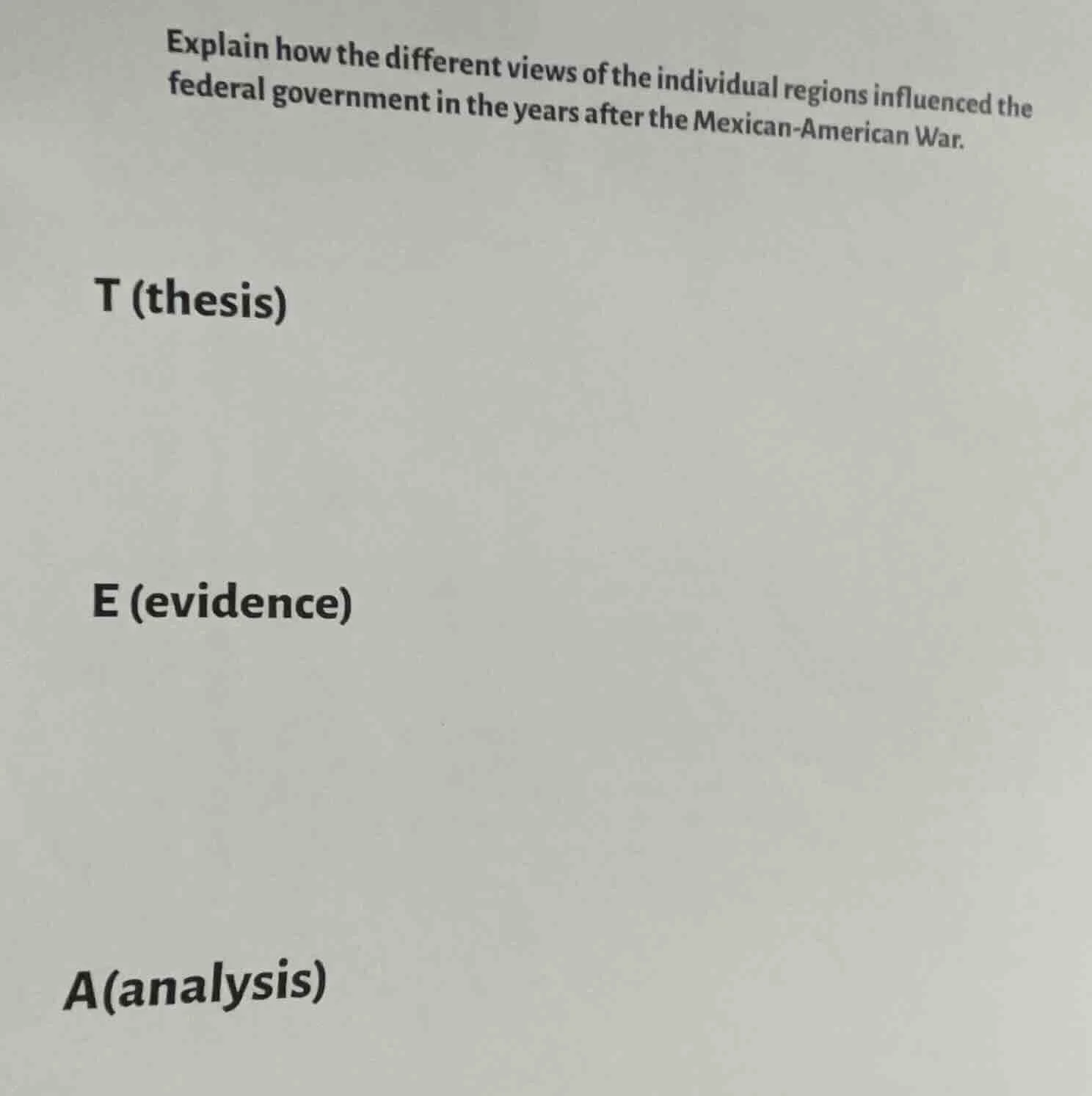
explain how the different views of the individual regions influenced the federal government in the years after the mexican - american war.
t (thesis)
e (evidence)
a(analysis)
T (thesis)
After the Mexican - American War, the differing views of the North, South, and West on issues like slavery and states' rights vis - à - vis the federal government exacerbated sectional tensions, ultimately influencing the federal government's policies and contributing to the growing divide that led to the Civil War.
E (evidence)
- Slavery in New Territories: The North, with its growing industrial base and anti - slavery sentiment (fueled by the Free - Soil movement), wanted the new territories acquired from Mexico (such as California, New Mexico) to be free of slavery. The South, dependent on plantation - based slavery, wanted these territories to either allow slavery or have the issue of slavery decided by popular sovereignty (as seen in the debate over the Wilmot Proviso, which the South opposed). The West, with its diverse economic interests, had a more mixed view but was often caught in the middle of the North - South struggle.
- States' Rights vs. Federal Power: The South emphasized states' rights, believing that states should have the power to decide on issues like slavery within their borders and that the federal government should have limited authority. The North, while also valuing states' rights to an extent, believed that the federal government had a role in regulating slavery in the territories and promoting national economic policies (like tariffs, which the South opposed as they hurt Southern agricultural exports).
- Compromises and Their Failure: The Compromise of 1850 (including the Fugitive Slave Act) was an attempt by the federal government to appease both sides. The North was angered by the Fugitive Slave Act, and the South was dissatisfied with the admission of California as a free state. Later, the Kansas - Nebraska Act (1854) which allowed popular sovereignty in those territories led to violent conflicts (Bleeding Kansas) as pro - and anti - slavery forces clashed, showing the inability of the federal government to find a lasting solution due to regional differences.
A (analysis)
The different regional views created a power struggle within the federal government. The North's push for free territories and a stronger federal role in limiting slavery clashed with the South's desire for slave - holding territories and greater states' rights. The West's position, though less unified, added to the complexity. These conflicting views made it difficult for the federal government to pass coherent policies, as seen in the series of compromises that failed to address the core issues. The growing sectionalism, driven by these regional perspectives, weakened the federal government's ability to maintain national unity and ultimately led to the breakdown of the Union in the Civil War. The federal government's actions, like the Compromise of 1850 and the Kansas - Nebraska Act, were direct responses to these regional pressures, but they only served to highlight the deep - seated differences and the limited ability of the federal government to reconcile them.

Snap & solve any problem in the app
Get step-by-step solutions on Sovi AI
Photo-based solutions with guided steps
Explore more problems and detailed explanations
T (thesis)
After the Mexican - American War, the differing views of the North, South, and West on issues like slavery and states' rights vis - à - vis the federal government exacerbated sectional tensions, ultimately influencing the federal government's policies and contributing to the growing divide that led to the Civil War.
E (evidence)
- Slavery in New Territories: The North, with its growing industrial base and anti - slavery sentiment (fueled by the Free - Soil movement), wanted the new territories acquired from Mexico (such as California, New Mexico) to be free of slavery. The South, dependent on plantation - based slavery, wanted these territories to either allow slavery or have the issue of slavery decided by popular sovereignty (as seen in the debate over the Wilmot Proviso, which the South opposed). The West, with its diverse economic interests, had a more mixed view but was often caught in the middle of the North - South struggle.
- States' Rights vs. Federal Power: The South emphasized states' rights, believing that states should have the power to decide on issues like slavery within their borders and that the federal government should have limited authority. The North, while also valuing states' rights to an extent, believed that the federal government had a role in regulating slavery in the territories and promoting national economic policies (like tariffs, which the South opposed as they hurt Southern agricultural exports).
- Compromises and Their Failure: The Compromise of 1850 (including the Fugitive Slave Act) was an attempt by the federal government to appease both sides. The North was angered by the Fugitive Slave Act, and the South was dissatisfied with the admission of California as a free state. Later, the Kansas - Nebraska Act (1854) which allowed popular sovereignty in those territories led to violent conflicts (Bleeding Kansas) as pro - and anti - slavery forces clashed, showing the inability of the federal government to find a lasting solution due to regional differences.
A (analysis)
The different regional views created a power struggle within the federal government. The North's push for free territories and a stronger federal role in limiting slavery clashed with the South's desire for slave - holding territories and greater states' rights. The West's position, though less unified, added to the complexity. These conflicting views made it difficult for the federal government to pass coherent policies, as seen in the series of compromises that failed to address the core issues. The growing sectionalism, driven by these regional perspectives, weakened the federal government's ability to maintain national unity and ultimately led to the breakdown of the Union in the Civil War. The federal government's actions, like the Compromise of 1850 and the Kansas - Nebraska Act, were direct responses to these regional pressures, but they only served to highlight the deep - seated differences and the limited ability of the federal government to reconcile them.