QUESTION IMAGE
Question
exercises
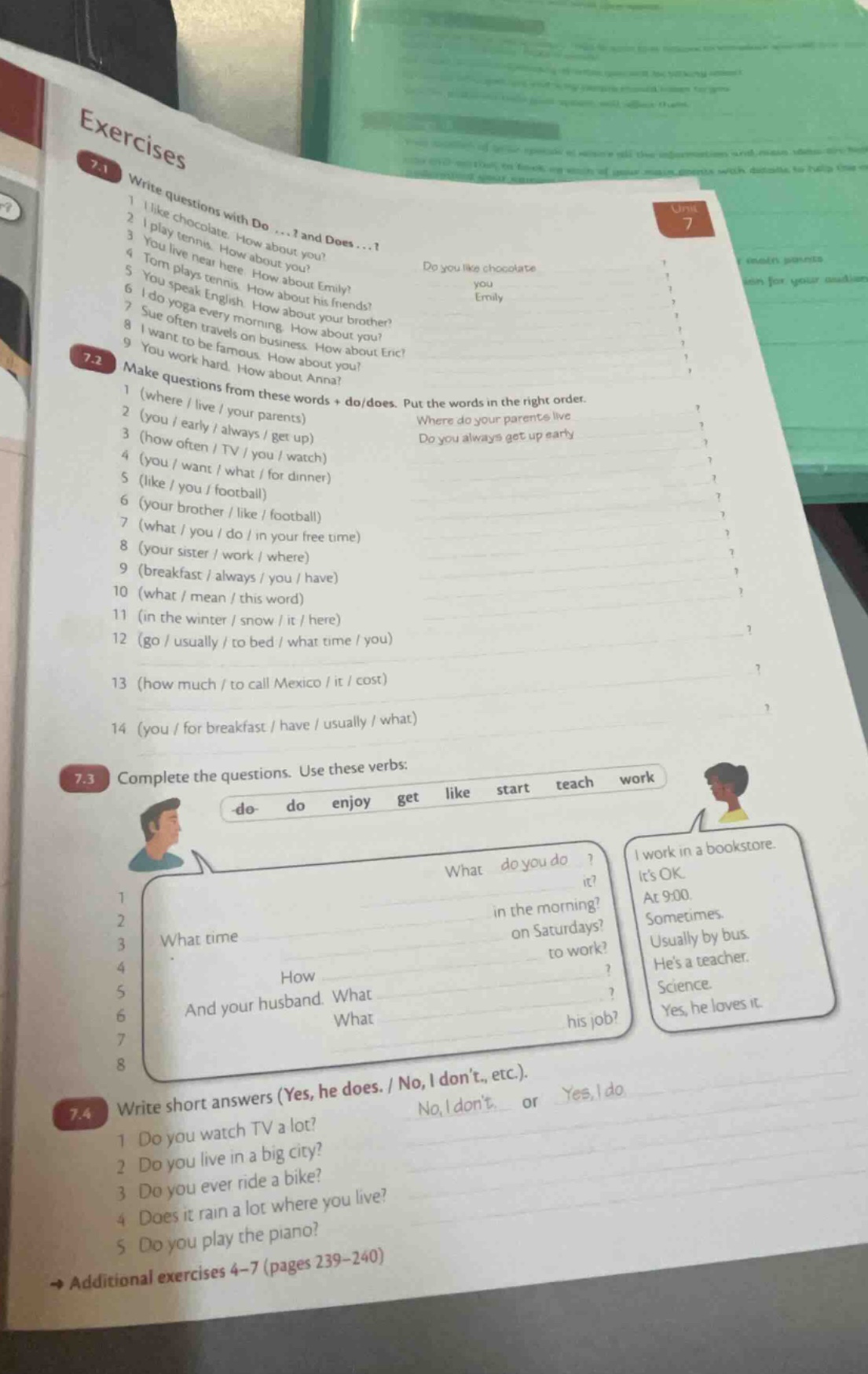
7.1 write questions with do ...? and does ...?
1 i like chocolate. how about you? do you like chocolate?
2 i play tennis. how about you? you?
3 you live near here. how about emily? emily?
4 tom plays tennis. how about his friends?
5 you speak english. how about your brother?
6 i do yoga every morning. how about you?
7 sue often travels on business. how about eric?
8 i want to be famous. how about you?
9 you work hard. how about anna?
7.2 make questions from these words + do/does. put the words in the right order.
1 (where / live / your parents) where do your parents live?
2 (you / early / always / get up) do you always get up early?
3 (how often / tv / you / watch)?
4 (you / want / what / for dinner)?
5 (like / you / football)?
6 (your brother / like / football)?
7 (what / you / do / in your free time)?
8 (your sister / work / where)?
9 (breakfast / always / you / have)?
10 (what / mean / this word)?
11 (in the winter / snow / it / here)?
12 (go / usually / to bed / what time / you)?
13 (how much / to call mexico / it / cost)?
14 (you / for breakfast / have / usually / what)?
7.3 complete the questions. use these verbs:
do do enjoy get like start teach work
1 what do you do? i work in a bookstore.
2 it? its ok.
3 what time in the morning? at 9:00.
4 on saturdays? sometimes.
5 how to work? usually by bus.
6 and your husband. what? hes a teacher.
7 what? science.
8 his job? yes, he loves it.
7.4 write short answers (yes, he does. / no, i dont., etc.).
1 do you watch tv a lot? no, i dont. or yes, i do.
2 do you live in a big city?
3 do you ever ride a bike?
4 does it rain a lot where you live?
5 do you play the piano?
Formulate questions with Do/Does
Using the English Grammar knowledge point, we construct questions using the auxiliary verbs "do" or "does" based on the subject. "Do" is used for "I/you/we/they" and plural nouns, while "does" is used for "he/she/it" and singular nouns.
- 1: "I like chocolate. How about you?" -> "Do you like chocolate?"
- 2: "I play tennis. How about you?" -> "Do you play tennis?"
- 3: "You live near here. How about Emily?" -> "Does Emily live near here?"
- 4: "Tom plays tennis. How about his friends?" -> "Do his friends play tennis?"
- 5: "You speak English. How about your brother?" -> "Does your brother speak English?"
- 6: "I do yoga every morning. How about you?" -> "Do you do yoga every morning?"
- 7: "Sue often travels on business. How about Eric?" -> "Does Eric often travel on business?"
- 8: "I want to be famous. How about you?" -> "Do you want to be famous?"
- 9: "You work hard. How about Anna?" -> "Does Anna work hard?"
Reorder words to make questions
We arrange the given words into the correct grammatical order for questions: (Question Word) + do/does + Subject + Verb + Object/Adverbial.
- 1: (where / live / your parents) -> "Where do your parents live?"
- 2: (you / early / always / get up) -> "Do you always get up early?"
- 3: (how often / TV / you / watch) -> "How often do you watch TV?"
- 4: (you / want / what / for dinner) -> "What do you want for dinner?"
- 5: (like / you / football) -> "Do you like football?"
- 6: (your brother / like / football) -> "Does your brother like football?"
- 7: (what / you / do / in your free time) -> "What do you do in your free time?"
- 8: (your sister / work / where) -> "Where does your sister work?"
- 9: (breakfast / always / you / have) -> "Do you always have breakfast?"
- 10: (what / mean / this word) -> "What does this word mean?"
- 11: (in the winter / snow / it / here) -> "Does it snow here in the winter?"
- 12: (go / usually / to bed / what time / you) -> "What time do you usually go to bed?"
- 13: (how much / to call Mexico / it / cost) -> "How much does it cost to call Mexico?"
- 14: (you / for breakfast / have / usually / what) -> "What do you usually have for breakfast?"
Complete dialogue questions
We match the answers on the right with appropriate questions using the verbs: do, do, enjoy, get, like, start, teach, work.
- 1: Answer: "I work in a bookstore." -> Question: "What do you do?"
- 2: Answer: "It's OK." -> Question: "Do you enjoy it?"
- 3: Answer: "At 9:00." -> Question: "What time do you start in the morning?"
- 4: Answer: "Sometimes." -> Question: "Do you work on Saturdays?"
- 5: Answer: "Usually by bus." -> Question: "How do you get to work?"
- 6: Answer: "He's a teacher." -> Question: "And your husband. What does he do?"
- 7: Answer: "Science." -> Question: "What does he teach?"
- 8: Answer: "Yes, he loves it." -> Question: "Does he like his job?"
Write short answers
We write natural short answers based on personal preference using "Yes, I do. / No, I don't." or "Yes, it does. / No, it doesn't."
- 1: "Do you watch TV a lot?" -> "No, I don't." or "Yes, I do."
- 2: "Do you live in a big city?" -> "No, I d…

Snap & solve any problem in the app
Get step-by-step solutions on Sovi AI
Photo-based solutions with guided steps
Explore more problems and detailed explanations
Exercise 7.1
- Do you like chocolate?
- Do you play tennis?
- Does Emily live near here?
- Do his friends play tennis?
- Does your brother speak English?
- Do you do yoga every morning?
- Does Eric often travel on business?
- Do you want to be famous?
- Does Anna work hard?
Exercise 7.2
- Where do your parents live?
- Do you always get up early?
- How often do you watch TV?
- What do you want for dinner?
- Do you like football?
- Does your brother like football?
- What do you do in your free time?
- Where does your sister work?
- Do you always have breakfast?
- What does this word mean?
- Does it snow here in the winter?
- What time do you usually go to bed?
- How much does it cost to call Mexico?
- What do you usually have for breakfast?
Exercise 7.3
- What do you do?
- Do you enjoy it?
- What time do you start in the morning?
- Do you work on Saturdays?
- How do you get to work?
- And your husband. What does he do?
- What does he teach?
- Does he like his job?
Exercise 7.4 (Example Answers)
- No, I don't. / Yes, I do.
- Yes, I do. / No, I don't.
- Yes, I do. / No, I don't.
- Yes, it does. / No, it doesn't.
- No, I don't. / Yes, I do.