QUESTION IMAGE
Question
exercise 4
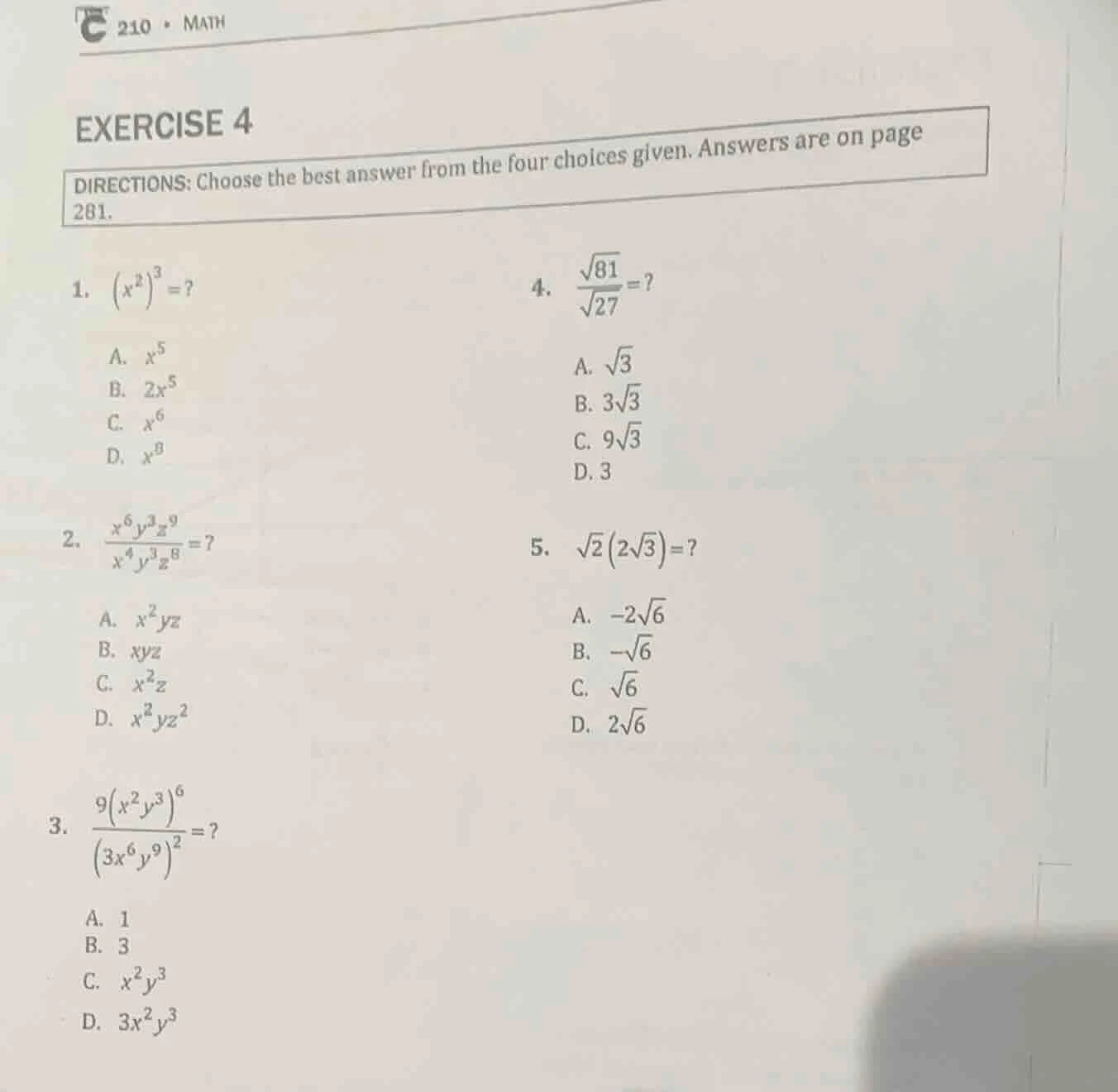
directions: choose the best answer from the four choices given. answers are on page 281.
- ((x^{2})^{3} =?)
a. (x^{5})
b. (2x^{5})
c. (x^{6})
d. (x^{8})
- (\frac{x^{6}y^{3}z^{9}}{x^{4}y^{3}z^{8}} =?)
a. (x^{2}yz)
b. (xyz)
c. (x^{2}z)
d. (x^{2}yz^{2})
- (\frac{9(x^{2}y^{3})^{6}}{(3x^{6}y^{9})^{2}} =?)
a. 1
b. 3
c. (x^{2}y^{3})
d. (3x^{2}y^{3})
- (\frac{sqrt{81}}{sqrt{27}} =?)
a. (sqrt{3})
b. (3sqrt{3})
c. (9sqrt{3})
d. 3
- (sqrt{2}(2sqrt{3}) =?)
a. (-2sqrt{6})
b. (-sqrt{6})
c. (sqrt{6})
d. (2sqrt{6})
Question 1
Step1: Apply power of a power rule
To simplify \((x^{2})^{3}\), we use the power of a power rule \((a^{m})^{n}=a^{m\times n}\). Here, \(a = x\), \(m = 2\), and \(n=3\). So we calculate \(2\times3 = 6\).
\((x^{2})^{3}=x^{2\times3}=x^{6}\)
Step1: Simplify \(x\)-terms
For the \(x\)-terms, we use the quotient rule of exponents \(\frac{a^{m}}{a^{n}}=a^{m - n}\). So \(\frac{x^{6}}{x^{4}}=x^{6-4}=x^{2}\)
Step2: Simplify \(y\)-terms
For the \(y\)-terms, \(\frac{y^{3}}{y^{3}}=y^{3 - 3}=y^{0}=1\) (since \(a^{0}=1\) for \(a
eq0\))
Step3: Simplify \(z\)-terms
For the \(z\)-terms, \(\frac{z^{9}}{z^{8}}=z^{9 - 8}=z^{1}=z\)
Step4: Combine the results
Multiplying the simplified terms together: \(x^{2}\times1\times z=x^{2}yz\)
Step1: Simplify the numerator's power
First, simplify \((x^{2}y^{3})^{6}\) using the power of a product rule \((ab)^{n}=a^{n}b^{n}\) and power of a power rule. So \((x^{2})^{6}=x^{12}\) and \((y^{3})^{6}=y^{18}\), so \((x^{2}y^{3})^{6}=x^{12}y^{18}\). Then the numerator is \(9x^{12}y^{18}\)
Step2: Simplify the denominator's power
Simplify \((3x^{6}y^{9})^{2}\) using the power of a product rule. \((3)^{2}=9\), \((x^{6})^{2}=x^{12}\), \((y^{9})^{2}=y^{18}\). So \((3x^{6}y^{9})^{2}=9x^{12}y^{18}\)
Step3: Divide numerator by denominator
Now we have \(\frac{9x^{12}y^{18}}{9x^{12}y^{18}}\). The \(9\) cancels out, \(x^{12}\) cancels out, and \(y^{18}\) cancels out, leaving \(1\)
\(\frac{9x^{12}y^{18}}{9x^{12}y^{18}} = 1\)

Snap & solve any problem in the app
Get step-by-step solutions on Sovi AI
Photo-based solutions with guided steps
Explore more problems and detailed explanations
C. \(x^{6}\)