QUESTION IMAGE
Question
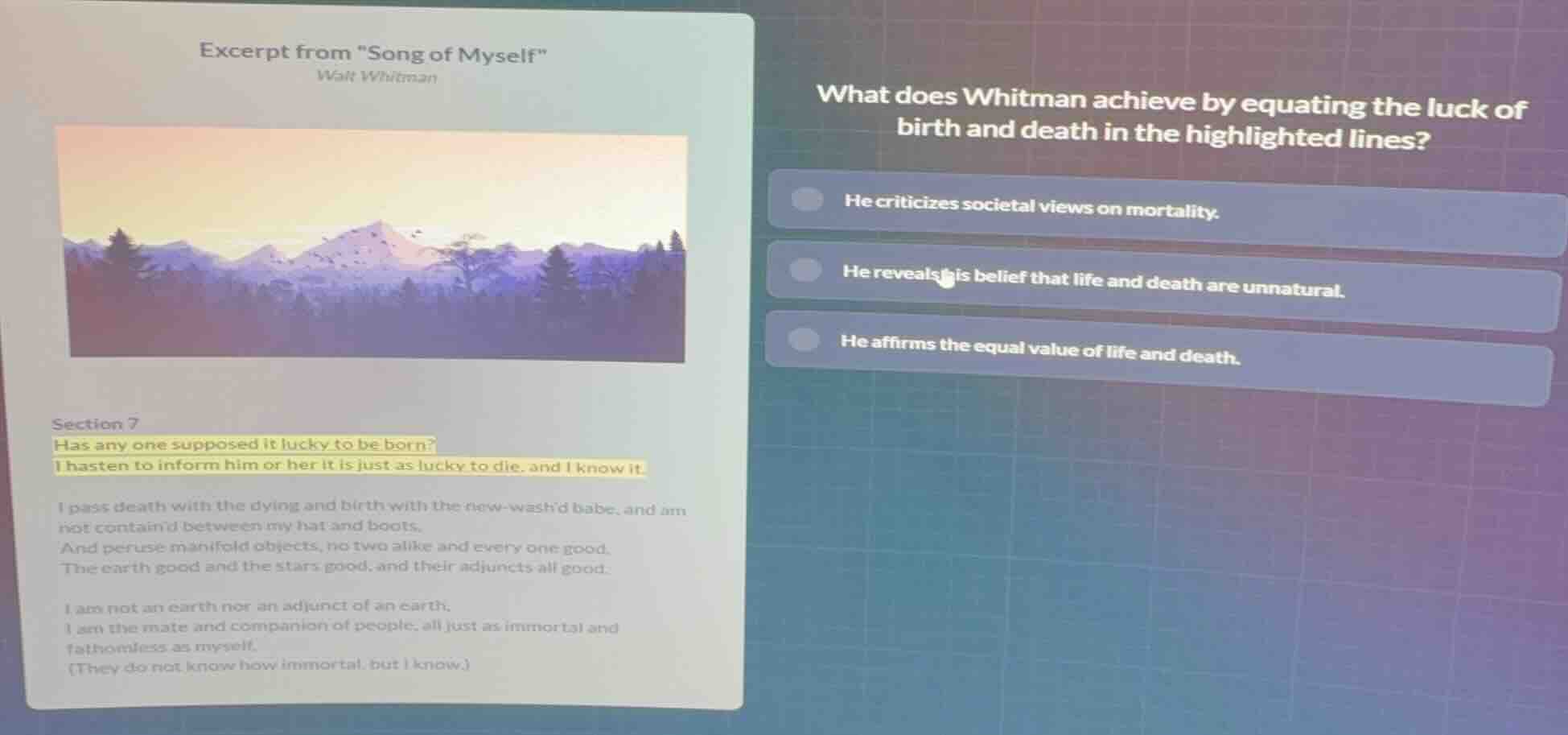
excerpt from \song of myself\
walt whitman
section 7
has any one supposed it lucky to be born?
i hasten to inform him or her it is just as lucky to die, and i know it.
i pass death with the dying and birth with the new-washd babe, and am not containd between my hat and boots,
and peruse manifold objects, no two alike and every one good,
the earth good and the stars good, and their adjuncts all good.
i am not an earth nor an adjunct of an earth,
i am the mate and companion of people, all just as immortal and fathomless as myself,
(they do not know how immortal, but i know.)
what does whitman achieve by equating the luck of birth and death in the highlighted lines?
he criticizes societal views on mortality.
he reveals his belief that life and death are unnatural.
he affirms the equal value of life and death.
Analyze the highlighted lines
The highlighted lines from Section 7 of Walt Whitman's "Song of Myself" read:
"Has any one supposed it lucky to be born?
I hasten to inform him or her it is just as lucky to die, and I know it."
In these lines, Whitman directly addresses the reader's assumptions about existence. While birth is universally celebrated as a fortunate event ("lucky"), Whitman immediately balances this by stating that dying is "just as lucky."
Connect to Whitman's poetic themes
Using the Whitman Poetic Themes knowledge point, we know that Whitman views life and death not as opposites or as a tragedy, but as continuous, cyclical parts of a single, unified cosmic process. By equating the "luck" of birth with the "luck" of death, he is not criticizing society or calling these processes unnatural. Instead, he is elevating death to the same level of spiritual and natural value as birth.
Evaluate the options
Using the Poetic Analysis knowledge point, let us evaluate the given choices:
- He criticizes societal views on mortality. While he challenges the fear of death, his primary focus here is affirmative rather than critical.
- He reveals his belief that life and death are unnatural. This contradicts Whitman's transcendentalist view that both are deeply natural and sacred.
- He affirms the equal value of life and death. This directly matches his assertion that it is "just as lucky" to die as it is to be born, showing both stages of existence hold equal spiritual worth.

Snap & solve any problem in the app
Get step-by-step solutions on Sovi AI
Photo-based solutions with guided steps
Explore more problems and detailed explanations
- He criticizes societal views on mortality.
- He reveals his belief that life and death are unnatural.
- He affirms the equal value of life and death. (Correct answer)