QUESTION IMAGE
Question
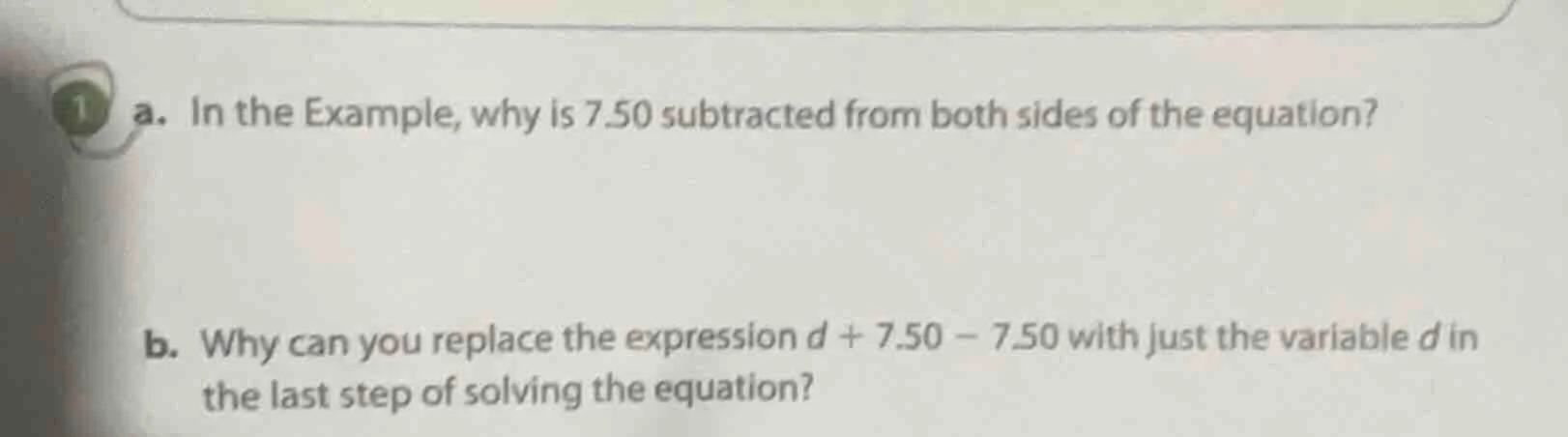
a. in the example, why is 7.50 subtracted from both sides of the equation?
b. why can you replace the expression $d + 7.50 - 7.50$ with just the variable $d$ in the last step of solving the equation?
Part a
When solving an equation, we use the Subtraction Property of Equality, which states that if we subtract the same quantity from both sides of an equation, the equation remains true. Subtracting 7.50 from both sides is done to isolate the variable (let's say the variable is \( d \) if the equation is of the form \( d + 7.50=\text{some value} \)) by getting rid of the constant term (7.50) on the side with the variable. This step helps in finding the value of the variable by simplifying the equation.
The expression \( d + 7.50 - 7.50 \) can be simplified because adding a number and then subtracting the same number is equivalent to doing nothing to the original number (this is based on the additive inverse property, where a number and its opposite sum to zero, so \( 7.50 - 7.50 = 0 \), and then \( d+0=d \) by the Identity Property of Addition, which states that adding zero to a number does not change the number). So we can replace \( d + 7.50 - 7.50 \) with \( d \) as the \( 7.50 - 7.50 \) cancels out (sums to zero) and adding zero to \( d \) leaves \( d \) unchanged.

Snap & solve any problem in the app
Get step-by-step solutions on Sovi AI
Photo-based solutions with guided steps
Explore more problems and detailed explanations
To isolate the variable (using the Subtraction Property of Equality) and simplify the equation to find the variable's value.