QUESTION IMAGE
Question
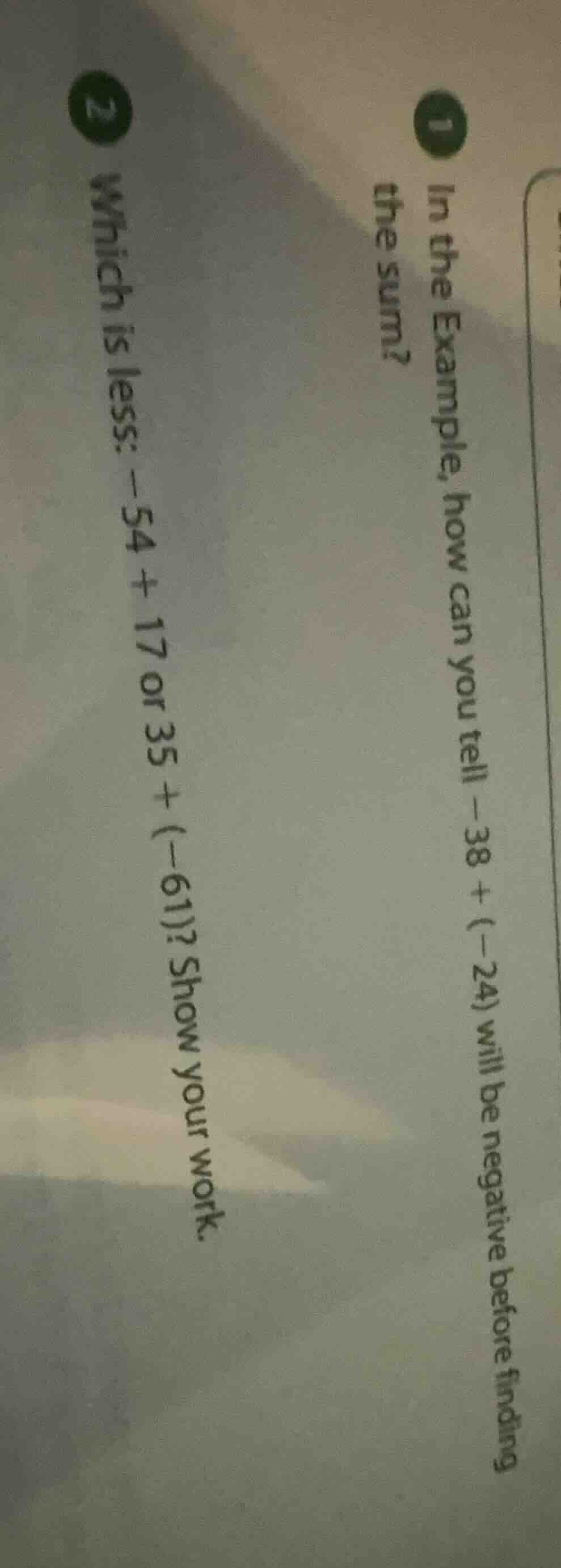
1 in the example, how can you tell $-38 + (-24)$ will be negative before finding the sum?
2 which is less: $-54 + 17$ or $35 + (-61)$? show your work.
Step1: Calculate \(-54 + 17\)
To add a negative and a positive number, we subtract the smaller absolute value from the larger absolute value and take the sign of the number with the larger absolute value. The absolute value of \(-54\) is \(54\), and the absolute value of \(17\) is \(17\). So, \(54 - 17 = 37\), and since \(-54\) has the larger absolute value, \(-54 + 17 = -37\).
Step2: Calculate \(35 + (-61)\)
Similarly, for \(35 + (-61)\), the absolute value of \(35\) is \(35\), and the absolute value of \(-61\) is \(61\). Subtract the smaller from the larger: \(61 - 35 = 26\). Since \(-61\) has the larger absolute value, \(35 + (-61) = -26\).
Step3: Compare the two results
We have \(-37\) (from \(-54 + 17\)) and \(-26\) (from \(35 + (-61)\)). On the number line, numbers to the left are smaller. Since \(-37\) is to the left of \(-26\) (because \(-37 < -26\)), \(-54 + 17\) is less than \(35 + (-61)\).

Snap & solve any problem in the app
Get step-by-step solutions on Sovi AI
Photo-based solutions with guided steps
Explore more problems and detailed explanations
\(-54 + 17\) is less.