QUESTION IMAGE
Question
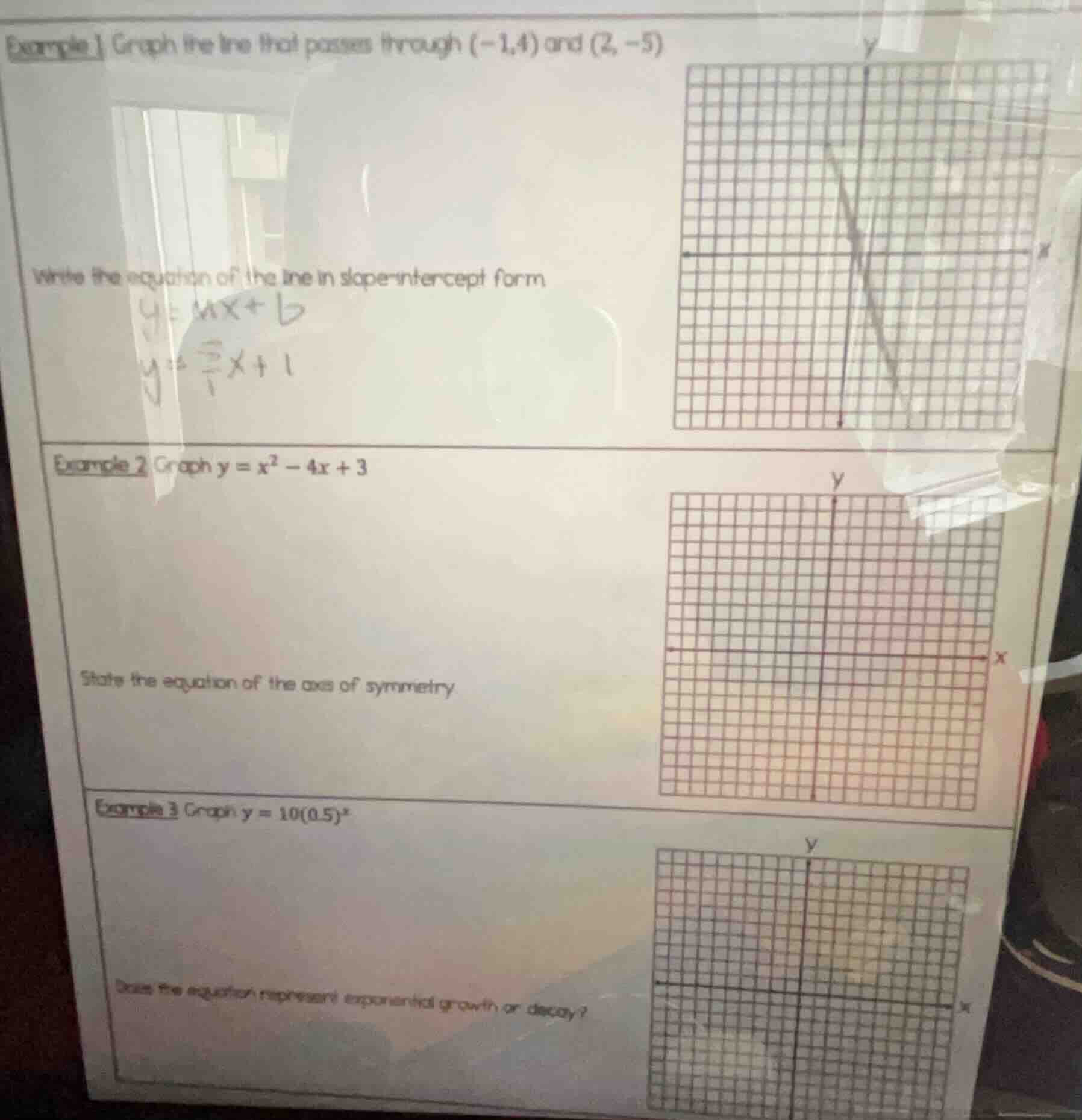
example 1 graph the line that passes through \\((-1,4)\\) and \\((2,-5)\\)
write the equation of the line in slope-intercept form
example 2 graph \\(y = x^2 - 4x + 3\\)
state the equation of the axis of symmetry
example 3 graph \\(y = 10(0.5)^x\\)
does the equation represent exponential growth or decay?
<pre_analysis>
{
"quality": "clear",
"question_count": 3,
"skills_matched": [
"step_cot",
"explain_then_answer",
"tutor"
],
"needs_drawing": true,
"concepts_used": [],
"new_concepts": [
"Linear Equations",
"Quadratic Functions",
"Exponential Functions"
],
"current_concepts": [
"Linear Equations",
"Quadratic Functions",
"Exponential Functions"
]
}
</pre_analysis>
<reasoning>
求解例题 1 的直线方程
已知直线通过点 \((-1, 4)\) 和 \((2, -5)\)。
首先计算斜率 \(m\):
\[
m = \frac{-5 - 4}{2 - (-1)} = \frac{-9}{3} = -3
\]
使用点斜式求直线方程,代入点 \((-1, 4)\):
\[
y - 4 = -3(x - (-1)) \implies y - 4 = -3x - 3 \implies y = -3x + 1
\]
确定例题 2 的对称轴
已知二次函数为 \(y = x^2 - 4x + 3\)。
二次函数 \(y = ax^2 + bx + c\) 的对称轴公式为:
\[
x = -\frac{b}{2a}
\]
代入 \(a = 1\), \(b = -4\):
\[
x = -\frac{-4}{2(1)} = 2
\]
判断例题 3 的指数函数类型
已知指数函数为 \(y = 10(0.5)^x\)。
该函数的形式为 \(y = a \cdot b^x\),其中 \(a = 10 > 0\),底数 \(b = 0.5\)。
因为底数 \(b\) 满足 \(0 < b < 1\),所以随着 \(x\) 的增加,\(y\) 的值会逐渐减小。
因此,该方程表示指数衰减(Exponential Decay)。
</reasoning>
<answer>
Question 1
斜截式直线方程为:
\[y = -3x + 1\]
Question 2
对称轴方程为:
\[x = 2\]
Question 3
该方程表示:
指数衰减 (Exponential Decay)
</answer>
<plot>
{
"elements": [
{
"type": "functiongraph",
"params": [{"js": "-3*x + 1", "latex": "y = -3x + 1"}, -10, 10],
"properties": {
"strokeColor": "#8C55F2",
"strokeWidth": 2,
"name": "y = -3x + 1",
"withLabel": true
}
},
{
"type": "point",
"params": [[-1, 4]],
"properties": {
"name": "(-1, 4)",
"color": "#5583F2",
"withLabel": true
}
},
{
"type": "point",
"params": [[2, -5]],
"properties": {
"name": "(2, -5)",
"color": "#5583F2",
"withLabel": true
}
},
{
"type": "functiongraph",
"params": [{"js": "xx - 4x + 3", "latex": "y = x^2 - 4x + 3"}, -10, 10],
"properties": {
"strokeColor": "#F2557F",
"strokeWidth": 2,
"name": "y = x^2 - 4x + 3",
"withLabel": true
}
},
{
"type": "line",
"params": [[2, -10], [2, 10]],
"properties": {
"strokeColor": "#F28A55",
"strokeWidth": 1.5,
"dash": 2,
"name": "x = 2",
"withLabel": true
}
},
{
"type": "functiongraph",
"params": [{"js": "10*Math.pow(0.5, x)", "latex": "y = 10(0.5)^x"}, -2, 10],
"properties": {
"strokeColor": "#55DDF2",
"strokeWidth": 2,
"name": "y = 10(0.5)^x",
"withLabel": true
}
}
],
"timestamps": [0, 1, 2]
}
</plot>
<post_analysis>
{
"subject": "Mathematics",
"question_type": "Multi-part",
"knowledge_point": ["Mathematics", "Algebra", "Functions and Graphs"]
}
</post_analysis>
Snap & solve any problem in the app
Get step-by-step solutions on Sovi AI
Photo-based solutions with guided steps
Explore more problems and detailed explanations
<pre_analysis>
{
"quality": "clear",
"question_count": 3,
"skills_matched": [
"step_cot",
"explain_then_answer",
"tutor"
],
"needs_drawing": true,
"concepts_used": [],
"new_concepts": [
"Linear Equations",
"Quadratic Functions",
"Exponential Functions"
],
"current_concepts": [
"Linear Equations",
"Quadratic Functions",
"Exponential Functions"
]
}
</pre_analysis>
<reasoning>
求解例题 1 的直线方程
已知直线通过点 \((-1, 4)\) 和 \((2, -5)\)。
首先计算斜率 \(m\):
\[
m = \frac{-5 - 4}{2 - (-1)} = \frac{-9}{3} = -3
\]
使用点斜式求直线方程,代入点 \((-1, 4)\):
\[
y - 4 = -3(x - (-1)) \implies y - 4 = -3x - 3 \implies y = -3x + 1
\]
确定例题 2 的对称轴
已知二次函数为 \(y = x^2 - 4x + 3\)。
二次函数 \(y = ax^2 + bx + c\) 的对称轴公式为:
\[
x = -\frac{b}{2a}
\]
代入 \(a = 1\), \(b = -4\):
\[
x = -\frac{-4}{2(1)} = 2
\]
判断例题 3 的指数函数类型
已知指数函数为 \(y = 10(0.5)^x\)。
该函数的形式为 \(y = a \cdot b^x\),其中 \(a = 10 > 0\),底数 \(b = 0.5\)。
因为底数 \(b\) 满足 \(0 < b < 1\),所以随着 \(x\) 的增加,\(y\) 的值会逐渐减小。
因此,该方程表示指数衰减(Exponential Decay)。
</reasoning>
<answer>
Question 1
斜截式直线方程为:
\[y = -3x + 1\]
Question 2
对称轴方程为:
\[x = 2\]
Question 3
该方程表示:
指数衰减 (Exponential Decay)
</answer>
<plot>
{
"elements": [
{
"type": "functiongraph",
"params": [{"js": "-3*x + 1", "latex": "y = -3x + 1"}, -10, 10],
"properties": {
"strokeColor": "#8C55F2",
"strokeWidth": 2,
"name": "y = -3x + 1",
"withLabel": true
}
},
{
"type": "point",
"params": [[-1, 4]],
"properties": {
"name": "(-1, 4)",
"color": "#5583F2",
"withLabel": true
}
},
{
"type": "point",
"params": [[2, -5]],
"properties": {
"name": "(2, -5)",
"color": "#5583F2",
"withLabel": true
}
},
{
"type": "functiongraph",
"params": [{"js": "xx - 4x + 3", "latex": "y = x^2 - 4x + 3"}, -10, 10],
"properties": {
"strokeColor": "#F2557F",
"strokeWidth": 2,
"name": "y = x^2 - 4x + 3",
"withLabel": true
}
},
{
"type": "line",
"params": [[2, -10], [2, 10]],
"properties": {
"strokeColor": "#F28A55",
"strokeWidth": 1.5,
"dash": 2,
"name": "x = 2",
"withLabel": true
}
},
{
"type": "functiongraph",
"params": [{"js": "10*Math.pow(0.5, x)", "latex": "y = 10(0.5)^x"}, -2, 10],
"properties": {
"strokeColor": "#55DDF2",
"strokeWidth": 2,
"name": "y = 10(0.5)^x",
"withLabel": true
}
}
],
"timestamps": [0, 1, 2]
}
</plot>
<post_analysis>
{
"subject": "Mathematics",
"question_type": "Multi-part",
"knowledge_point": ["Mathematics", "Algebra", "Functions and Graphs"]
}
</post_analysis>