QUESTION IMAGE
Question
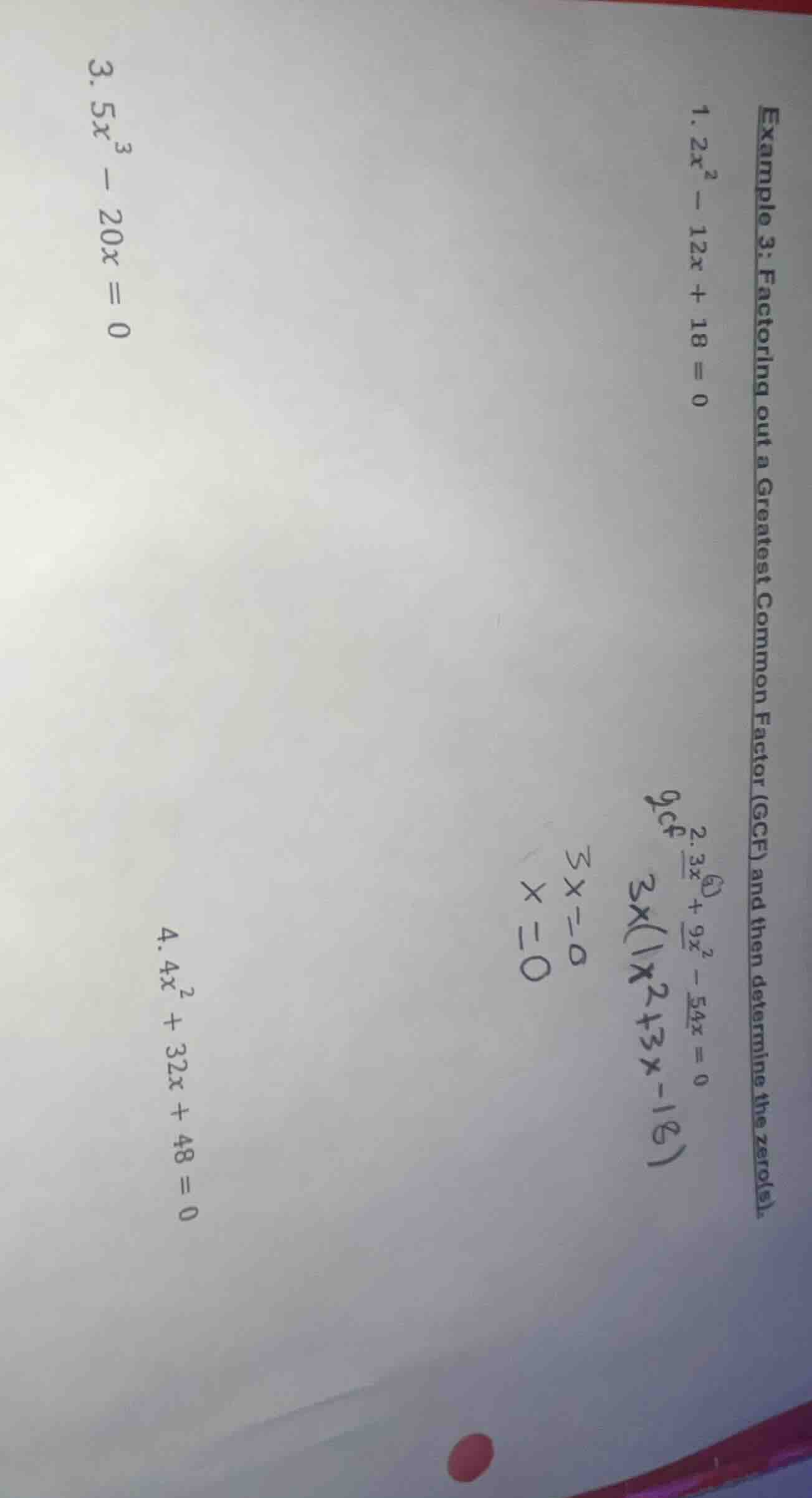
example 3: factoring out a greatest common factor (gcf) and then determine the zero(s).
- $2x^2 - 12x + 18 = 0$
- $3x + 9x^2 - 54x = 0$
- $5x^3 - 20x = 0$
- $4x^2 + 32x + 48 = 0$
Let's solve each equation one by one:
1. \(2x^2 - 12x + 18 = 0\)
Step 1: Factor out GCF
The GCF of \(2x^2\), \(-12x\), and \(18\) is \(2\). So we factor out \(2\):
\(2(x^2 - 6x + 9) = 0\)
Step 2: Factor the quadratic
The quadratic \(x^2 - 6x + 9\) is a perfect square trinomial, which factors as \((x - 3)^2\). So now we have:
\(2(x - 3)^2 = 0\)
Step 3: Solve for \(x\)
Divide both sides by \(2\): \((x - 3)^2 = 0\)
Take the square root of both sides: \(x - 3 = 0\)
So \(x = 3\) (with multiplicity \(2\))
Step 1: Combine like terms
First, combine the \(x\) terms: \(9x^2 + (3x - 54x) = 0\)
\(9x^2 - 51x = 0\) (Wait, maybe better to factor out GCF first. Let's re - do:
Original equation: \(9x^2+3x - 54x = 0\)
Combine like terms: \(9x^2-51x = 0\)
But actually, the GCF of \(9x^2\), \(3x\), and \(-54x\) is \(3x\). Let's factor out \(3x\) from the original equation:
\(3x(3x + 1 - 18)=0\) (Wait, no, original terms are \(3x\), \(9x^2\), \(-54x\). So:
\(9x^2+3x - 54x=9x^2 - 51x\). Wait, maybe the user made a typo, but looking at the hand - written part: \(3x(x^{2}+3x - 18)=0\) (maybe the original equation was \(3x + 9x^2-54x = 0\) and we can factor as follows)
Let's start over. Let's assume the equation is \(9x^2+3x - 54x = 0\) or \(9x^2-51x = 0\). But the hand - written shows \(3x(x^{2}+3x - 18)=0\), so maybe the original equation is \(9x^2 + 3x-54x=0\) which is \(9x^2-51x = 0\), but let's go with the hand - written approach.
If we factor out \(3x\) from \(9x^2+3x - 54x\):
\(3x(3x + 1 - 18)=3x(3x - 17)=0\) (No, that's not matching the hand - written. Wait, the hand - written has \(3x(x^{2}+3x - 18)=0\), so maybe the original equation is \(9x^2+3x - 54x = 0\) is wrong, and it's \(9x^2+3x - 54 = 0\) (without the \(x\) on the last term). Let's assume that.
If the equation is \(9x^2+3x - 54 = 0\), factor out \(3\): \(3(3x^2 + x - 18)=0\)
But the hand - written is \(3x(x^{2}+3x - 18)=0\), so let's use that.
\(3x(x^{2}+3x - 18)=0\)
Step 2: Factor the quadratic
Factor \(x^{2}+3x - 18\). We need two numbers that multiply to \(-18\) and add to \(3\). The numbers are \(6\) and \(-3\). So \(x^{2}+3x - 18=(x + 6)(x - 3)\)
So the equation becomes \(3x(x + 6)(x - 3)=0\)
Step 3: Solve for \(x\)
Set each factor equal to zero:
\(3x = 0\Rightarrow x = 0\)
\(x + 6 = 0\Rightarrow x=-6\)
\(x - 3 = 0\Rightarrow x = 3\)
Step 1: Factor out GCF
The GCF of \(5x^3\) and \(-20x\) is \(5x\). Factor out \(5x\):
\(5x(x^2 - 4)=0\)
Step 2: Factor the difference of squares
\(x^2 - 4\) is a difference of squares, which factors as \((x - 2)(x + 2)\). So now we have:
\(5x(x - 2)(x + 2)=0\)
Step 3: Solve for \(x\)
Set each factor equal to zero:
\(5x = 0\Rightarrow x = 0\)
\(x - 2 = 0\Rightarrow x = 2\)
\(x + 2 = 0\Rightarrow x=-2\)

Snap & solve any problem in the app
Get step-by-step solutions on Sovi AI
Photo-based solutions with guided steps
Explore more problems and detailed explanations
\(x = 3\)