QUESTION IMAGE
Question
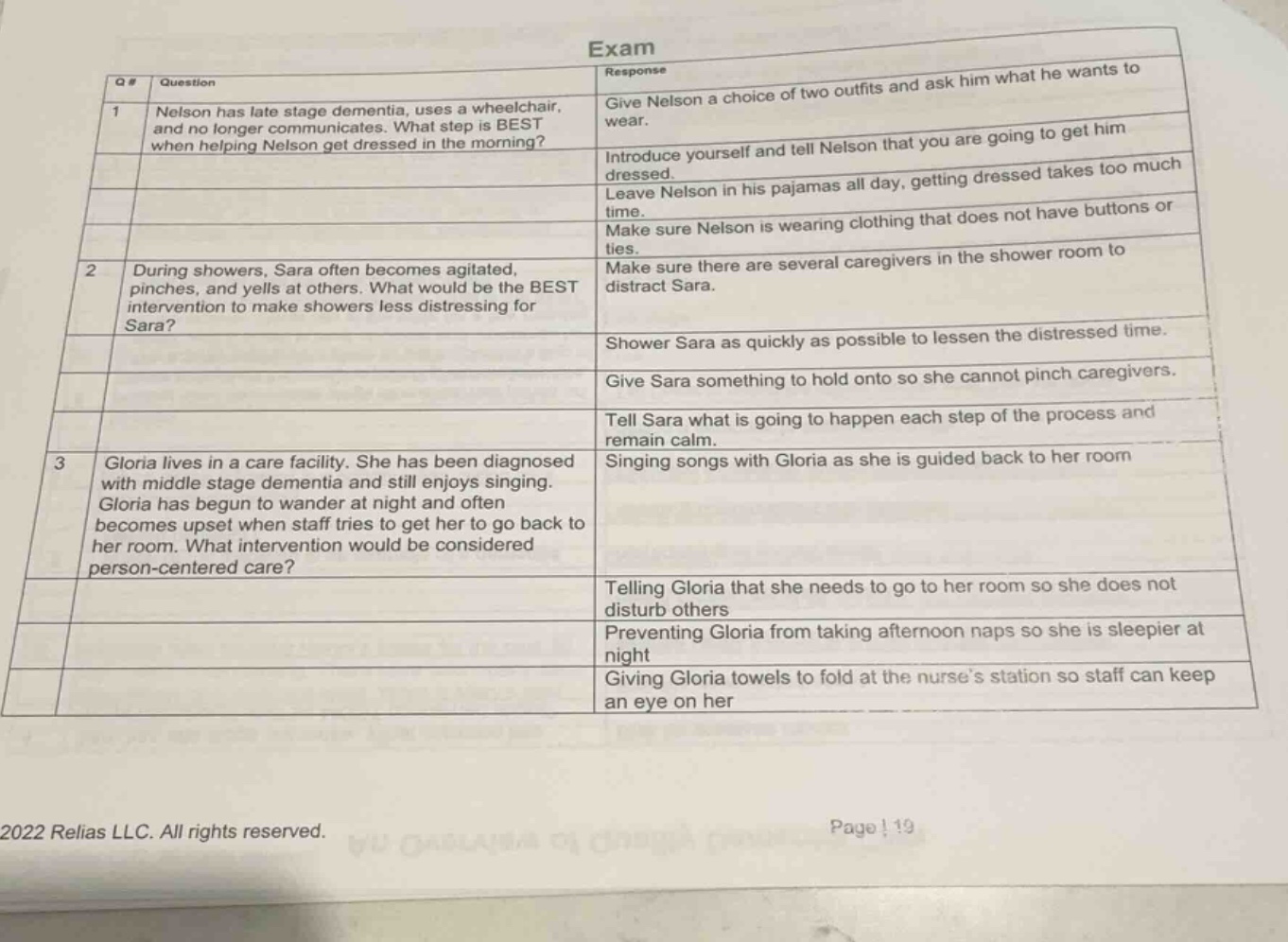
exam
q # question response
1 nelson has late stage dementia, uses a wheelchair, and no longer communicates. what step is best when helping nelson get dressed in the morning?
give nelson a choice of two outfits and ask him what he wants to wear.
introduce yourself and tell nelson that you are going to get him dressed.
leave nelson in his pajamas all day, getting dressed takes too much time.
make sure nelson is wearing clothing that does not have buttons or ties.
2 during showers, sara often becomes agitated, pinches, and yells at others. what would be the best intervention to make showers less distressing for sara?
make sure there are several caregivers in the shower room to distract sara.
shower sara as quickly as possible to lessen the distressed time.
give sara something to hold onto so she cannot pinch caregivers.
tell sara what is going to happen each step of the process and remain calm.
3 gloria lives in a care facility. she has been diagnosed with middle stage dementia and still enjoys singing. gloria has begun to wander at night and often becomes upset when staff tries to get her to go back to her room. what intervention would be considered person-centered care?
singing songs with gloria as she is guided back to her room
telling gloria that she needs to go to her room so she does not disturb others
preventing gloria from taking afternoon naps so she is sleepier at night
giving gloria towels to fold at the nurses station so staff can keep an eye on her
Analyze dressing assistance for late-stage dementia
For Question 1, Nelson has late-stage dementia, uses a wheelchair, and no longer communicates. We apply Dementia Communication principles. Offering choices of outfits is too overwhelming for late-stage non-verbal dementia. Leaving him in pajamas is neglectful. Introducing yourself and explaining what you are doing is the standard respectful protocol for someone who cannot verbally communicate, ensuring they are not startled.
Analyze bathing interventions for agitated behaviors
For Question 2, Sara becomes agitated, pinches, and yells during showers. We apply Behavior Problem-Solving to find a calming intervention. Having multiple caregivers can increase her anxiety. Rushing the shower can escalate fear. Giving her something to hold onto is a physical distraction, but explaining each step calmly addresses the root cause of fear and confusion during bathing.
Analyze person-centered care for wandering
For Question 3, Gloria has middle-stage dementia, enjoys singing, and gets upset when guided back to her room. Person-centered care focuses on the individual's unique preferences and strengths. Since Gloria enjoys singing, singing songs with her while guiding her back to her room uses her personal interest to ease the transition and prevent distress.

Snap & solve any problem in the app
Get step-by-step solutions on Sovi AI
Photo-based solutions with guided steps
Explore more problems and detailed explanations
Question 1
- Give Nelson a choice of two outfits and ask him what he wants to wear.
- Introduce yourself and tell Nelson that you are going to get him dressed. (Correct answer)
- Leave Nelson in his pajamas all day, getting dressed takes too much time.
- Make sure Nelson is wearing clothing that does not have buttons or ties.
Question 2
- Make sure there are several caregivers in the shower room to distract Sara.
- Shower Sara as quickly as possible to lessen the distressed time.
- Give Sara something to hold onto so she cannot pinch caregivers.
- Tell Sara what is going to happen each step of the process and remain calm. (Correct answer)
Question 3
- Singing songs with Gloria as she is guided back to her room (Correct answer)
- Telling Gloria that she needs to go to her room so she does not disturb others
- Preventing Gloria from taking afternoon naps so she is sleepier at night
- Giving Gloria towels to fold at the nurse's station so staff can keep an eye on her