QUESTION IMAGE
Question
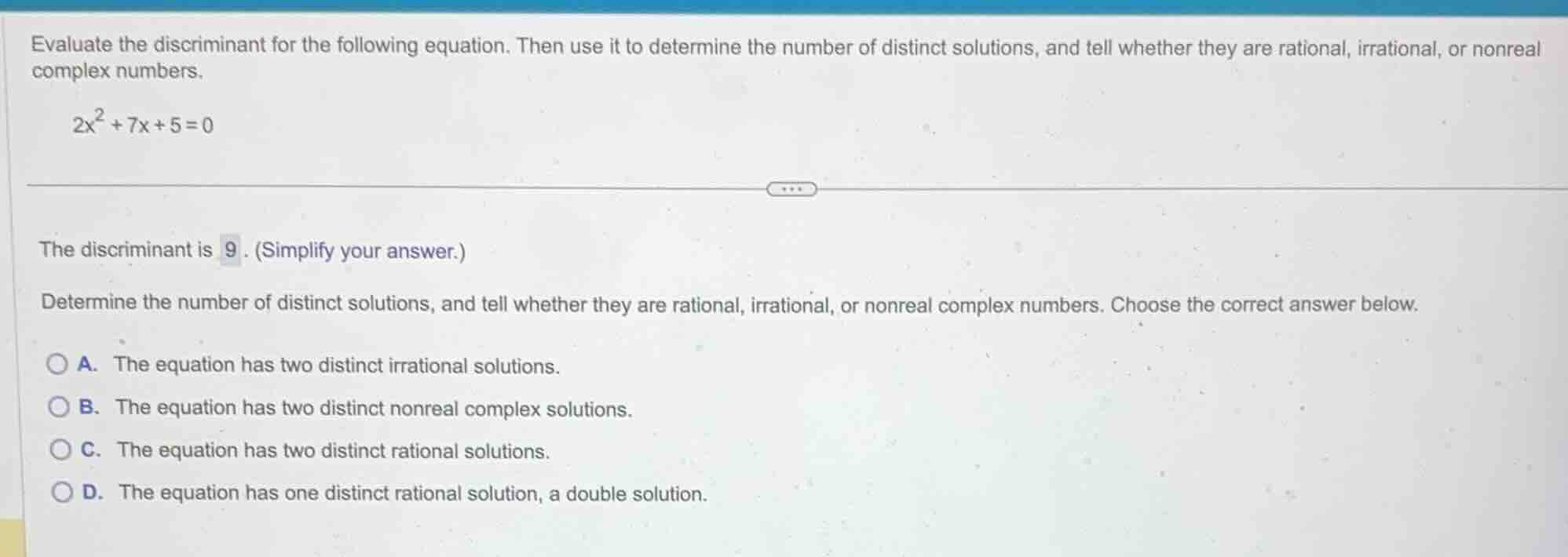
evaluate the discriminant for the following equation. then use it to determine the number of distinct solutions, and tell whether they are rational, irrational, or nonreal complex numbers.
\\(2x^2 + 7x + 5 = 0\\)
the discriminant is 9. (simplify your answer.)
determine the number of distinct solutions, and tell whether they are rational, irrational, or nonreal complex numbers. choose the correct answer below.
\\(\bigcirc\\) a. the equation has two distinct irrational solutions.
\\(\bigcirc\\) b. the equation has two distinct nonreal complex solutions.
\\(\bigcirc\\) c. the equation has two distinct rational solutions.
\\(\bigcirc\\) d. the equation has one distinct rational solution, a double solution.
Step1: Recall discriminant rules
For a quadratic equation \(ax^2 + bx + c = 0\), the discriminant \(D = b^2 - 4ac\). The nature of roots:
- If \(D>0\), two distinct real roots. If \(D\) is a perfect square, roots are rational; else, irrational.
- If \(D = 0\), one real root (double root).
- If \(D<0\), two nonreal complex roots.
Step2: Analyze given discriminant
Given discriminant \(D = 9\), which is \(>0\), so two distinct real roots. Also, \(9 = 3^2\), a perfect square. For the equation \(2x^2 + 7x + 5 = 0\), \(a = 2\), \(b = 7\), \(c = 5\). The roots are \(\frac{-b\pm\sqrt{D}}{2a}=\frac{-7\pm3}{4}\), which are rational (since numerator and denominator are integers).

Snap & solve any problem in the app
Get step-by-step solutions on Sovi AI
Photo-based solutions with guided steps
Explore more problems and detailed explanations
C. The equation has two distinct rational solutions.