Sovi.AI - AI Math Tutor

Scan to solve math questions

QUESTION IMAGE

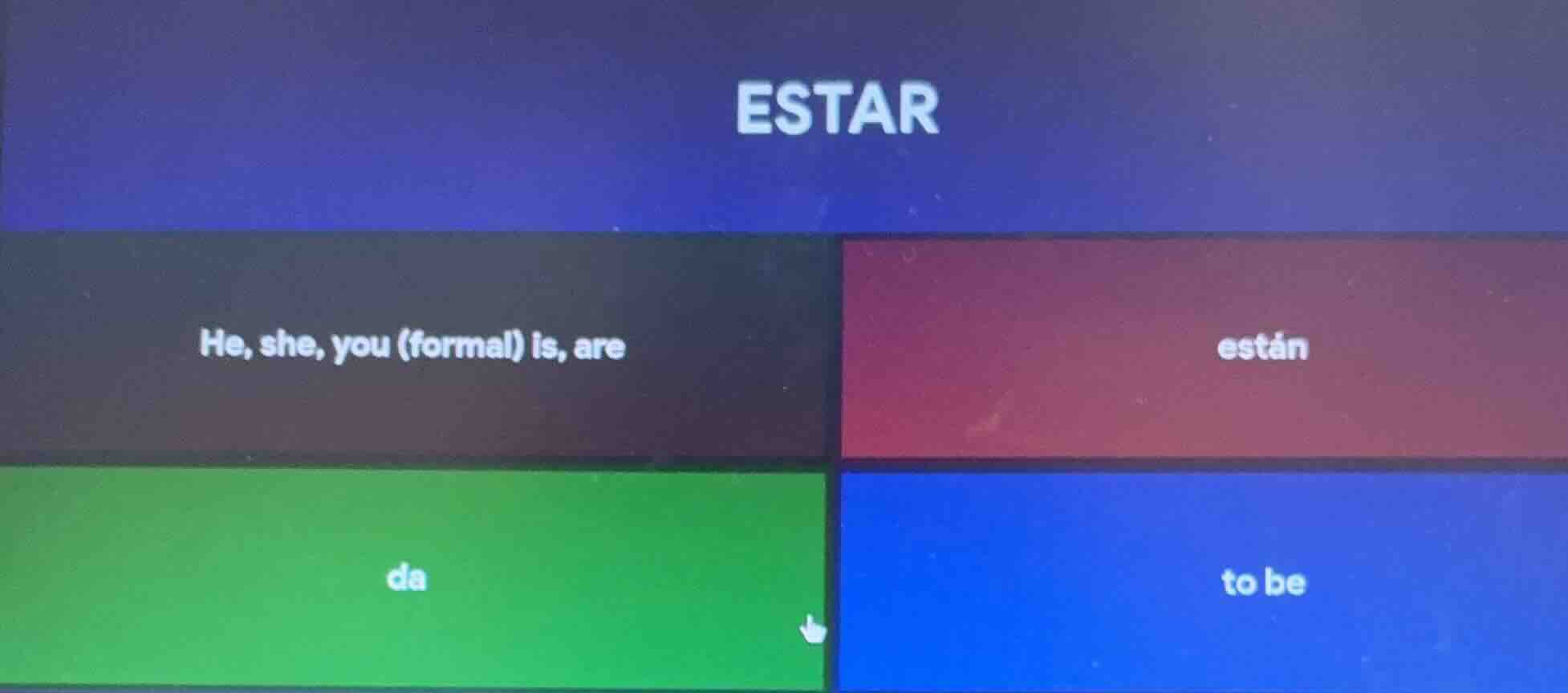
estar he, she, you (formal) is, are están da to be

Question

estar

he, she, you (formal) is, are
están
da
to be

Explanation:

Response

<pre_analysis>
{
"quality": "clear",
"question_count": 1,
"skills_matched": [
"direct_cot",
"multiple_choice_formatter",
"explain_then_answer",
"quick"
],
"needs_drawing": false,
"concepts_used": [
"Spanish Infinitive Verbs",
"Spanish Verbs",
"Spanish Verb Translation"
],
"new_concepts": [],
"current_concepts": [
"Spanish Infinitive Verbs",
"Spanish Verbs",
"Spanish Verb Translation"
]
}
</pre_analysis>

<reasoning>

Identify the target word

The main word displayed at the top is the Spanish verb "ESTAR".

Analyze the options

  • "He, she, you (formal) is, are" represents conjugated forms of a verb (specifically, third-person singular present tense of "estar" is "está").
  • "están" is the third-person plural present tense conjugation of "estar" ("they/you all are").
  • "da" is a conjugated form of the verb "dar" ("to give").
  • "to be" is the English infinitive translation of the Spanish infinitive verb "estar".

Match the correct translation

Since "ESTAR" is in its infinitive form, its direct translation is the English infinitive "to be".
</reasoning>

<answer>
<mcq-option>He, she, you (formal) is, are</mcq-option>
<mcq-option>están</mcq-option>
<mcq-option>da</mcq-option>
<mcq-correct>to be</mcq-correct>
</answer>

<post_analysis>
{
"subject": "Others",
"question_type": "Multiple Choice",
"knowledge_point": [
"Others",
"Spanish",
"Spanish Infinitive Verbs"
]
}
</post_analysis>

Answer:

<pre_analysis>
{
"quality": "clear",
"question_count": 1,
"skills_matched": [
"direct_cot",
"multiple_choice_formatter",
"explain_then_answer",
"quick"
],
"needs_drawing": false,
"concepts_used": [
"Spanish Infinitive Verbs",
"Spanish Verbs",
"Spanish Verb Translation"
],
"new_concepts": [],
"current_concepts": [
"Spanish Infinitive Verbs",
"Spanish Verbs",
"Spanish Verb Translation"
]
}
</pre_analysis>

<reasoning>

Identify the target word

The main word displayed at the top is the Spanish verb "ESTAR".

Analyze the options

  • "He, she, you (formal) is, are" represents conjugated forms of a verb (specifically, third-person singular present tense of "estar" is "está").
  • "están" is the third-person plural present tense conjugation of "estar" ("they/you all are").
  • "da" is a conjugated form of the verb "dar" ("to give").
  • "to be" is the English infinitive translation of the Spanish infinitive verb "estar".

Match the correct translation

Since "ESTAR" is in its infinitive form, its direct translation is the English infinitive "to be".
</reasoning>

<answer>
<mcq-option>He, she, you (formal) is, are</mcq-option>
<mcq-option>están</mcq-option>
<mcq-option>da</mcq-option>
<mcq-correct>to be</mcq-correct>
</answer>

<post_analysis>
{
"subject": "Others",
"question_type": "Multiple Choice",
"knowledge_point": [
"Others",
"Spanish",
"Spanish Infinitive Verbs"
]
}
</post_analysis>