QUESTION IMAGE
Question
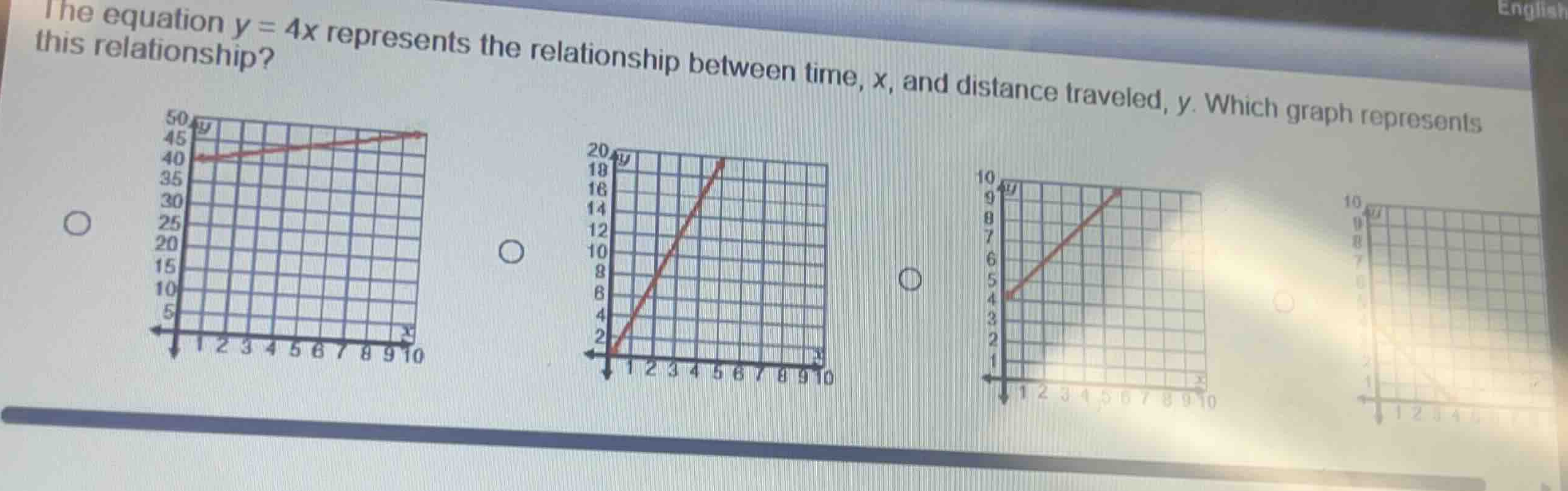
the equation \\(y = 4x\\) represents the relationship between time, \\(x\\), and distance traveled, \\(y\\). which graph represents this relationship?
<pre_analysis>
{
"quality": "clear",
"question_count": 1,
"skills_matched": [
"step_cot",
"multiple_choice_formatter",
"explain_then_answer",
"tutor"
],
"needs_drawing": true,
"concepts_used": [
"Constant of Proportionality",
"Proportional Relationship Equation"
],
"new_concepts": [
"Graphing Proportional Relationships"
],
"current_concepts": [
"Constant of Proportionality",
"Proportional Relationship Equation",
"Graphing Proportional Relationships"
]
}
</pre_analysis>
<reasoning>
Analyze the given equation
The given equation is \(y = 4x\). This represents a direct variation or proportional relationship.
Using the Proportional Relationship Equation knowledge point, we know that the graph of a proportional relationship of the form \(y = kx\) must pass through the origin \((0,0)\).
Identify key points on the graph
Using the Constant of Proportionality knowledge point, where \(k = 4\), we can find specific coordinates \((x, y)\) that must lie on the line:
- When \(x = 0\), \(y = 4(0) = 0\). The point is \((0, 0)\).
- When \(x = 1\), \(y = 4(1) = 4\). The point is \((1, 4)\).
- When \(x = 2\), \(y = 4(2) = 8\). The point is \((2, 8)\).
- When \(x = 3\), \(y = 4(3) = 12\). The point is \((3, 12)\).
- When \(x = 4\), \(y = 4(4) = 16\). The point is \((4, 16)\).
- When \(x = 5\), \(y = 4(5) = 20\). The point is \((5, 20)\).
Evaluate the given graph options
Let's check each graph to see which one contains these points:
- First Graph: The line starts at \((0, 40)\) and has a very flat slope. This does not pass through \((0,0)\).
- Second Graph: The line starts at \((0,0)\). Looking at the grid:
- At \(x = 1\), \(y = 4\).
- At \(x = 2\), \(y = 8\).
- At \(x = 3\), \(y = 12\).
- At \(x = 4\), \(y = 16\).
- At \(x = 5\), \(y = 20\).
This perfectly matches our calculated points.
- Third Graph: The line starts at \((0, 4)\) and goes to \((5, 9)\). This does not pass through \((0,0)\).
- Fourth Graph: This graph is blank/incomplete.
Therefore, the second graph is the correct representation.
</reasoning>
<answer>
<mcq-option>(A) Graph starting at (0, 40) with a very flat slope</mcq-option>
<mcq-correct>(B) Graph starting at (0, 0) and passing through (5, 20)</mcq-correct>
<mcq-option>(C) Graph starting at (0, 4) and passing through (5, 9)</mcq-option>
<mcq-option>(D) Blank graph grid</mcq-option>
</answer>
<plot>
{
"elements": [
{
"type": "functiongraph",
"params": [
{
"js": "4*x",
"latex": "y = 4x"
},
0,
5
],
"properties": {
"strokeColor": "#8C55F2",
"strokeWidth": 3,
"name": "y = 4x",
"withLabel": true
}
},
{
"type": "point",
"params": [
[0, 0]
],
"properties": {
"name": "(0,0)",
"color": "#F2557F",
"size": 4,
"withLabel": true
}
},
{
"type": "point",
"params": [
[5, 20]
],
"properties": {
"name": "(5,20)",
"color": "#F2557F",
"size": 4,
"withLabel": true
}
}
]
}
</plot>
<post_analysis>
{
"subject": "Mathematics",
"question_type": "Multiple Choice",
"knowledge_point": [
"Mathematics",
"Geometry",
"Graphing Proportional Relationships"
]
}
</post_analysis>
Snap & solve any problem in the app
Get step-by-step solutions on Sovi AI
Photo-based solutions with guided steps
Explore more problems and detailed explanations
<pre_analysis>
{
"quality": "clear",
"question_count": 1,
"skills_matched": [
"step_cot",
"multiple_choice_formatter",
"explain_then_answer",
"tutor"
],
"needs_drawing": true,
"concepts_used": [
"Constant of Proportionality",
"Proportional Relationship Equation"
],
"new_concepts": [
"Graphing Proportional Relationships"
],
"current_concepts": [
"Constant of Proportionality",
"Proportional Relationship Equation",
"Graphing Proportional Relationships"
]
}
</pre_analysis>
<reasoning>
Analyze the given equation
The given equation is \(y = 4x\). This represents a direct variation or proportional relationship.
Using the Proportional Relationship Equation knowledge point, we know that the graph of a proportional relationship of the form \(y = kx\) must pass through the origin \((0,0)\).
Identify key points on the graph
Using the Constant of Proportionality knowledge point, where \(k = 4\), we can find specific coordinates \((x, y)\) that must lie on the line:
- When \(x = 0\), \(y = 4(0) = 0\). The point is \((0, 0)\).
- When \(x = 1\), \(y = 4(1) = 4\). The point is \((1, 4)\).
- When \(x = 2\), \(y = 4(2) = 8\). The point is \((2, 8)\).
- When \(x = 3\), \(y = 4(3) = 12\). The point is \((3, 12)\).
- When \(x = 4\), \(y = 4(4) = 16\). The point is \((4, 16)\).
- When \(x = 5\), \(y = 4(5) = 20\). The point is \((5, 20)\).
Evaluate the given graph options
Let's check each graph to see which one contains these points:
- First Graph: The line starts at \((0, 40)\) and has a very flat slope. This does not pass through \((0,0)\).
- Second Graph: The line starts at \((0,0)\). Looking at the grid:
- At \(x = 1\), \(y = 4\).
- At \(x = 2\), \(y = 8\).
- At \(x = 3\), \(y = 12\).
- At \(x = 4\), \(y = 16\).
- At \(x = 5\), \(y = 20\).
This perfectly matches our calculated points.
- Third Graph: The line starts at \((0, 4)\) and goes to \((5, 9)\). This does not pass through \((0,0)\).
- Fourth Graph: This graph is blank/incomplete.
Therefore, the second graph is the correct representation.
</reasoning>
<answer>
<mcq-option>(A) Graph starting at (0, 40) with a very flat slope</mcq-option>
<mcq-correct>(B) Graph starting at (0, 0) and passing through (5, 20)</mcq-correct>
<mcq-option>(C) Graph starting at (0, 4) and passing through (5, 9)</mcq-option>
<mcq-option>(D) Blank graph grid</mcq-option>
</answer>
<plot>
{
"elements": [
{
"type": "functiongraph",
"params": [
{
"js": "4*x",
"latex": "y = 4x"
},
0,
5
],
"properties": {
"strokeColor": "#8C55F2",
"strokeWidth": 3,
"name": "y = 4x",
"withLabel": true
}
},
{
"type": "point",
"params": [
[0, 0]
],
"properties": {
"name": "(0,0)",
"color": "#F2557F",
"size": 4,
"withLabel": true
}
},
{
"type": "point",
"params": [
[5, 20]
],
"properties": {
"name": "(5,20)",
"color": "#F2557F",
"size": 4,
"withLabel": true
}
}
]
}
</plot>
<post_analysis>
{
"subject": "Mathematics",
"question_type": "Multiple Choice",
"knowledge_point": [
"Mathematics",
"Geometry",
"Graphing Proportional Relationships"
]
}
</post_analysis>