QUESTION IMAGE
Question
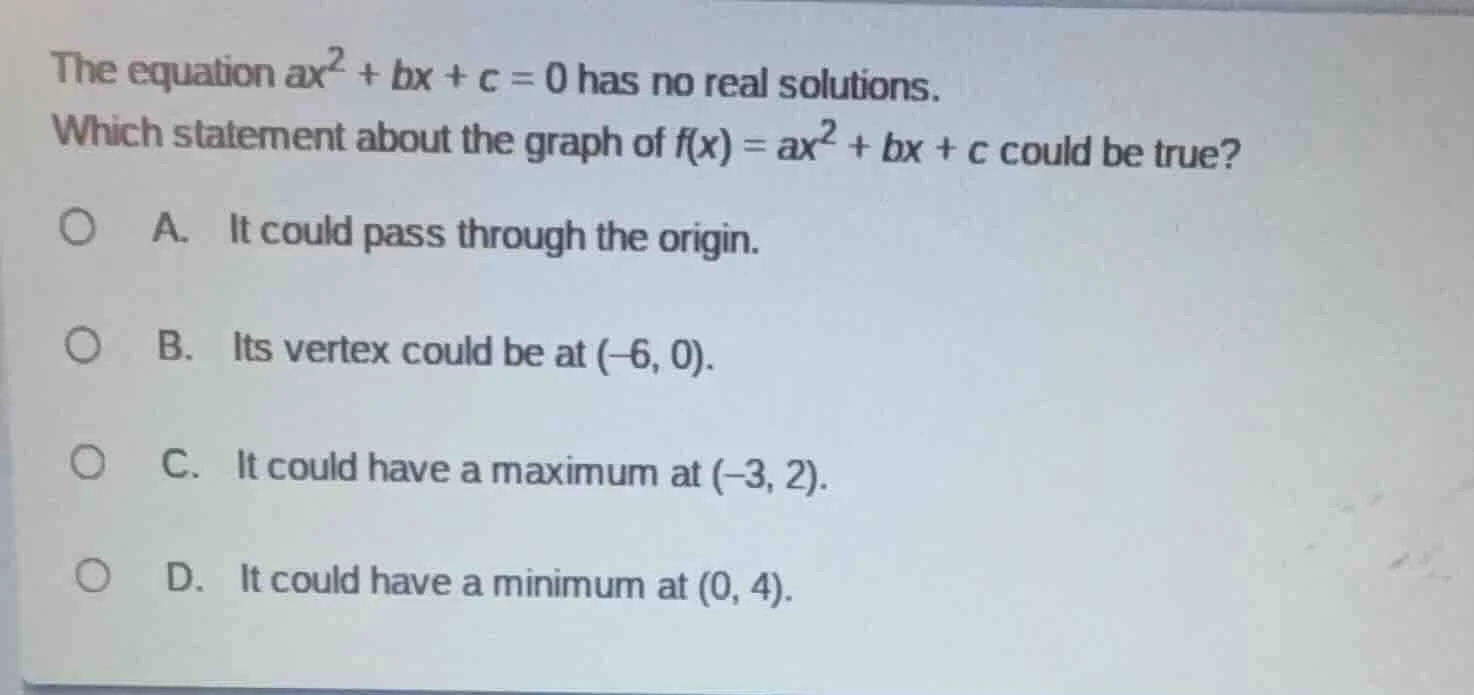
the equation $ax^2 + bx + c = 0$ has no real solutions. which statement about the graph of $f(x) = ax^2 + bx + c$ could be true? \
\
a. it could pass through the origin. \
\
b. its vertex could be at $(-6, 0)$. \
\
c. it could have a maximum at $(-3, 2)$. \
\
d. it could have a minimum at $(0, 4)$. \
Step1: Recall discriminant condition
For $ax^2+bx+c=0$ to have no real solutions, the discriminant must satisfy $\Delta = b^2 - 4ac < 0$. This means the parabola $f(x)=ax^2+bx+c$ never crosses the $x$-axis.
Step2: Analyze Option A
If the graph passes through the origin $(0,0)$, then $f(0)=0$, so $c=0$. Substitute into discriminant: $\Delta = b^2 - 0 = b^2 \geq 0$, which contradicts $\Delta < 0$. So A is false.
Step3: Analyze Option B
If vertex is at $(-6,0)$, then $f(-6)=0$, meaning $x=-6$ is a real solution to $ax^2+bx+c=0$. This contradicts no real solutions. So B is false.
Step4: Analyze Option C
A maximum at $(-3,2)$ means the parabola opens downward ($a<0$) and its highest point is at $y=2$. Since it opens downward and the maximum is above the $x$-axis, the parabola never crosses the $x$-axis, so $\Delta < 0$ (no real solutions). This is possible.
Step5: Analyze Option D
A minimum at $(0,4)$ means the parabola opens upward ($a>0$) and its lowest point is at $y=4$. Since it opens upward and the minimum is above the $x$-axis, the parabola never crosses the $x$-axis, so $\Delta < 0$ (no real solutions). This is possible.

Snap & solve any problem in the app
Get step-by-step solutions on Sovi AI
Photo-based solutions with guided steps
Explore more problems and detailed explanations
C. It could have a maximum at (-3, 2).
D. It could have a minimum at (0, 4).