QUESTION IMAGE
Question
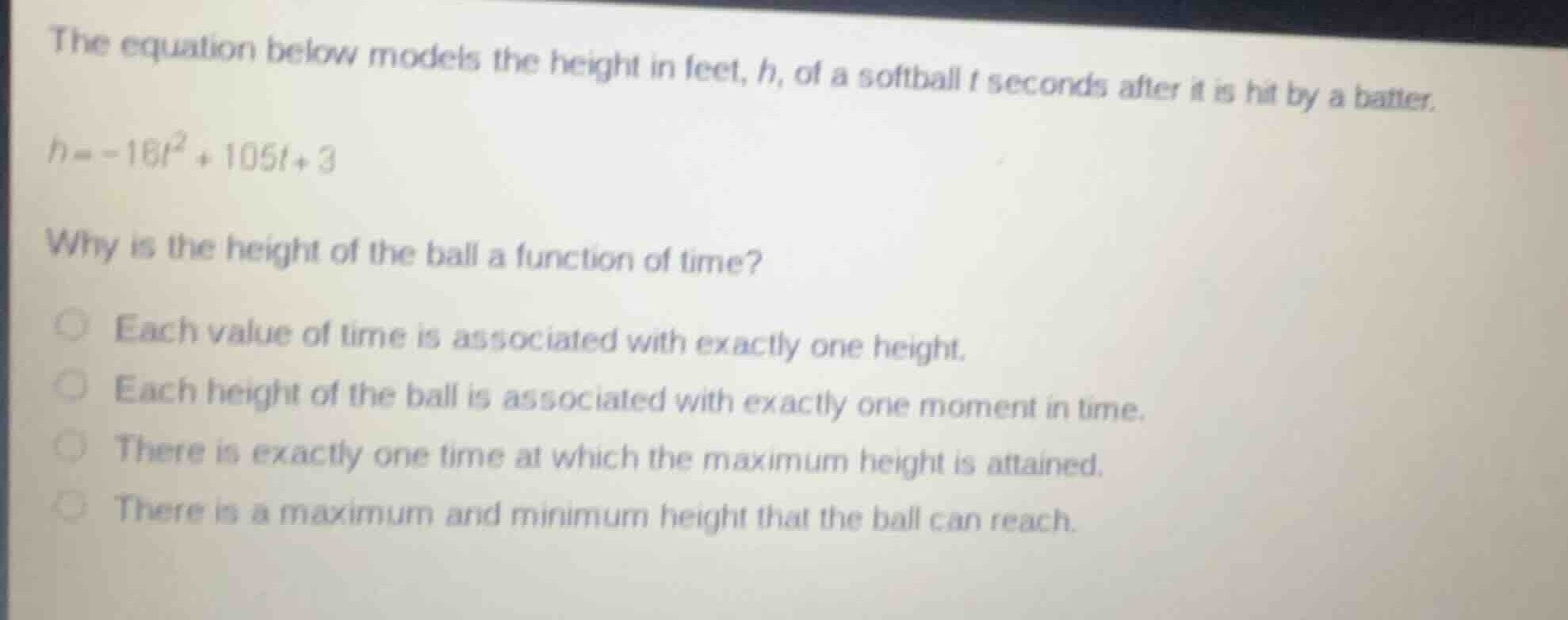
the equation below models the height in feet, (h), of a softball (t) seconds after it is hit by a batter.
(h = -16t^2 + 105t + 3)
why is the height of the ball a function of time?
- each value of time is associated with exactly one height.
- each height of the ball is associated with exactly one moment in time.
- there is exactly one time at which the maximum height is attained.
- there is a maximum and minimum height that the ball can reach.
Analyze the definition of a function
To understand why height is a function of time, we must apply the mathematical Function Definition. A relation is defined as a function if each input value from the domain maps to exactly one output value in the range.
Identify input and output variables
In the given equation \(h = -16t^2 + 105t + 3\), the independent variable (input) is time, \(t\), and the dependent variable (output) is height, \(h\).
Apply the function rule to the variables
For height to be a function of time, every single input value of time \(t\) must pair with exactly one output value of height \(h\). Even if the ball reaches the same height at two different times (such as on the way up and on the way down), each specific moment in time \(t\) yields only one unique height \(h\).
Evaluate the given choices
- Choice 1: "Each value of time is associated with exactly one height." This matches our definition where each input \(t\) has exactly one output \(h\).
- Choice 2: "Each height of the ball is associated with exactly one moment in time." This is incorrect because a ball can be at the same height at two different times (rising and falling).
- Choice 3: "There is exactly one time at which the maximum height is attained." While true for a parabola, this describes a property of quadratic vertices, not the fundamental definition of a function.
- Choice 4: "There is a maximum and minimum height that the ball can reach." This describes the range of the physical scenario, not why it is a function.

Snap & solve any problem in the app
Get step-by-step solutions on Sovi AI
Photo-based solutions with guided steps
Explore more problems and detailed explanations
- (A) Each value of time is associated with exactly one height. (Correct answer)
- (B) Each height of the ball is associated with exactly one moment in time.
- (C) There is exactly one time at which the maximum height is attained.
- (D) There is a maximum and minimum height that the ball can reach.