QUESTION IMAGE
Question
the epic of king gilgamesh
sumerian legends
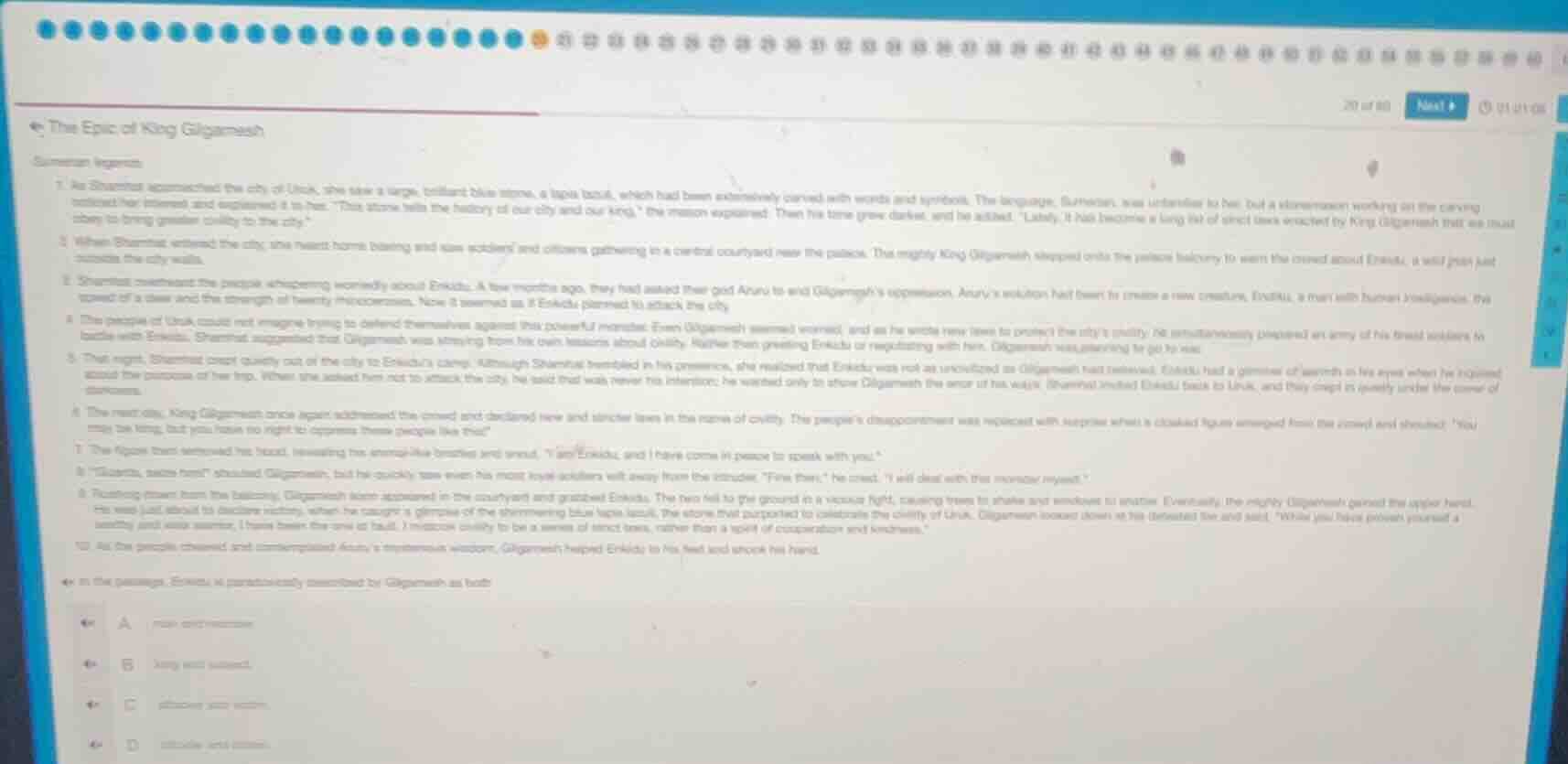
- as shamhat approached the city of uruk, she saw a large, polished blue stone, a lapis lazuli, which had been extensively carved with words and symbols. the language, sumerian, was unfamiliar to her, but a stonemason working on the carving noticed her interest and explained to her, “this stone tells the history of our city and our king,” the mason explained. then his tone grew darker, and he added, “lately, it has become a long list of strict laws enacted by king gilgamesh that we must obey to bring greater civility to the city.”
- when shamhat entered the city, she heard horns blowing and saw soldiers and citizens gathering in a central courtyard near the palace. the mighty king gilgamesh stepped onto the palace balcony to warn the crowd about enkidu, a wild man just outside the city walls.
- shamhat overheard the people whispering worriedly about enkidu. a few months ago, they had asked their god anu to end gilgamesh’s oppression. anu’s solution had been to create a new creature, enkidu, a man with human intelligence, the strength of a bull and the strength of twenty microorganisms. now it seemed as if enkidu planned to attack the city.
- the people of uruk could not imagine trying to defend themselves against that powerful monster! even gilgamesh seemed worried, and as he wrote new laws to protect the city’s purity. he simultaneously prepared an army of his finest soldiers to battle with enkidu. shamhat suggested that gilgamesh was straying from his own lessons about civility. rather than greeting enkidu or negotiating with him, gilgamesh was choosing to go to war.
- that night, shamhat crept quietly out of the city to enkidu’s camp. although shamhat trembled in his presence, she realized that enkidu was not as uncivilized as gilgamesh had presumed. enkidu had a glimmer of warmth in his eyes when he inquired about the purpose of her trip. when she asked him not to attack the city, he said that was never his intention; he wanted only to show gilgamesh the error of his ways. shamhat invited enkidu back to uruk, and they crept in quietly under the cover of darkness.
- the next day, king gilgamesh once again addressed the crowd and declared new and stricter laws in the name of civility. the people’s disappointment was replaced with surprise when a cloaked figure emerged from the crowd and shouted, “you may be king, but you have no right to oppress these people like this!”
- the figure then removed his hood, revealing his animal - like features and smell. “i am enkidu, and i have come in peace to speak with you.”
- “guards, seize him!” shouted gilgamesh, but he quickly saw even his most loyal soldiers wilt away from the intruder. “fine then,” he cried, “i will deal with the monster myself!”
- leaping down from the balcony, gilgamesh soon confronted enkidu in the courtyard and grabbed enkidu. the two fell to the ground in a vicious fight, causing trees to shake and windows to rattle. eventually, the mighty gilgamesh gained the upper hand. he was just about to declare victory, when he caught a glimpse of the shimmering blue lapis lazuli, the stone that purported to celebrate the civility of uruk. gilgamesh looked down at his defeated foe and said, “while you have proven yourself a worthy and just warrior, i have been the one at fault. i mistake civility to be a series of strict laws, rather than a spirit of cooperation and kindness.”
- as the people cheered, and contemplated such a tremendous wisdom, gilgamesh helped enkidu to his feet and shook his hand.
in the passage, enkidu is primarily described by gilgamesh as both
a
b
c
d
Brief Explanations
To solve this, we analyze the text:
- In paragraph 3, Gilgamesh's people describe Enkidu as "a man with human intelligence, the strength of a beast and the strength of twenty - men combined" and Gilgamesh sees him as a "monster" (paragraph 8). Also, Enkidu is presented as a challenge to Gilgamesh's rule (paragraphs 4 - 6). So Enkidu is portrayed as fierce (due to his strength and the initial perception as a threat) and wild (his origin and initial untamed nature, though he later shows wisdom).
- Option A: "man and monster" fits. The text shows Enkidu has human - like qualities (intelligence, later peaceful intent) but is initially seen as a monster by Gilgamesh.
- Option B: Enkidu is not a king, so B is wrong.
- Option C: The text doesn't show Enkidu as "pleasure - seeker" or "weak", so C is wrong.
- Option D: The text doesn't support Enkidu as "childlike" or "cowardly", so D is wrong.

Snap & solve any problem in the app
Get step-by-step solutions on Sovi AI
Photo-based solutions with guided steps
Explore more problems and detailed explanations
A. man and monster