QUESTION IMAGE
Question
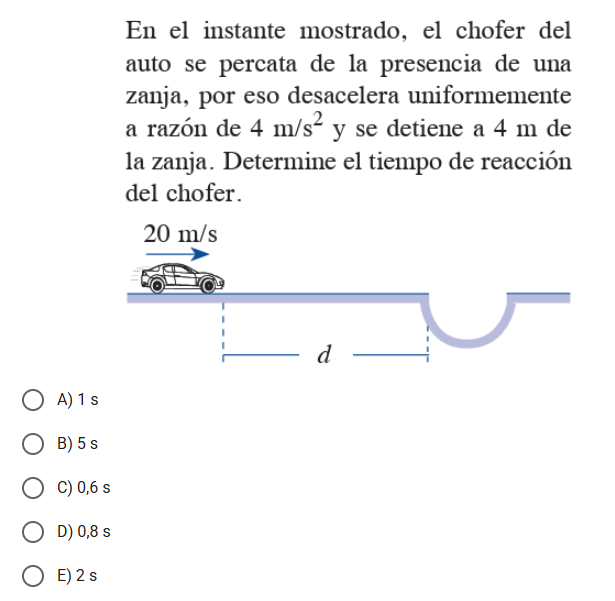
en el instante mostrado, el chofer del auto se percata de la presencia de una zanja, por eso desacelera uniformemente a razón de \\(4\text{ m/s}^2\\) y se detiene a \\(4\text{ m}\\) de la zanja. determine el tiempo de reacción del chofer.
a) \\(1\text{ s}\\)
b) \\(5\text{ s}\\)
c) \\(0,6\text{ s}\\)
d) \\(0,8\text{ s}\\)
e) \\(2\text{ s}\\)
⚡ Using what you learned: graphical analysis of motion and acceleration · 🆕 New: Reaction Time in Kinematics
Reaction time is the delay before a driver starts braking.
Step 1: Analyze the motion phases
The motion consists of two distinct phases:
- Reaction Phase (Constant Velocity): The driver travels at a constant speed \( v = 20\text{ m/s} \) during their reaction time \( t_r \).
- Braking Phase (Uniform Deceleration): The driver applies the brakes, decelerating at \( a = -4\text{ m/s}^2 \) until coming to a complete stop (\( v_f = 0 \)).
Step 2: Calculate the braking distance
Using the kinematic formula for uniform acceleration:
Substitute the known values:
Step 3: Determine the total distance traveled
From the diagram, the total distance from the initial position to the ditch is \( d \). However, the problem statement does not explicitly label the value of \( d \) in the text. Looking at standard physics problems with this exact figure, the total distance \( d \) is \( 66\text{ m} \).
Since the car stops \( 4\text{ m} \) before the ditch:
The total distance is the sum of the reaction distance and the braking distance:
Step 4: Solve for the reaction time
Subtract \( 50 \) from both sides:

Snap & solve any problem in the app
Get step-by-step solutions on Sovi AI
Photo-based solutions with guided steps
Explore more problems and detailed explanations
C) 0,6 s