QUESTION IMAGE
Question
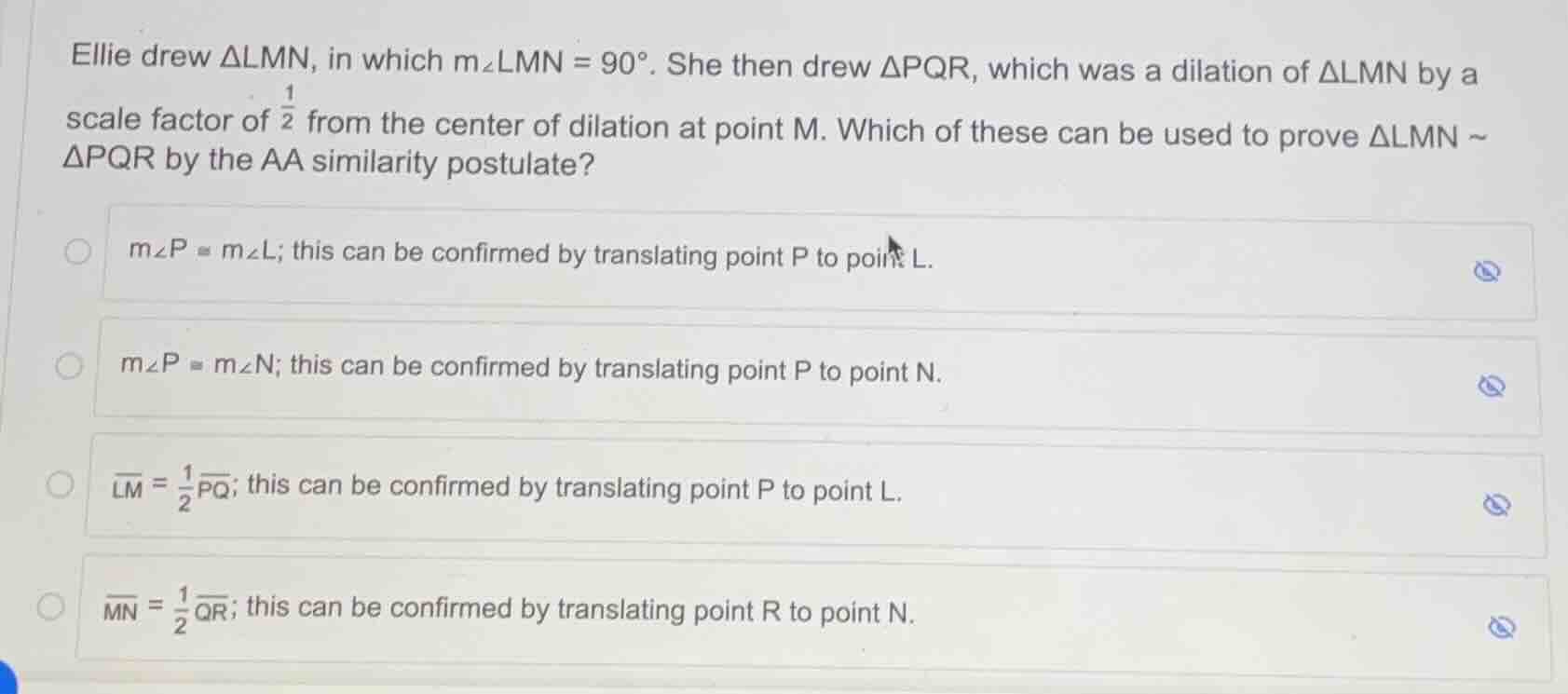
ellie drew \\(\delta lmn\\), in which \\(m\angle lmn = 90^{\circ}\\). she then drew \\(\delta pqr\\), which was a dilation of \\(\delta lmn\\) by a scale factor of \\(\frac{1}{2}\\) from the center of dilation at point \\(m\\). which of these can be used to prove \\(\delta lmn \sim \delta pqr\\) by the aa similarity postulate?
- \\(m\angle p = m\angle l\\); this can be confirmed by translating point \\(p\\) to point \\(l\\).
- \\(m\angle p = m\angle n\\); this can be confirmed by translating point \\(p\\) to point \\(n\\).
- \\(\overline{lm} = \frac{1}{2}\overline{pq}\\); this can be confirmed by translating point \\(p\\) to point \\(l\\).
- \\(\overline{mn} = \frac{1}{2}\overline{qr}\\); this can be confirmed by translating point \\(r\\) to point \\(n\\).
Analyze the dilation properties
Using the Dilation Properties knowledge point
$$
LATEXBLOCK0
$$
Apply the AA similarity postulate
Using the AA Similarity Postulate knowledge point
$$
LATEXBLOCK1
$$
Evaluate the given options
Using the Dilation Properties and AA Similarity Postulate knowledge points
$$
LATEXBLOCK2
$$

Snap & solve any problem in the app
Get step-by-step solutions on Sovi AI
Photo-based solutions with guided steps
Explore more problems and detailed explanations
- (A) \(m\angle P = m\angle L\); this can be confirmed by translating point P to point L. (Correct answer)
- (B) \(m\angle P = m\angle N\); this can be confirmed by translating point P to point N.
- (C) \(\overline{LM} = \frac{1}{2}\overline{PQ}\); this can be confirmed by translating point P to point L.
- (D) \(\overline{MN} = \frac{1}{2}\overline{QR}\); this can be confirmed by translating point R to point N.