QUESTION IMAGE
Question
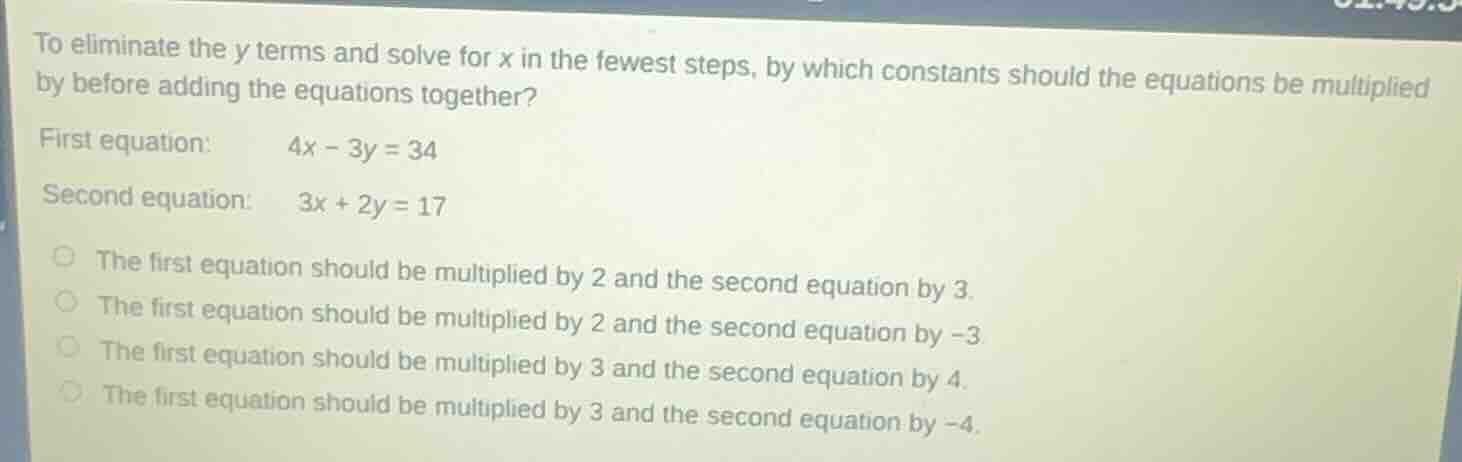
to eliminate the y terms and solve for x in the fewest steps, by which constants should the equations be multiplied by before adding the equations together?
first equation: 4x - 3y = 34
second equation: 3x + 2y = 17
the first equation should be multiplied by 2 and the second equation by 3.
the first equation should be multiplied by 2 and the second equation by -3
the first equation should be multiplied by 3 and the second equation by 4.
the first equation should be multiplied by 3 and the second equation by -4.
Step1: Recall elimination method
To eliminate \( y \), we need the coefficients of \( y \) to be equal in magnitude (so they can cancel when added). The coefficients of \( y \) are \(-3\) (from first equation) and \( 2 \) (from second equation). We find the least common multiple (LCM) of \( 3 \) and \( 2 \), which is \( 6 \). So we want to make the coefficients of \( y \) as \( -6 \) and \( +6 \) (or \( +6 \) and \( -6 \)) so that when added, they cancel.
Step2: Analyze each option
- For the first option: Multiply first equation \( 4x - 3y = 34 \) by \( 2 \): \( 8x - 6y = 68 \). Multiply second equation \( 3x + 2y = 17 \) by \( 3 \): \( 9x + 6y = 51 \). Now, adding these two new equations: \( (8x - 6y)+(9x + 6y)=68 + 51 \), the \( y \) terms (\(-6y\) and \(+6y\)) cancel out, leaving \( 17x=119 \), which allows us to solve for \( x \).
- Let's check other options for completeness (though not necessary once we find the correct one):
- Second option: Multiply first by \( 2 \): \( 8x - 6y = 68 \), second by \(-3\): \( -9x - 6y = -51 \). Adding them: \( 8x - 6y-9x - 6y=68 - 51\), which gives \( -x - 12y = 17 \), \( y \) terms don't cancel.
- Third option: Multiply first by \( 3 \): \( 12x - 9y = 102 \), second by \( 4 \): \( 12x + 8y = 68 \). Adding them: \( 12x - 9y+12x + 8y=102 + 68\), \( y \) terms (\(-9y\) and \(+8y\)) don't cancel.
- Fourth option: Multiply first by \( 3 \): \( 12x - 9y = 102 \), second by \(-4\): \( -12x - 8y = -68 \). Adding them: \( 12x - 9y-12x - 8y=102 - 68\), gives \( -17y = 34 \), we are eliminating \( x \) here, not \( y \) (and the question is to eliminate \( y \) to solve for \( x \) in fewest steps, so this is not for eliminating \( y \) to solve \( x \) efficiently).

Snap & solve any problem in the app
Get step-by-step solutions on Sovi AI
Photo-based solutions with guided steps
Explore more problems and detailed explanations
The first equation should be multiplied by 2 and the second equation by 3.