Sovi.AI - AI Math Tutor

Scan to solve math questions

QUESTION IMAGE

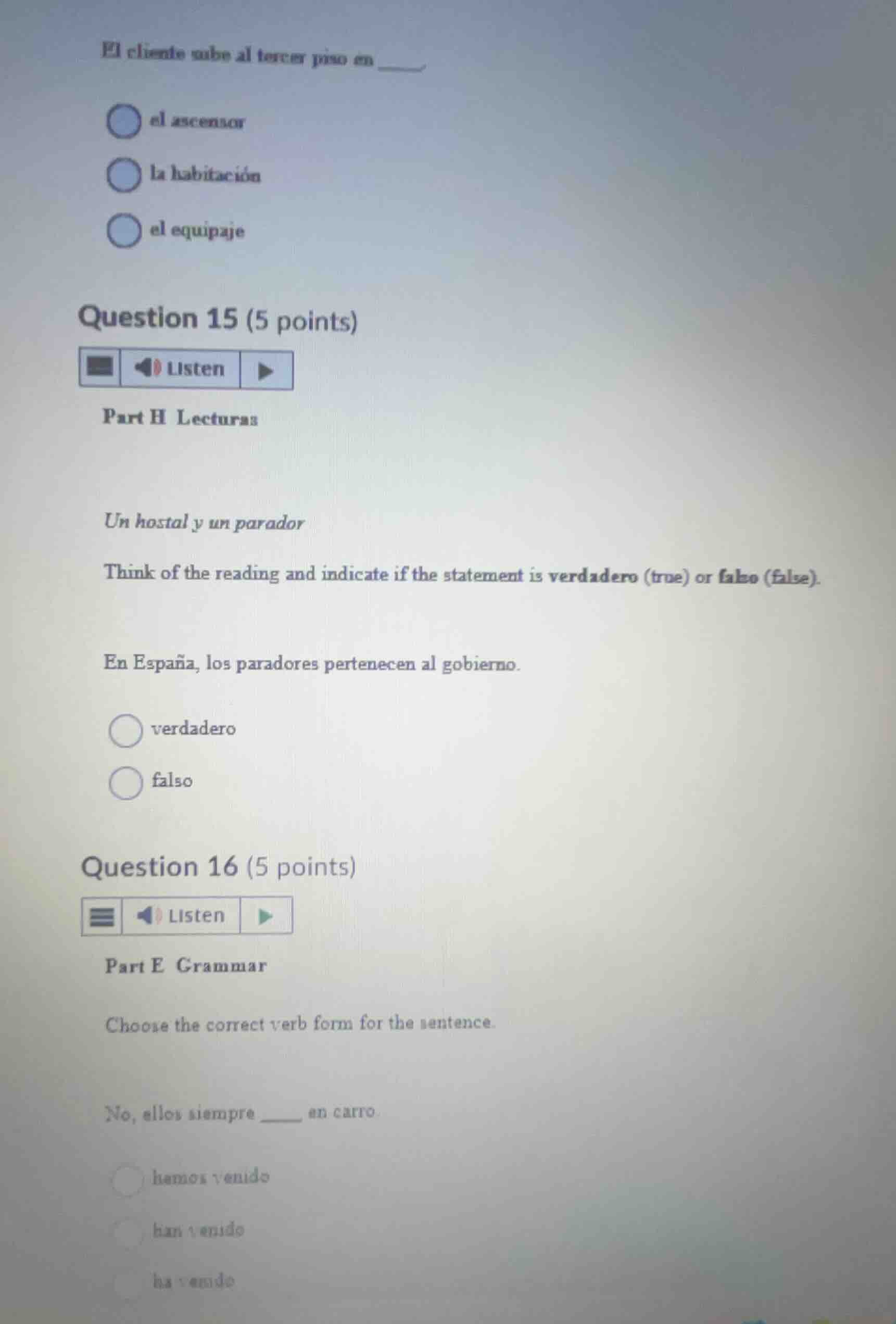
el cliente sube al tercer piso en ___ - el ascensor - la habitación - e…

Question

el cliente sube al tercer piso en ___

  • el ascensor
  • la habitación
  • el equipaje

question 15 (5 points)
part h lecturas
un hostal y un parador
think of the reading and indicate if the statement is verdadero (true) or falso (false).
en españa, los paradores pertenecen al gobierno.

  • verdadero
  • falso

question 16 (5 points)
part e grammar
choose the correct verb form for the sentence.
no, ellos siempre ___ en carro.

  • hemos venido
  • han venido
  • ha venido

Explanation:

Response

<pre_analysis>
{
"quality": "clear",
"question_count": 3,
"skills_matched": [
"direct_cot",
"multiple_choice_formatter",
"explain_then_answer",
"quick"
],
"needs_drawing": false,
"concepts_used": [
"Spanish Vocabulary",
"Spanish Reading Comprehension",
"Spanish Verb Conjugation",
"Spanish Present Perfect"
],
"new_concepts": [],
"current_concepts": [
"Spanish Vocabulary",
"Spanish Reading Comprehension",
"Spanish Verb Conjugation",
"Spanish Present Perfect"
]
}
</pre_analysis>

<reasoning>

Translate and analyze the first question

The sentence is: "El cliente sube al tercer piso en ___" (The guest goes up to the third floor in ___).

  • "el ascensor" means "the elevator".
  • "la habitación" means "the room".
  • "el equipaje" means "the luggage".

Going up to a floor logically requires an elevator.

Analyze Question 15

The statement is: "En España, los paradores pertenecen al gobierno." (In Spain, paradores belong to the government.)

  • "Paradores" (Paradores de Turismo de España) are a chain of luxury hotels in Spain that are state-owned (government-run).
  • Therefore, the statement is true ("verdadero").

Analyze Question 16

The sentence is: "No, ellos siempre ___ en carro." (No, they have always ___ by car.)
The subject is "ellos" (third-person plural).

  • "hemos venido" is first-person plural (we).
  • "han venido" is third-person plural (they).
  • "ha venido" is third-person singular (he/she/you formal).

The correct verb form matching "ellos" is "han venido".
</reasoning>

<answer>

Question 1

<mcq-correct>(A) el ascensor</mcq-correct>
<mcq-option>(B) la habitación</mcq-option>
<mcq-option>(C) el equipaje</mcq-option>

Question 15

<mcq-correct>(A) verdadero</mcq-correct>
<mcq-option>(B) falso</mcq-option>

Question 16

<mcq-option>(A) hemos venido</mcq-option>
<mcq-correct>(B) han venido</mcq-correct>
<mcq-option>(C) ha venido</mcq-option>
</answer>

<post_analysis>
{
"subject": "Others",
"question_type": "Multiple Choice",
"knowledge_point": [
"Others",
"Spanish",
"Spanish Grammar and Vocabulary"
]
}
</post_analysis>

Answer:

<pre_analysis>
{
"quality": "clear",
"question_count": 3,
"skills_matched": [
"direct_cot",
"multiple_choice_formatter",
"explain_then_answer",
"quick"
],
"needs_drawing": false,
"concepts_used": [
"Spanish Vocabulary",
"Spanish Reading Comprehension",
"Spanish Verb Conjugation",
"Spanish Present Perfect"
],
"new_concepts": [],
"current_concepts": [
"Spanish Vocabulary",
"Spanish Reading Comprehension",
"Spanish Verb Conjugation",
"Spanish Present Perfect"
]
}
</pre_analysis>

<reasoning>

Translate and analyze the first question

The sentence is: "El cliente sube al tercer piso en ___" (The guest goes up to the third floor in ___).

  • "el ascensor" means "the elevator".
  • "la habitación" means "the room".
  • "el equipaje" means "the luggage".

Going up to a floor logically requires an elevator.

Analyze Question 15

The statement is: "En España, los paradores pertenecen al gobierno." (In Spain, paradores belong to the government.)

  • "Paradores" (Paradores de Turismo de España) are a chain of luxury hotels in Spain that are state-owned (government-run).
  • Therefore, the statement is true ("verdadero").

Analyze Question 16

The sentence is: "No, ellos siempre ___ en carro." (No, they have always ___ by car.)
The subject is "ellos" (third-person plural).

  • "hemos venido" is first-person plural (we).
  • "han venido" is third-person plural (they).
  • "ha venido" is third-person singular (he/she/you formal).

The correct verb form matching "ellos" is "han venido".
</reasoning>

<answer>

Question 1

<mcq-correct>(A) el ascensor</mcq-correct>
<mcq-option>(B) la habitación</mcq-option>
<mcq-option>(C) el equipaje</mcq-option>

Question 15

<mcq-correct>(A) verdadero</mcq-correct>
<mcq-option>(B) falso</mcq-option>

Question 16

<mcq-option>(A) hemos venido</mcq-option>
<mcq-correct>(B) han venido</mcq-correct>
<mcq-option>(C) ha venido</mcq-option>
</answer>

<post_analysis>
{
"subject": "Others",
"question_type": "Multiple Choice",
"knowledge_point": [
"Others",
"Spanish",
"Spanish Grammar and Vocabulary"
]
}
</post_analysis>