QUESTION IMAGE
Question
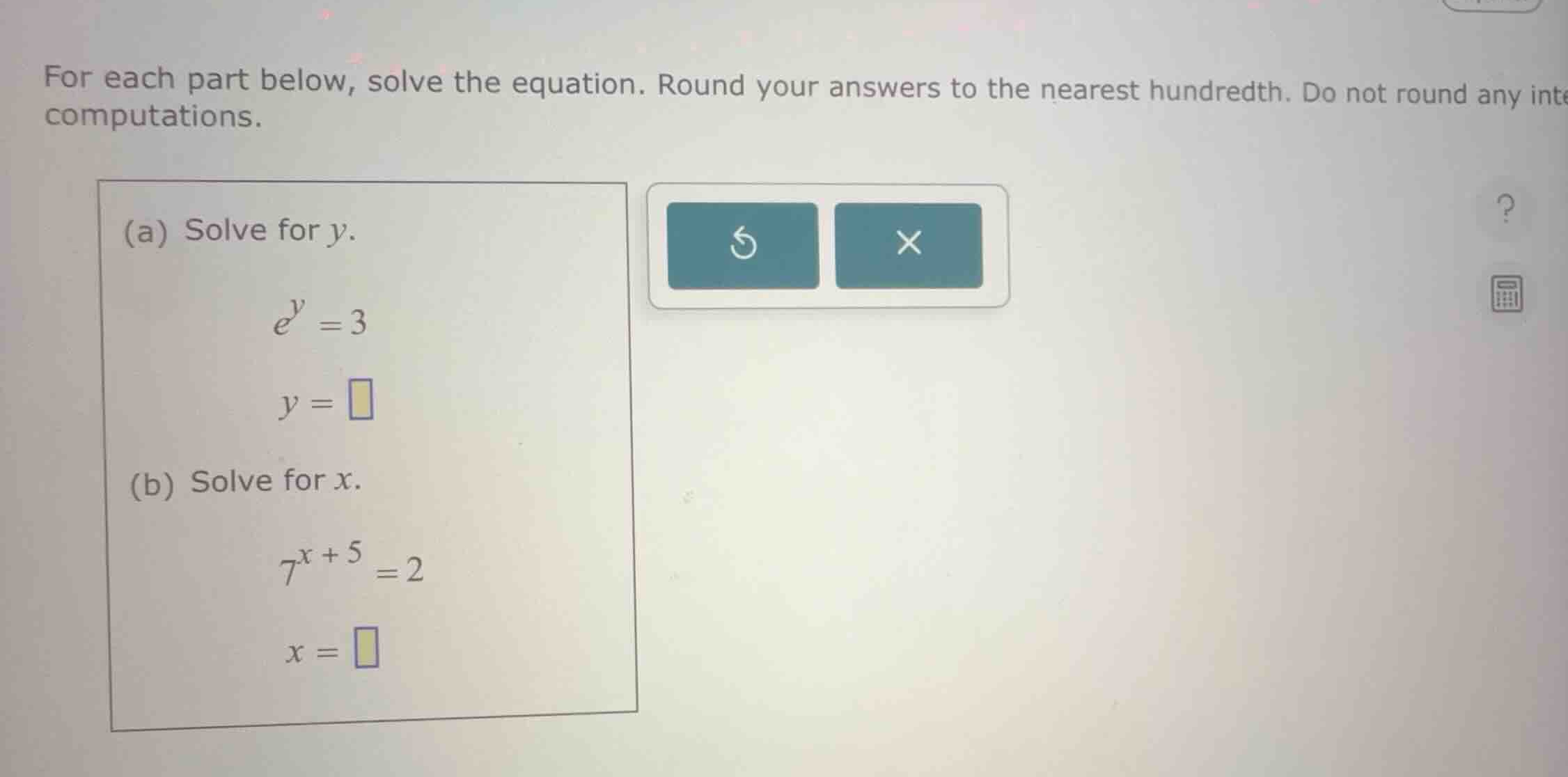
for each part below, solve the equation. round your answers to the nearest hundredth. do not round any intermediate computations.
(a) solve for (y).
e^y = 3
(y = square)
(b) solve for (x).
7^{x + 5} = 2
(x = square)
Solve the first exponential equation
We begin with the equation in part (a):
To solve for \(y\), we apply the natural logarithm (\(\ln\)) to both sides of the equation.
Using the Exponential Functions concept, we know that the natural logarithm is the inverse function of the natural exponential function:
Using a calculator to find the decimal value:
Rounding to the nearest hundredth gives:
Solve the second exponential equation
Next, we solve the equation in part (b):
To solve for \(x\), we take the logarithm of both sides. We can use the natural logarithm (\(\ln\)):
Using the power property of logarithms, we bring the exponent to the front:
Now, divide both sides by \(\ln(7)\):
Subtract 5 from both sides to isolate \(x\):
Using a calculator to compute the value:
Rounding to the nearest hundredth gives:

Snap & solve any problem in the app
Get step-by-step solutions on Sovi AI
Photo-based solutions with guided steps
Explore more problems and detailed explanations
Question 1
(a) Solve for \(y\).
\(e^y = 3\)
\(y =\) <blank>\(1.10\)</blank>
Question 2
(b) Solve for \(x\).
\(7^{x+5} = 2\)
\(x =\) <blank>\(-4.64\)</blank>