QUESTION IMAGE
Question
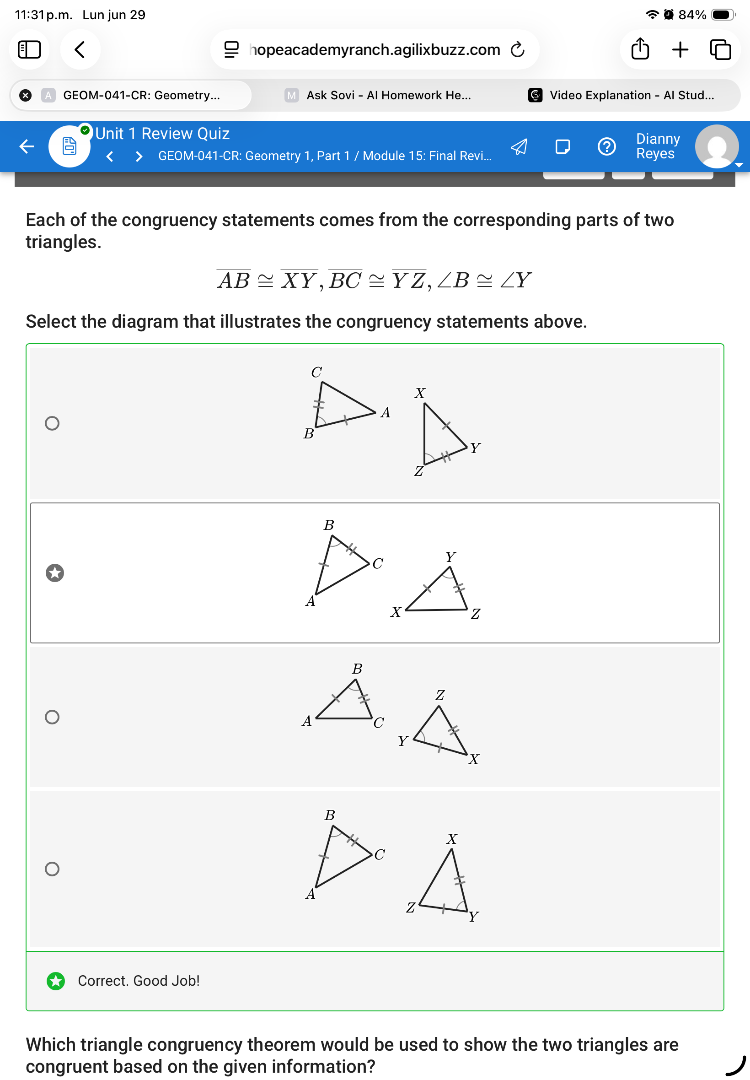
each of the congruency statements comes from the corresponding parts of two triangles.
\\\overline{ab} \cong \overline{xy}, \overline{bc} \cong \overline{yz}, \angle b \cong \angle y\\
select the diagram that illustrates the congruency statements above.
which triangle congruency theorem would be used to show the two triangles are congruent based on the given information?
⚡ Using what you learned: congruence criteria for triangles (sss, sas, asa, aas, hl)
Step 1: Analyze the given information
We are given three congruency statements for corresponding parts of two triangles:
- \(\overline{AB} \cong \overline{XY}\) (Side)
- \(\overline{BC} \cong \overline{YZ}\) (Side)
- \(\angle B \cong \angle Y\) (Angle)
Step 2: Determine the relative positions of the parts
Let's look at the arrangement of these parts in \(\triangle ABC\) and \(\triangle XYZ\):
- In \(\triangle ABC\), the angle \(\angle B\) is the included angle between the sides \(\overline{AB}\) and \(\overline{BC}\).
- In \(\triangle XYZ\), the angle \(\angle Y\) is the included angle between the sides \(\overline{XY}\) and \(\overline{YZ}\).
Since two sides and their included angle of one triangle are congruent to two sides and their included angle of another triangle, the triangles are congruent.
Step 3: Identify the congruency theorem
The theorem that states two triangles are congruent if two sides and the included angle of one triangle are congruent to two sides and the included angle of another triangle is the Side-Angle-Side (SAS) congruence theorem.

Snap & solve any problem in the app
Get step-by-step solutions on Sovi AI
Photo-based solutions with guided steps
Explore more problems and detailed explanations
SAS (Side-Angle-Side) congruence theorem